


 Cart
Cart
 sales@molnova.com



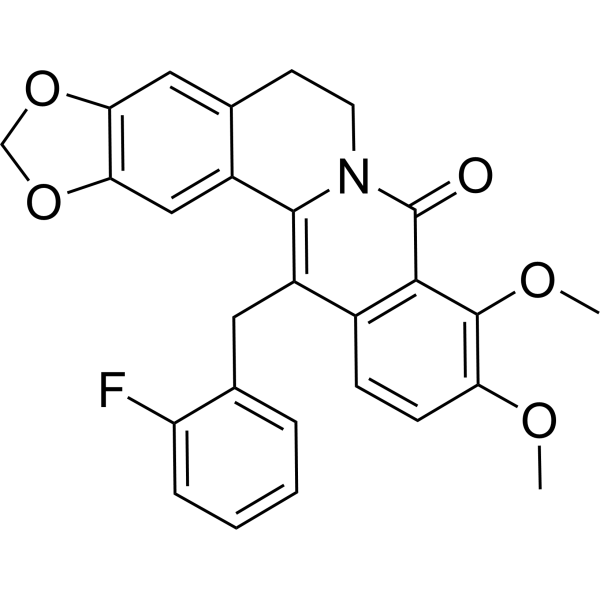
KRN5
CAS No. 1800465-47-7
KRN5( —— )
Catalog No. M26570 CAS No. 1800465-47-7
KRN5 has potential to treat NFAT5-mediated Chronic Arthritis. KRN5, a derivative of KRN2, is an oral active Nuclear factor of activated T cells 5 (NFAT5) suppressor, with an IC50 of 750 nM.
Purity : >98% (HPLC)
 COA
Datasheet
HNMR
HPLC
MSDS
Handing Instructions
COA
Datasheet
HNMR
HPLC
MSDS
Handing Instructions
| Size | Price / USD | Stock | Quantity |
| 2MG | 33 | In Stock |


|
| 5MG | 53 | In Stock |
|
| 10MG | 85 | In Stock |
|
| 25MG | 187 | In Stock |
|
| 100MG | Get Quote | In Stock |
|
| 200MG | Get Quote | In Stock |
|
| 500MG | Get Quote | In Stock |
|
| 1G | Get Quote | In Stock |
|
Biological Information
-
Product NameKRN5
-
NoteResearch use only, not for human use.
-
Brief DescriptionKRN5 has potential to treat NFAT5-mediated Chronic Arthritis. KRN5, a derivative of KRN2, is an oral active Nuclear factor of activated T cells 5 (NFAT5) suppressor, with an IC50 of 750 nM.
-
DescriptionKRN5 has potential to treat NFAT5-mediated Chronic Arthritis. KRN5, a derivative of KRN2, is an oral active Nuclear factor of activated T cells 5 (NFAT5) suppressor, with an IC50 of 750 nM.(In Vitro):KRN5 (1 μM) inhibits the expressions of NFAT5, IL-6,MCP-1, and GM-CSF in RAW264.7 macrophages stimulated with LPS.(In Vivo):In DBA/1Jmice immunized with bovine type II collagen, KRN5 (15 and 60 mg/kg; oral) dose-dependently mitigates arthritis severity. KRN5 significantly decreases the concentration of serum anti-type II collagen IgG in the sera. KRN5 lowers TNF-α and IL-6 production by LPS-stimulated splenocytes in mice.
-
In VitroKRN5 is less toxic than BBR as determined by a cytotoxicity assay, hERG K+ channel assay, cytochrome inhibition assay, and liver microsomal metabolic stability test, which makes it a potential drug candidate.KRN5 at a concentration of 1 μM inhibits the expressions of NFAT5, IL-6,MCP-1, and GM-CSF,which are NFAT5 target molecules, in RAW264.7 macrophages stimulated with LPS.
-
In VivoOral feeding of KRN5 (15 mg/kg and 60 mg/kg) every other day for 3 weeks from day 21 dose-dependently mitigates arthritis severity.The concentration of serum anti-type II collagen IgG also significantly decreases in the sera of KRN5-treated mice. TNF-α and IL-6 production by LPS-stimulated splenocytes are significantly lower in KRN5-treated CIA mice than in vehicle-treated mice. Animal Model:8-week-old DBA/1Jmice immunized with bovine type II collagen.Dosage:15 mg/kg and 60 mg/kg.Administration:Orally on alternate days (every other day) for 3 weeks.Result:Dose-dependently mitigated arthritis severity.
-
Synonyms——
-
PathwayOthers
-
TargetOther Targets
-
Recptor——
-
Research Area——
-
Indication——
Chemical Information
-
CAS Number1800465-47-7
-
Formula Weight459.473
-
Molecular FormulaC27H22FNO5
-
Purity>98% (HPLC)
-
SolubilityIn Vitro:?DMSO : 5 mg/mL (10.88 mM)
-
SMILESCOc1ccc2c(Cc3ccccc3F)c3-c4cc5OCOc5cc4CCn3c(=O)c2c1OC
-
Chemical Name——
Shipping & Storage Information
-
Storage(-20℃)
-
ShippingWith Ice Pack
-
Stability≥ 2 years
Reference
1.ThomasBriggs, et al. Allocholic acid, the major component in bile from the river carpsucker, Carpiodes carpio (Rafinesque) (Catostomidae). Comp Biochem Physiol B. 1972 Jul 15;42(3):493-6.
molnova catalog



related products
-
Azido-PEG5-azide
Azido-PEG5-azide is a PEG-based PROTAC linker that can be used in the synthesis of PROTACs.
-
Substance P (3-11)/N...
Substance P (3-11)/Nona-Substance P
-
MARCKS Protein (159-...
MARCKS Protein (159-165)
