


 Cart
Cart
 sales@molnova.com



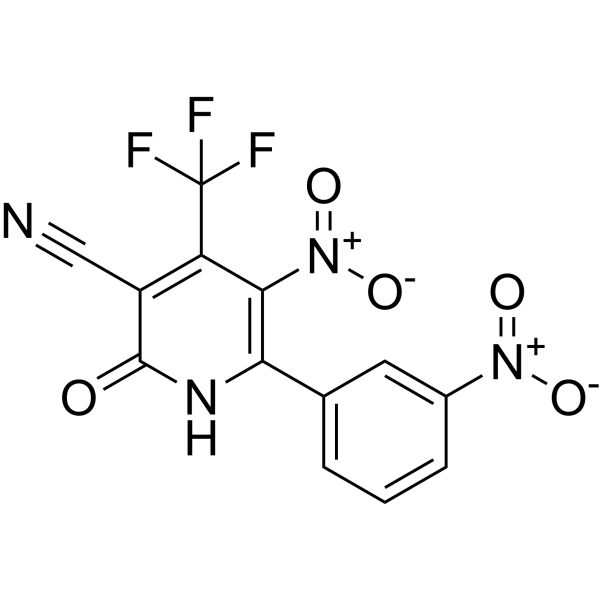
SynuClean-D
CAS No. 685121-45-3
SynuClean-D( SC-D )
Catalog No. M26472 CAS No. 685121-45-3
SynuClean-D is an α-synuclein aggregation inhibitor preventing fibril propagation, disrupting mature amyloid fibrils, and abolishing the degeneration of dopaminergic neurons in an animal model of Parkinson’s disease.
Purity : >98% (HPLC)
 COA
Datasheet
HNMR
HPLC
MSDS
Handing Instructions
COA
Datasheet
HNMR
HPLC
MSDS
Handing Instructions
| Size | Price / USD | Stock | Quantity |
| 1 mL x 10 mM in DMSO | 319 | In Stock |


|
| 5MG | 282 | In Stock |
|
| 10MG | 464 | In Stock |
|
| 25MG | 820 | In Stock |
|
| 50MG | 1144 | In Stock |
|
| 100MG | 1535 | In Stock |
|
| 200MG | Get Quote | In Stock |
|
| 500MG | Get Quote | In Stock |
|
| 1G | Get Quote | In Stock |
|
Biological Information
-
Product NameSynuClean-D
-
NoteResearch use only, not for human use.
-
Brief DescriptionSynuClean-D is an α-synuclein aggregation inhibitor preventing fibril propagation, disrupting mature amyloid fibrils, and abolishing the degeneration of dopaminergic neurons in an animal model of Parkinson’s disease.
-
DescriptionSynuClean-D is an α-synuclein aggregation inhibitor preventing fibril propagation, disrupting mature amyloid fibrils, and abolishing the degeneration of dopaminergic neurons in an animal model of Parkinson’s disease.(In Vitro):SynuClean-D prevents fibril propagation in protein-misfolding cyclic amplification assays and decreases the number of α-synuclein inclusions in human neuroglioma cells. SynuClean-D significantly reduces the aggregation of wild-type α-synuclein and the familiar A30P and H50Q variants in a substoichiometric molar ratio. SynuClean-D can bind to cavities in mature α-synuclein fibrils.(In Vivo):SynuClean-D-treated worms show decreased α-synuclein aggregation in muscle and a concomitant motility recovery. SynuClean-D is able to rescue dopaminergic neurons from α-synuclein-induced degeneration. In two parkinson’s disease (PD) Caenorhabditis elegans models, SynuClean-D expresses α-synuclein either in muscle or in dopaminergic neurons and significantly reduces the toxicity exerted by α-synuclein.
-
In VitroSynuClean-D significantly reduces the in vitro aggregation of wild-type α-synuclein and the familiar A30P and H50Q variants in a substoichiometric molar ratio. SynuClean-D prevents fibril propagation in protein-misfolding cyclic amplification assays and decreases the number of α-synuclein inclusions in human neuroglioma cells. Computational analysis suggests that SynuClean-D can bind to cavities in mature α-synuclein fibrils and, indeed, it displays a strong fibril disaggregation activity.
-
In VivoThe treatment with SynuClean-D of two parkinson’s disease (PD) Caenorhabditis elegans models, expressing α-synuclein either in muscle or in dopaminergic neurons, significantly reduces the toxicity exerted by α-synuclein. SynuClean-D-treated worms show decreased α-synuclein aggregation in muscle and a concomitant motility recovery. More importantly, this compound is able to rescue dopaminergic neurons from α-synuclein-induced degeneration.
-
SynonymsSC-D
-
PathwayOthers
-
TargetOther Targets
-
RecptorPRPP Amidotransferase
-
Research Area——
-
Indication——
Chemical Information
-
CAS Number685121-45-3
-
Formula Weight354.201
-
Molecular FormulaC13H5F3N4O5
-
Purity>98% (HPLC)
-
SolubilityIn Vitro:?DMSO : 83.33 mg/mL (235.26 mM)
-
SMILESOc1nc(-c2cccc(c2)[N+]([O-])=O)c(c(c1C#N)C(F)(F)F)[N+]([O-])=O
-
Chemical Name——
Shipping & Storage Information
-
Storage(-20℃)
-
ShippingWith Ice Pack
-
Stability≥ 2 years
Reference
1.ANISSIMOVA MARIA, ALLARD MATHIEU, MARLIERE PHILIPPE.Production of alkenes from 3-hydroxycarboxylic acids via 3-hydroxycarboxyl-nucleotidylic acids.CN105940111A
molnova catalog



related products
-
Isorabaichromone
Isorabaichromone is a potent antioxidant agent. Isorabaichromone shows a potent antioxidative activity and exhibits DPPH radical and superoxide anion scavenging activities.
-
P-2-deoxyribose
P-2'-deoxyribose (P-Nucleoside) is a deoxyribose that is widely found in organisms.
-
methyl 2-benzoylamin...
methyl 2-benzoylamino-3-phenylpropyionate is a natural product found in Aspergillus flavipes.
