


 Cart
Cart
 sales@molnova.com



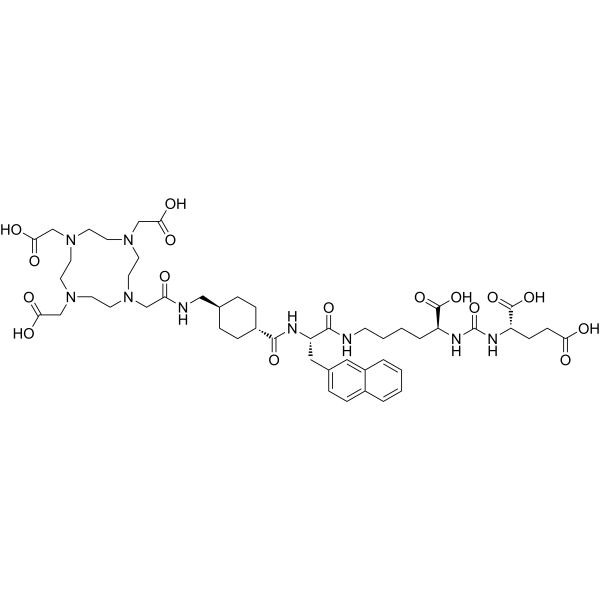
Vipivotide tetraxetan
CAS No. 1702967-37-0
Vipivotide tetraxetan( PSMA-617 )
Catalog No. M26397 CAS No. 1702967-37-0
Vipivotide tetraxetan is a high potent inhibitor of prostate-specific membrane antigen (PSMA)(Ki of 0.37 nM).
Purity : >98% (HPLC)
 COA
Datasheet
HNMR
HPLC
MSDS
Handing Instructions
COA
Datasheet
HNMR
HPLC
MSDS
Handing Instructions
| Size | Price / USD | Stock | Quantity |
| 1 mL x 10 mM in DMSO | 1131 | In Stock |


|
| 2MG | 273 | In Stock |
|
| 5MG | 459 | In Stock |
|
| 10MG | 656 | In Stock |
|
| 25MG | 1026 | In Stock |
|
| 50MG | 1386 | In Stock |
|
| 100MG | 1823 | In Stock |
|
| 200MG | Get Quote | In Stock |
|
| 500MG | Get Quote | In Stock |
|
| 1G | Get Quote | In Stock |
|
Biological Information
-
Product NameVipivotide tetraxetan
-
NoteResearch use only, not for human use.
-
Brief DescriptionVipivotide tetraxetan is a high potent inhibitor of prostate-specific membrane antigen (PSMA)(Ki of 0.37 nM).
-
DescriptionVipivotide tetraxetan is a high potent inhibitor of prostate-specific membrane antigen (PSMA)(Ki of 0.37 nM).(In Vitro):Vipivotide tetraxetan demonstrated high radihigh inhibition potency, highly efficient internalization into LNCaP cells and olytic stability for at least 72 h.(In Vivo):The small-animal PET measurements showed high tumor-to-background contrasts as early as 1 h after injection of Vipivotide tetraxetan. Organ distribution revealed specific uptake in LNCaP tumors and in the kidneys 1 h after injection of Vipivotide tetraxetan.
-
In VitroVipivotide tetraxetan (PSMA-617) demonstrates high radiolytic stability for at least 72 h. A high inhibition potency (equilibrium dissociation constant Ki=2.34±2.94 nM on LNCaP; Ki=0.37±0.21 nM enzymatically determined) and highly efficient internalization into LNCaP cells are demonstrated.
-
In VivoOrgan distribution with 68Ga-labeled Vipivotide tetraxetan (PSMA-617) after 1 h (n=3) reveals a high specific uptake in LNCaP tumors and in the kidneys. The high uptake in the kidneys is nearly completely blocked by coinjection of 2 mg of 2-PMPA per kilogram. Other organs such as the liver, lung, and spleen show rather low uptake and no blocking effect, with the exception of the spleen. Tumor-to-background ratios are 7.8 (tumor to blood) and 17.1 (tumor to muscle) at 1 h after injection. As compared with the 68Ga-labeled version, the organ distribution with 177Lu-labeled Vipivotide tetraxetan (PSMA-617) (n=3) show a similar uptake in the LNCaP tumors and in the kidneys. The liver uptake is found to be statistically different. Tumor-to-background ratios determined 1 h after injection show slightly higher values (tumor to blood, 22.1; tumor to muscle, 25.6) than previous organ distribution with 68Ga-labeled Vipivotide tetraxetan (PSMA-617).
-
SynonymsPSMA-617
-
PathwayOthers
-
TargetOther Targets
-
Recptor——
-
Research Area——
-
Indication——
Chemical Information
-
CAS Number1702967-37-0
-
Formula Weight1042.154
-
Molecular FormulaC49H71N9O16
-
Purity>98% (HPLC)
-
SolubilityIn Vitro:?DMSO : 125 mg/mL (119.95 mM)
-
SMILESOC(=O)CC[C@H](NC(=O)N[C@@H](CCCCNC(=O)[C@H](Cc1ccc2ccccc2c1)NC(=O)[C@H]1CC[C@H](CNC(=O)CN2CCN(CC(O)=O)CCN(CC(O)=O)CCN(CC(O)=O)CC2)CC1)C(O)=O)C(O)=O
-
Chemical Name——
Shipping & Storage Information
-
Storage(-20℃)
-
ShippingWith Ice Pack
-
Stability≥ 2 years
Reference
1.Feng X, Su G, Ye Y, Zhang R, Yang X, Du B, Peng B, Tu P, Chai X. Alashinols F and G, two lignans from stem bark of Syringa pinnatifolia. Nat Prod Res. 2017 Jul;31(13):1555-1560.
molnova catalog



related products
-
CK1tide
CK1tide
-
(1R)-(-)-Menthyl ace...
(1R)-(-)-Menthyl acetate is a derivative of L-menthol.
-
Azetidine-2-carboxyl...
Azetidine-2-carboxylic acid is a non proteinogenic amino acid homologue of proline found in common beets. Azetidine-2-carboxylic acid can be misincorporated into proteins in place of proline in many species including humans. It is a toxic and teratogenic agent.
