


 Cart
Cart
 sales@molnova.com



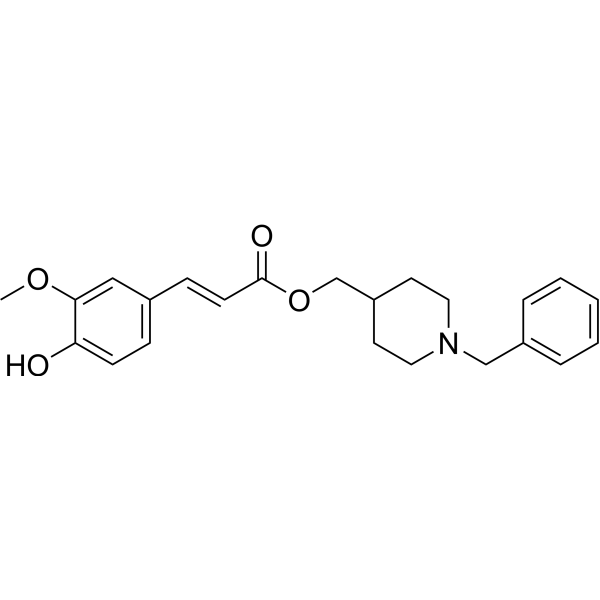
PQM130
CAS No. 2089415-51-8
PQM130( —— )
Catalog No. M26392 CAS No. 2089415-51-8
PQM130 is a Feruloyl-Donepezil Hybrid compound against the neurotoxicity induced by Aβ1-42 oligomer (AβO) and shows anti-inflammatory activity. PQM130 can be used in anti-AD studies.
Purity : >98% (HPLC)
 COA
Datasheet
HNMR
HPLC
MSDS
Handing Instructions
COA
Datasheet
HNMR
HPLC
MSDS
Handing Instructions
| Size | Price / USD | Stock | Quantity |
| 1 mL x 10 mM in DMSO | 34 | In Stock |


|
| 10MG | 36 | In Stock |
|
| 25MG | 73 | In Stock |
|
| 50MG | 119 | In Stock |
|
| 100MG | 193 | In Stock |
|
| 200MG | 276 | In Stock |
|
| 500MG | Get Quote | In Stock |
|
| 1G | Get Quote | In Stock |
|
Biological Information
-
Product NamePQM130
-
NoteResearch use only, not for human use.
-
Brief DescriptionPQM130 is a Feruloyl-Donepezil Hybrid compound against the neurotoxicity induced by Aβ1-42 oligomer (AβO) and shows anti-inflammatory activity. PQM130 can be used in anti-AD studies.
-
DescriptionPQM130 is a Feruloyl-Donepezil Hybrid compound against the neurotoxicity induced by Aβ1-42 oligomer (AβO) and shows anti-inflammatory activity. PQM130 can be used in anti-AD studies.(In Vitro):PQM130 had already shown anti-inflammatory activity in different in vivo models and neuroprotective activity in human neuronal cells. (In Vivo):The intracerebroventricular (i.c.v.) injection of AβO in mice caused the increase of memory impairment, oxidative stress, neurodegeneration, and neuroinflammation. Instead, PQM130 (0.5-1 mg/kg) treatment after the i.c.v. AβO injection reduced oxidative damage and neuroinflammation and induced cell survival and protein synthesis through the modulation of glycogen synthase kinase 3β (GSK3β) and extracellular signal-regulated kinases (ERK1/2). Moreover, PQM130 increased brain plasticity and protected mice against the decline in spatial cognition. PQM130 modulated different pathways compared to donepezil, and it is much more effective in counteracting AβO damage.
-
In Vitro——
-
In VivoPQM130 (0.5-1 mg/kg, i.p., daily for 10 days) treatment after the i.c.v. AβO injection reduces oxidative damage and neuroinflammation and induces cell survival and protein synthesis through the modulation of GSK3β and extracellular signal-regulated kinases (ERK1/2) . Animal Model:Adult male C57Bl/6 mice (9 weeks old, 25-30 g body weight) .Dosage:0.5 and 1.0 mg/kg.Administration:IP injection daily for 10 days.Result:Ameliorated Aβ1-42O-induced cognitive deficits in mice.Prevented Aβ1-42O-induced neuronal death in mice.Antagonized Aβ1-42O-Induced Oxidative Stress in Mice.Regulated GSK3β and ERK1/2 protein expressions in mice.Reduced Aβ1-42O-induced astrocytic activation in mice.
-
Synonyms——
-
PathwayMembrane Transporter/Ion Channel
-
TargetBeta Amyloid
-
Recptor——
-
Research Area——
-
Indication——
Chemical Information
-
CAS Number2089415-51-8
-
Formula Weight381.472
-
Molecular FormulaC23H27NO4
-
Purity>98% (HPLC)
-
SolubilityIn Vitro:?DMSO : 1.82 mg/mL (4.77 mM)
-
SMILESCOc1cc(\C=C\C(=O)OCC2CCN(Cc3ccccc3)CC2)ccc1O
-
Chemical Name——
Shipping & Storage Information
-
Storage(-20℃)
-
ShippingWith Ice Pack
-
Stability≥ 2 years
Reference
1.Süntar I, Küpeli Akkol E, Keles H, Yesilada E, Sarker SD, Arroo R, Baykal T. Efficacy of Daphne oleoides subsp. kurdica used for wound healing: identification of active compounds through bioassay guided isolation technique. J Ethnopharmacol. 2012 Jun 14;141(3):1058-70.
molnova catalog



related products
-
β-Amyloid 22-40
This synthetic peptide consists of amino acids 22 to 40 of beta amyloid protein. This peptide sequence is often used in beta amyloid structure and aggregation studies.
-
Chemerin-9 (149-157)
The nonapeptide 149,YFPGQFAFS157 (chemerin-9), corresponding to the C terminus of processed chemerin, retained most of the activity of the full-size protein, with regard to agonism toward the chemerinR.the natural ligand of ChemR23 (chemerinR).
-
Humantenmine
Humantenmine and koumine may inhibit several CYP450 enzyme activities.
