


 Cart
Cart
 sales@molnova.com



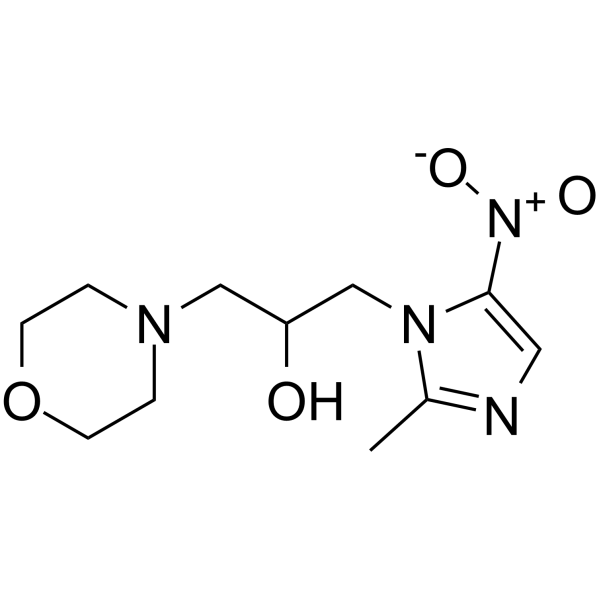
Morinidazole
CAS No. 92478-27-8
Morinidazole( —— )
Catalog No. M26305 CAS No. 92478-27-8
Morinidazole shows antibacterial activity and can be used in studies about bacterial infections research such as appendicitis and pelvic inflammatory disease caused by anaerobic bacteria.
Purity : >98% (HPLC)
 COA
Datasheet
HNMR
HPLC
MSDS
Handing Instructions
COA
Datasheet
HNMR
HPLC
MSDS
Handing Instructions
| Size | Price / USD | Stock | Quantity |
| 1 mL x 10 mM in DMSO | 28 | In Stock |


|
| 10MG | 31 | In Stock |
|
| 100MG | Get Quote | In Stock |
|
| 200MG | Get Quote | In Stock |
|
| 500MG | Get Quote | In Stock |
|
| 1G | Get Quote | In Stock |
|
Biological Information
-
Product NameMorinidazole
-
NoteResearch use only, not for human use.
-
Brief DescriptionMorinidazole shows antibacterial activity and can be used in studies about bacterial infections research such as appendicitis and pelvic inflammatory disease caused by anaerobic bacteria.
-
DescriptionMorinidazole shows antibacterial activity and can be used in studies about bacterial infections research such as appendicitis and pelvic inflammatory disease caused by anaerobic bacteria.(In Vitro):Morinidazole shows antibacterial activity against Trichomonas vaginalis and Entamoeba histolytica with MICs of 2 and 3 μg/mL.(In Vivo):Morinidazole (20 and 25 mg/kg; p.o.) inhibits Trichomonas vaginalis and Entamoeba histolytica in vivo. In the renal failure model in SD rats, Morinidazole (50 mg/kg; i.v.) shows a higher concentration in the liver, plasma, and kidney than lung, spleen, and heart.
-
In VitroMorinidazole can be metabolized to N+-glucuronide of S-morinidazole [M8-1] and N+-glucuronide of R-morinidazole [M8-2] via N+-glucuronidation, and sulfate conjugate of morinidazole [M7] via sulfation.M7 is a substrate for organic anion transporter 1 (OAT1) and OAT3 (Km=28.6 and 54.0 μM, respectively), M8-1 and M8-2 are the substrates for OAT3.Morinidazole shows activity against Trichomonas vaginalis and Entamoeba histolytica in vitro, with MIC values of 2 μg/mL and 3 μg/mL, respectively.
-
In VivoMorinidazole (20 mg/kg or 25 mg/kg; p.o.; single dose) inhibits Trichomonas vaginalis and Entamoeba histolytica in vivo in rats with EC50s of 20 mg/kg and 25 mg/kg, respectively.Morinidazole (50 mg/kg; i.v.; 0.25, 0.75, 1.5 h) shows a different concentration in tissues after intravenous injection, with a higher concentration in liver, kidney, plasma than lung, heart, and spleen in mice.Pharmacokinetic parameters of Morinidazole in control and 5/6 nephrectomized (Nx) rats.Intravenous injection; 50 mg/kg Morinidazole; Blood samples were collected from retro-orbital venous plexus before the dose (0 hours), at 5, 15, and 30 minutes, and at 1, 2, 4, 6, 8, and 12 hours after the dose. Animal Model:Renal failure model in SD rats (180-220 g)Dosage:50 mg/kg Administration:Intravenous injection; sacrificed rats at 0.25, 0.75, and 1.50 hours after dose administration Result:Increased plasma exposures slightly compared with control.
-
Synonyms——
-
PathwayGPCR/G Protein
-
TargetAntibacterial
-
Recptor——
-
Research Area——
-
Indication——
Chemical Information
-
CAS Number92478-27-8
-
Formula Weight270.289
-
Molecular FormulaC11H18N4O4
-
Purity>98% (HPLC)
-
SolubilityIn Vitro:?DMSO : ≥ 100 mg/mL (369.97 mM)
-
SMILESCc1ncc(n1CC(O)CN1CCOCC1)[N+]([O-])=O
-
Chemical Name——
Shipping & Storage Information
-
Storage(-20℃)
-
ShippingWith Ice Pack
-
Stability≥ 2 years
Reference
1.Jiang Y, Liu FJ, Wang YM, Li HJ. Dereplication-guided isolation of novel hepatoprotective triterpenoid saponins from Celosiae Semen by high-performance liquid chromatography coupled with electrospray ionization tandem quadrupole-time-of-flight mass spectrometry. J Pharm Biomed Anal. 2017 Jan 5;132:148-155.
molnova catalog



related products
-
Garenoxacin mesylate...
A quinolone antibiotic for the treatment of Gram-positive and Gram-negative bacterial infections.
-
CB-618 sodium salt
CB-618 (CB 238618) is a novel non-β-lactam β-lactamase inhibitor that potentiates meropenem MIC values against clinical Enterobacteriaceae isolates.
-
Loganetin
Loganetin, a non-toxic natural product, shows antibacterial activity against multidrug-resistant Gram-negative infections.
