


 Cart
Cart
 sales@molnova.com



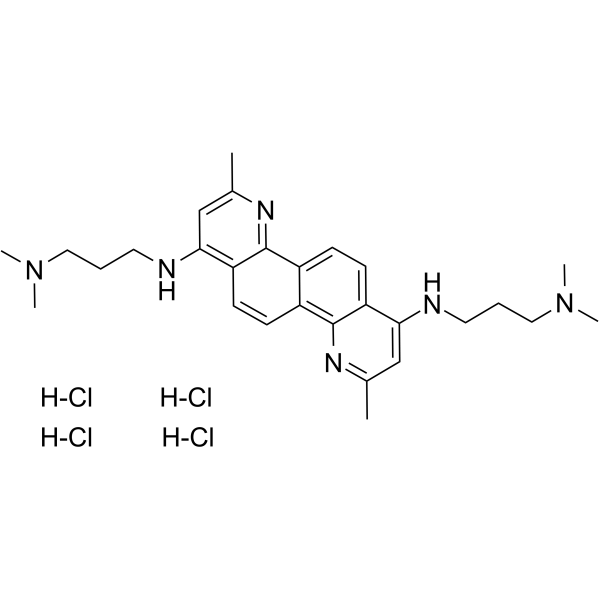
FGI-106 tetrahydrochloride
CAS No. 1149348-10-6
FGI-106 tetrahydrochloride( —— )
Catalog No. M26214 CAS No. 1149348-10-6
FGI-106 tetrahydrochloride is active against Ebola, Rift Valley and Dengue Fever viruses with EC50s of 100 nM, 800 nM and 400-900 nM, respectively.
Purity : >98% (HPLC)
 COA
Datasheet
HNMR
HPLC
MSDS
Handing Instructions
COA
Datasheet
HNMR
HPLC
MSDS
Handing Instructions
| Size | Price / USD | Stock | Quantity |
| 1 mL x 10 mM in DMSO | 219 | In Stock |


|
| 5MG | 164 | In Stock |
|
| 10MG | 259 | In Stock |
|
| 25MG | 429 | In Stock |
|
| 50MG | 591 | In Stock |
|
| 100MG | 798 | In Stock |
|
| 200MG | 1070 | In Stock |
|
| 500MG | Get Quote | In Stock |
|
| 1G | Get Quote | In Stock |
|
Biological Information
-
Product NameFGI-106 tetrahydrochloride
-
NoteResearch use only, not for human use.
-
Brief DescriptionFGI-106 tetrahydrochloride is active against Ebola, Rift Valley and Dengue Fever viruses with EC50s of 100 nM, 800 nM and 400-900 nM, respectively.
-
DescriptionFGI-106 tetrahydrochloride is active against Ebola, Rift Valley and Dengue Fever viruses with EC50s of 100 nM, 800 nM and 400-900 nM, respectively. FGI-106 tetrahydrochloride also inhibits non-hemorrhagic fever viruses HCV and HIV-1 with EC50s of 200 nM and 150 nM, respectively. FGI-106 tetrahydrochloride is a potent and broad-spectrum inhibitor with inhibitory activity against multiple viruses.(In Vitro):In cell-based assays, treatment with FGI-106 inhibits viral replication by divergent virus families, including positive and negative-strand RNA viruses.Treatment with 2 μM FGI-106 mediated a 4 log reduction in infectious viral titers relative to matched controls, with an EC90 for inhibition of viral killing of host cells (Vero E6 cells) estimated to be 0.6 μM. (In Vivo):FGI-106 treatment decreases mortality from Zaire EBOV in a dose-dependent manner.
-
In VitroTreatment with 2 μM FGI-106 mediated a 4 log reduction in infectious viral titers relative to matched controls, with an EC90 for inhibition of viral killing of host cells (Vero E6 cells) estimated to be 0.6 μM.In cell-based assays, treatment with FGI-106 inhibits viral replication by divergent virus families, including positive and negative-strand RNA viruses.
-
In VivoFGI-106 (0.1-5 mg/kg; intraperitoneal injection; treatments on days 2 and 5; C57BL/6 or BALB/c mice) treatment decreases mortality from Zaire EBOV in a dose-dependent manner. Animal Model:Male or female C57BL/6 or BALB/c mice (6-10 weeks of age) injected with EBOV (Ebola virus) Dosage:0.1 mg/kg, 0.5 mg/kg, 1 mg/kg, 2 mg/kg, 5 mg/kg Administration:Intraperitoneal injection; treatments on days 2 and 5Result:Decreased mortality from Zaire EBOV in a dose-dependent manner.
-
Synonyms——
-
PathwayOthers
-
TargetOther Targets
-
Recptor——
-
Research Area——
-
Indication——
Chemical Information
-
CAS Number1149348-10-6
-
Formula Weight604.49
-
Molecular FormulaC28H42Cl4N6
-
Purity>98% (HPLC)
-
SolubilityIn Vitro:?DMSO : 6.67 mg/mL (11.03 mM)
-
SMILESCl.Cl.Cl.Cl.CN(C)CCCNc1cc(C)nc2c1ccc1c2ccc2c(NCCCN(C)C)cc(C)nc12
-
Chemical Name——
Shipping & Storage Information
-
Storage(-20℃)
-
ShippingWith Ice Pack
-
Stability≥ 2 years
Reference
1.Bodner et al (2006) Pharmacological promotion of inclusion formation:a therapeutic approach for Huntington's and Parksinson's diseases. Proc.Natl.Acad.Sci.USA 103 4246
molnova catalog



related products
-
Fmoc-Ser(O-α-D-GalNA...
Fmoc-Ser(O-α-D-GalNAc(OAc)3)-OH is an anti-tumor drug.
-
MBC-11
MBC-11 is a first-in-class conjugate of the bone-targeting bisphosphonate etidronate covalently linked to the antimetabolite cytarabine (araC), with potential to treat tumor-induced bone disease (TIBD).
-
5,7-Dimethoxyflavano...
5,7-Dimethoxyflavanone has anti-inflammatory activities.
