


 Cart
Cart
 sales@molnova.com


 Home -
Products -
Proteasome/Ubiquitin -
Endogenous Metabolite -
1-Stearoyl-2-arachidonoyl-sn-glycero-3-phosphocholine
Home -
Products -
Proteasome/Ubiquitin -
Endogenous Metabolite -
1-Stearoyl-2-arachidonoyl-sn-glycero-3-phosphocholine
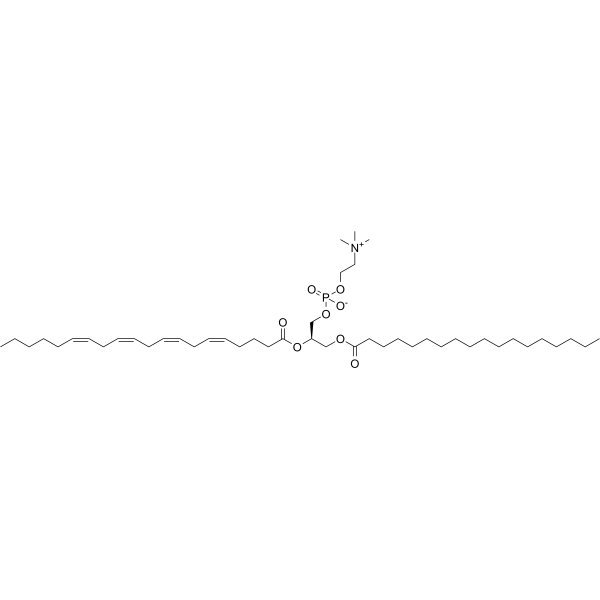
1-Stearoyl-2-arachidonoyl-sn-glycero-3-phosphocholine
CAS No. 35418-59-8
1-Stearoyl-2-arachidonoyl-sn-glycero-3-phosphocholine( —— )
Catalog No. M26016 CAS No. 35418-59-8
1-Stearoyl-2-arachidonoyl-sn-glycero-3-phosphocholine is an endogenous metabolite.
Purity : >98% (HPLC)
 COA
Datasheet
HNMR
HPLC
MSDS
Handing Instructions
COA
Datasheet
HNMR
HPLC
MSDS
Handing Instructions
| Size | Price / USD | Stock | Quantity |
| 5MG | 298 | Get Quote |


|
| 10MG | 447 | Get Quote |
|
| 25MG | 806 | Get Quote |
|
| 50MG | 1211 | Get Quote |
|
| 100MG | Get Quote | Get Quote |
|
| 200MG | Get Quote | Get Quote |
|
| 500MG | Get Quote | Get Quote |
|
| 1G | Get Quote | Get Quote |
|
Biological Information
-
Product Name1-Stearoyl-2-arachidonoyl-sn-glycero-3-phosphocholine
-
NoteResearch use only, not for human use.
-
Brief Description1-Stearoyl-2-arachidonoyl-sn-glycero-3-phosphocholine is an endogenous metabolite.
-
Description1-Stearoyl-2-arachidonoyl-sn-glycero-3-phosphocholine is an endogenous metabolite.
-
In Vitro——
-
In Vivo——
-
Synonyms——
-
PathwayProteasome/Ubiquitin
-
TargetEndogenous Metabolite
-
RecptorPEGs
-
Research Area——
-
Indication——
Chemical Information
-
CAS Number35418-59-8
-
Formula Weight810.151
-
Molecular FormulaC46H84NO8P
-
Purity>98% (HPLC)
-
Solubility——
-
SMILESCCCCCCCCCCCCCCCCCC(=O)OC[C@H](COP([O-])(=O)OCC[N+](C)(C)C)OC(=O)CCC\C=C/C\C=C/C\C=C/C\C=C/CCCCC
-
Chemical Name——
Shipping & Storage Information
-
Storage(-20℃)
-
ShippingWith Ice Pack
-
Stability≥ 2 years
Reference
1.An S, et al. Small-molecule PROTACs: An emerging and promising approach for the development of targeted therapy drugs. EBioMedicine. 2018 Oct;36:553-562.
molnova catalog



related products
-
Eicosadienoic acid
Eicosadienoic acid is a rare naturally occurring n-6 polyunsaturated fatty acid found mainly in animal tissues.
-
1,3-Dihydroxyacetone
1,3-Dihydroxyacetone is the main active ingredient in sunscreen tanning skin care preparations, an important precursor for the synthesis of a variety of fine chemicals, and a food additive that can be produced on an industrial scale by microbial fermentation on Gluconobacter oxydans.
-
H2S Donor 5a
H2S Donor 5a is a H2S donor that could mimic the slow and continuous H(2)S generation process.
