


 Cart
Cart
 sales@molnova.com


 Home -
Products -
Proteasome/Ubiquitin -
Endogenous Metabolite -
1-Myristoyl-2-stearoyl-sn-glycero-3-phosphocholine
Home -
Products -
Proteasome/Ubiquitin -
Endogenous Metabolite -
1-Myristoyl-2-stearoyl-sn-glycero-3-phosphocholine
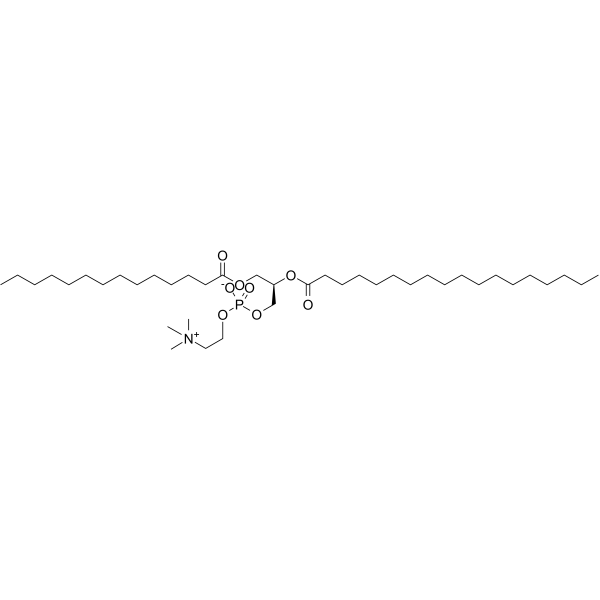
1-Myristoyl-2-stearoyl-sn-glycero-3-phosphocholine
CAS No. 76343-22-1
1-Myristoyl-2-stearoyl-sn-glycero-3-phosphocholine( —— )
Catalog No. M26014 CAS No. 76343-22-1
1-Myristoyl-2-stearoyl-sn-glycero-3-phosphocholine is an endogenous metabolite.
Purity : >98% (HPLC)
 COA
Datasheet
HNMR
HPLC
MSDS
Handing Instructions
COA
Datasheet
HNMR
HPLC
MSDS
Handing Instructions
| Size | Price / USD | Stock | Quantity |
| 2MG | 30 | In Stock |


|
| 5MG | 48 | In Stock |
|
| 10MG | 79 | In Stock |
|
| 25MG | 132 | In Stock |
|
| 50MG | 193 | In Stock |
|
| 100MG | 287 | In Stock |
|
| 200MG | 424 | In Stock |
|
| 500MG | Get Quote | In Stock |
|
| 1G | Get Quote | In Stock |
|
Biological Information
-
Product Name1-Myristoyl-2-stearoyl-sn-glycero-3-phosphocholine
-
NoteResearch use only, not for human use.
-
Brief Description1-Myristoyl-2-stearoyl-sn-glycero-3-phosphocholine is an endogenous metabolite.
-
Description1-Myristoyl-2-stearoyl-sn-glycero-3-phosphocholine is an endogenous metabolite.
-
In Vitro——
-
In Vivo——
-
Synonyms——
-
PathwayProteasome/Ubiquitin
-
TargetEndogenous Metabolite
-
RecptorPEGs
-
Research Area——
-
Indication——
Chemical Information
-
CAS Number76343-22-1
-
Formula Weight734.053
-
Molecular FormulaC40H80NO8P
-
Purity>98% (HPLC)
-
SolubilityIn Vitro:?DMSO : 1.96 mg/mL (2.67 mMu)
-
SMILESCCCCCCCCCCCCCCCCCC(=O)O[C@H](COC(=O)CCCCCCCCCCCCC)COP([O-])(=O)OCC[N+](C)(C)C
-
Chemical Name——
Shipping & Storage Information
-
Storage(-20℃)
-
ShippingWith Ice Pack
-
Stability≥ 2 years
Reference
1.An S, et al. Small-molecule PROTACs: An emerging and promising approach for the development of targeted therapy drugs. EBioMedicine. 2018 Oct;36:553-562
molnova catalog



related products
-
Nervonic acid
Nervonic acid is a long chain unsaturated fatty acid that is enriched in sphingomyelin. It consists of choline sphingosine phosphoric acid and fatty acid.
-
2'-Deoxycytidine mon...
One of the principal nucleosides of DNA composed of cytosine and deoxyribose. A nucleoside consists of only a pentose sugar linked to a purine or pyrimidine base without a phosphate group.
-
3-Oxopentanedioic ac...
3-oxoglutaric acid or acetonedicarboxylic acid is a simple carboxylic acid which may be used as a building block in organic chemistry. It has been found to be a microbial metabolite.
