


 Cart
Cart
 sales@molnova.com



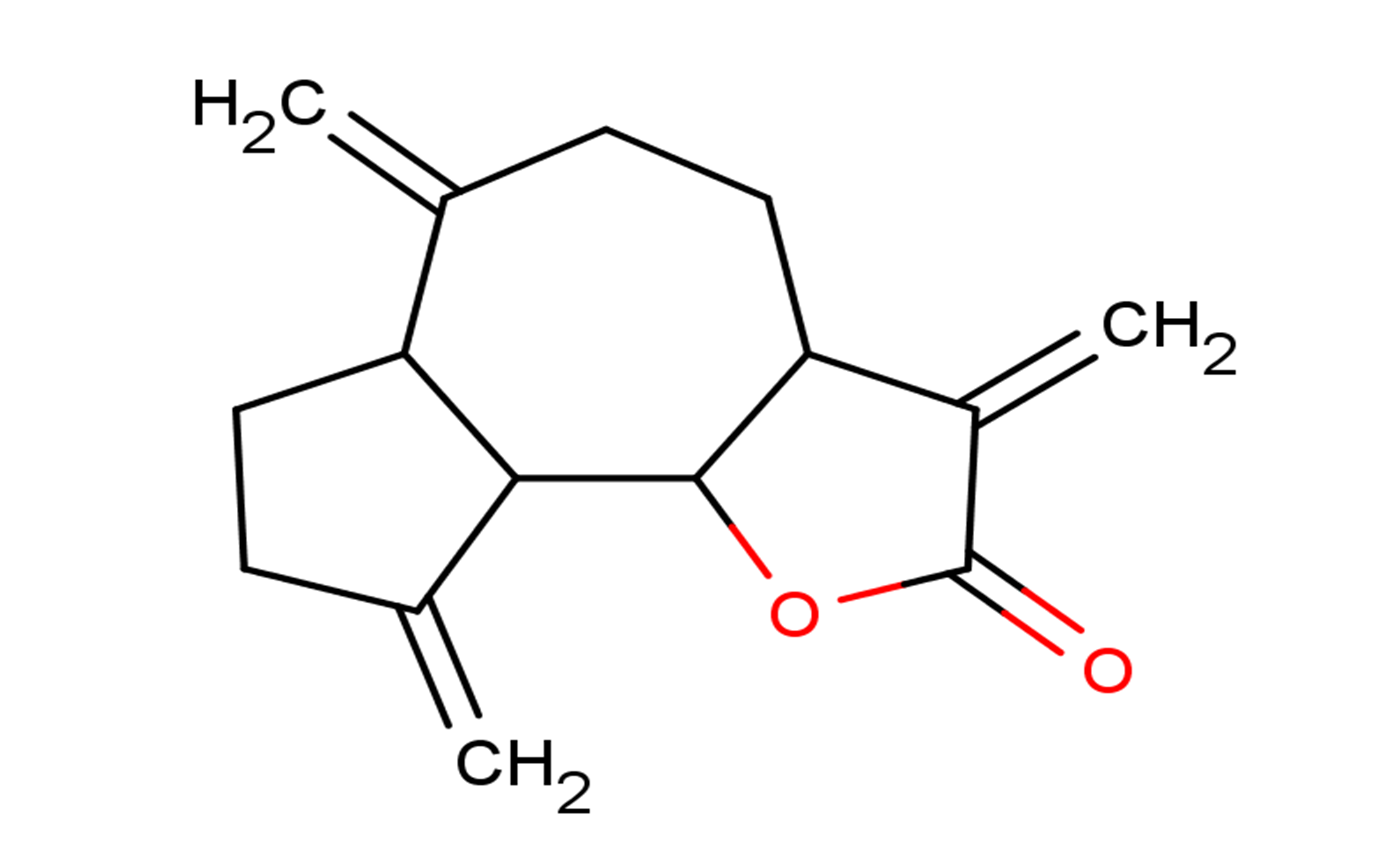
Dehydrocostuslactone
CAS No. 74299-48-2
Dehydrocostuslactone( —— )
Catalog No. M24751 CAS No. 74299-48-2
Dehydrocostuslactone is a natural product extracted from Aucklandia.
Purity : >98% (HPLC)
 COA
Datasheet
HNMR
HPLC
MSDS
Handing Instructions
COA
Datasheet
HNMR
HPLC
MSDS
Handing Instructions
| Size | Price / USD | Stock | Quantity |
| 1 mL x 10 mM in DMSO | 92 | In Stock |


|
| 5MG | 106 | In Stock |
|
| 10MG | 150 | In Stock |
|
| 25MG | 275 | In Stock |
|
| 50MG | 405 | In Stock |
|
| 100MG | 607 | In Stock |
|
| 200MG | 851 | In Stock |
|
| 500MG | Get Quote | In Stock |
|
| 1G | Get Quote | In Stock |
|
Biological Information
-
Product NameDehydrocostuslactone
-
NoteResearch use only, not for human use.
-
Brief DescriptionDehydrocostuslactone is a natural product extracted from Aucklandia.
-
DescriptionDehydrocostuslactone is a natural product extracted from Aucklandia.It has wide spectrum of biological effects, including anti-inflammatory, anticancer, antiviral, antimicrobial, antifungal, antioxidant, antidiabetic, antiulcer, and anthelmintic activities.
-
In Vitro——
-
In Vivo——
-
Synonyms——
-
PathwayOthers
-
TargetOther Targets
-
RecptorOthers
-
Research Area——
-
Indication——
Chemical Information
-
CAS Number74299-48-2
-
Formula Weight230.3
-
Molecular FormulaC15H18O2
-
Purity>98% (HPLC)
-
SolubilityDMSO:10 mM
-
SMILESC=C1CCC2C(C3C1CCC3=C)OC(=O)C2=C
-
Chemical Name——
Shipping & Storage Information
-
Storage(-20℃)
-
ShippingWith Ice Pack
-
Stability≥ 2 years
Reference
1.Lin X , Peng Z , Su C . Potential Anti-Cancer Activities and Mechanisms of Costunolide and Dehydrocostuslactone[J]. International Journal of Molecular Sciences, 2015, 16(5):10888.
molnova catalog



related products
-
Anthracene-9-carboxy...
Anthracene-9-carboxylic acid is an inhibitor of chloride transport with a moderate to strong inhibitory action on PKA activated cardiac IcI.
-
DPPH
DPPH is a cell-permeable, stable free radical that is commonly used to evaluate the ability of compounds to act as free radical scavengers or hydrogen donors and to measure the antioxidant activity of tissue extractsDPPH shows a strong absorption band at 517nm.
-
Monomethyl lithosper...
Monomethyl lithospermate has potential antiviral activity, alleviating ischemic stroke injury in vivo in middle cerebral artery occlusion mice by activating PI5K/Akt signaling and protecting oxygen-glucose deprivation/reoxygenation-induced SHSY-3Y cells in vitro.
