


 Cart
Cart
 sales@molnova.com



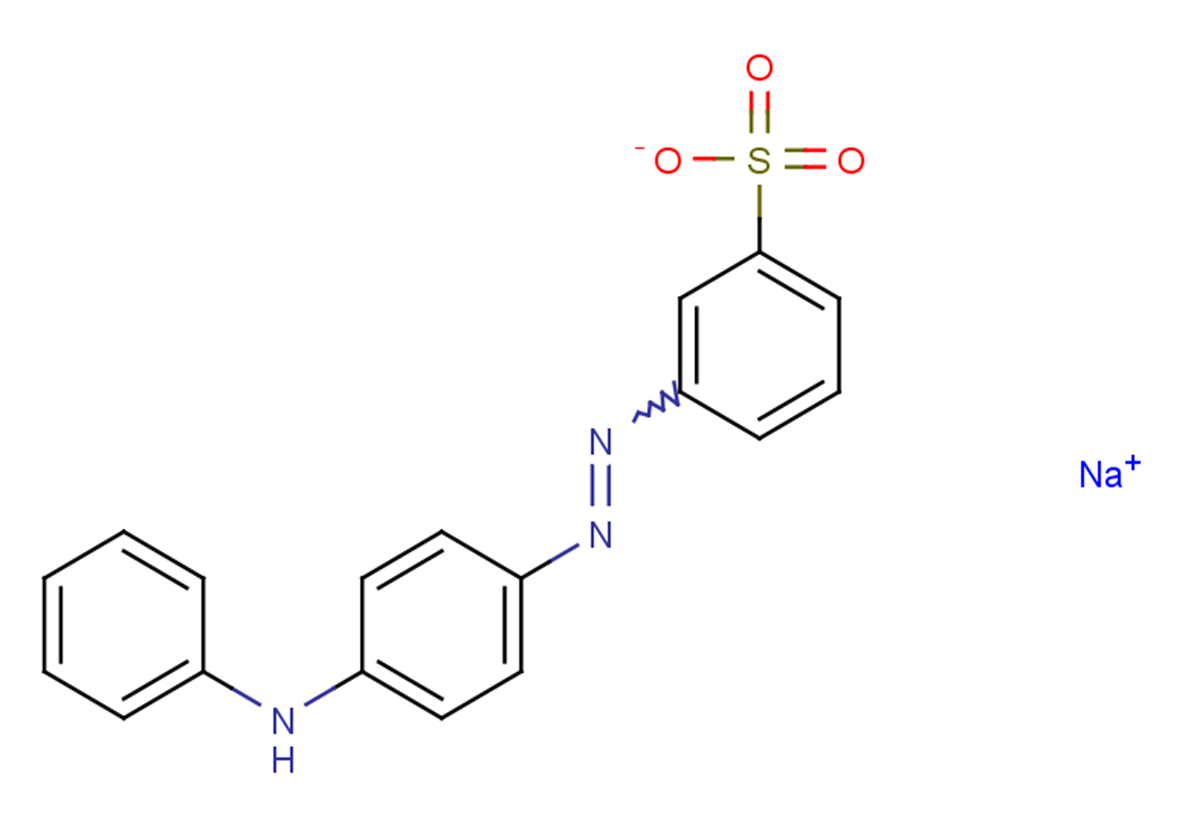
Acid Yellow 36
CAS No. 587-98-4
Acid Yellow 36( Metanil Yellow )
Catalog No. M24579 CAS No. 587-98-4
Acid Yellow 36 is an azo dye and a pH indicator. Acid Yellow 36 changes its color from red at pH 1.2 to yellow at pH 2.3.
Purity : >98% (HPLC)
 COA
Datasheet
HNMR
HPLC
MSDS
Handing Instructions
COA
Datasheet
HNMR
HPLC
MSDS
Handing Instructions
| Size | Price / USD | Stock | Quantity |
| 1 mL x 10 mM in DMSO | 44 | In Stock |


|
| 10MG | 34 | In Stock |
|
| 25MG | 68 | In Stock |
|
| 50MG | 91 | In Stock |
|
| 100MG | 151 | In Stock |
|
| 200MG | 226 | In Stock |
|
| 500MG | 431 | In Stock |
|
| 1G | Get Quote | In Stock |
|
Biological Information
-
Product NameAcid Yellow 36
-
NoteResearch use only, not for human use.
-
Brief DescriptionAcid Yellow 36 is an azo dye and a pH indicator. Acid Yellow 36 changes its color from red at pH 1.2 to yellow at pH 2.3.
-
DescriptionAcid Yellow 36 is an azo dye and a pH indicator. Acid Yellow 36 changes its color from red at pH 1.2 to yellow at pH 2.3.
-
In VitroAcid Yellow 36(Metanil Yellow) acts as an inducer of a specific form of microsomal P-450 and cytosolic glutathione-S-transferase (GST) and quinone reductase (QR), which may involve a cytosolic Ah receptor.
-
In Vivo——
-
SynonymsMetanil Yellow
-
PathwayOthers
-
TargetOther Targets
-
RecptorOthers
-
Research Area——
-
Indication——
Chemical Information
-
CAS Number587-98-4
-
Formula Weight375.38
-
Molecular FormulaC18H14N3NaO3S
-
Purity>98% (HPLC)
-
SolubilityDMSO:24 mg/mL?(63.93 mM;?Need ultrasonic)
-
SMILESO=S(C1=CC=CC(N=NC2=CC=C(NC3=CC=CC=C3)C=C2)=C1)([O-])=O.[Na+]
-
Chemical Name——
Shipping & Storage Information
-
Storage(-20℃)
-
ShippingWith Ice Pack
-
Stability≥ 2 years
Reference
1.Sharma UK, et al. Ameliorating efficacy of eugenol against metanil yellow induced toxicity in albino Wistar rats. Food Chem Toxicol. 2019;126:34-40.
molnova catalog



related products
-
Eucalyptone
Eucalyptone is a natural product from Eucalyptus globulus.
-
Methyl 3-[2-[[(4R)-4...
Methyl 3-[2-[[(4R)-4-cyano-4-(3,4-dimethoxyphenyl)-5-methylhexyl]methylamino]ethyl]benzoate is a biochemical reagent that can be used to synthesize active compounds.
-
VIP (1 - 12), human,...
VIP (1-12), human, porcine, rat, ovine is a vasoactive intestinal peptide (VIP) fragment. VIP (1-12), human, porcine, rat, ovine is a ligand for the CD4 (T4)/human immunodeficiency virus receptor.
