


 Cart
Cart
 sales@molnova.com



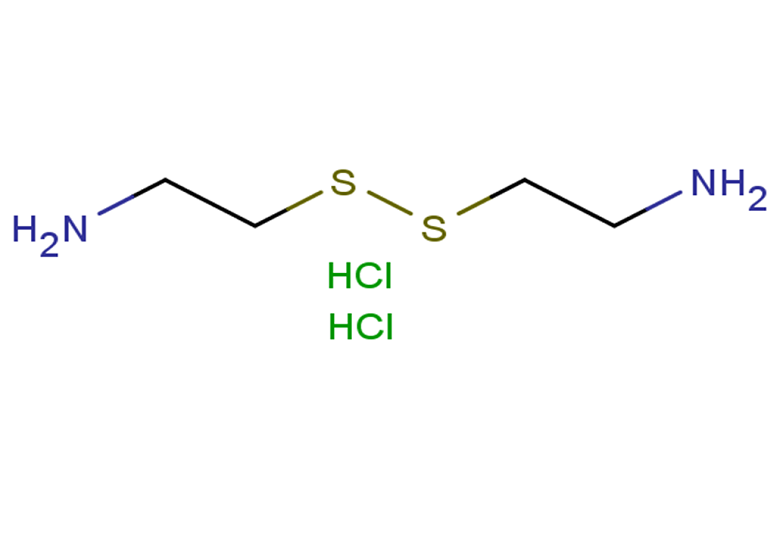
Cystamine dihydrochloride
CAS No. 56-17-7
Cystamine dihydrochloride( —— )
Catalog No. M24550 CAS No. 56-17-7
Cystamine dihydrochloride is a radiation-protective agent. It also protects against carbon tetrachloride liver damage.
Purity : >98% (HPLC)
 COA
Datasheet
HNMR
HPLC
MSDS
Handing Instructions
COA
Datasheet
HNMR
HPLC
MSDS
Handing Instructions
| Size | Price / USD | Stock | Quantity |
| 1 mL x 10 mM in DMSO | 39 | In Stock |


|
| 5MG | 49 | In Stock |
|
| 100MG | Get Quote | In Stock |
|
| 200MG | Get Quote | In Stock |
|
| 500MG | Get Quote | In Stock |
|
| 1G | Get Quote | In Stock |
|
Biological Information
-
Product NameCystamine dihydrochloride
-
NoteResearch use only, not for human use.
-
Brief DescriptionCystamine dihydrochloride is a radiation-protective agent. It also protects against carbon tetrachloride liver damage.
-
DescriptionCystamine dihydrochloride is a radiation-protective agent. It also protects against carbon tetrachloride liver damage.
-
In VitroCystamine (dihydrochloride) has inhibition activity for caspase-3 with an IC50 value of 23.6 μM.Cystamine (0-500 μM; 0-16 h) inhibits recombinant active caspase-3 in a concentration-dependent manner. Cystamine (250 μM; 10 h) robustly increases the levels of glutathione. Western Blot Analysis Cell Line:Human neuroblastoma SH-SY5Y cells Concentration:250, 500 μM Incubation Time:0-16 h Result:Inhibited the MG132-mediated activation of caspase-3.Inhibited the H2O2-mediated activation of caspase-3.Inhibited caspase-3 activity in a tTG-independent manner.
-
In VivoCystamine (dihydrochloride) (oral, i.p.; 112, 225 mg/kg) reduces Tgase activity and GGEL levels, lessens the behavioral and neuropathological severity, and extends survival in R6/2 transgenic HD mice. Animal Model:R6/2 transgenic HD miceDosage:112, 225 mg/kg Administration:Intraperitoneal or oral, daily Result:Significantly extended survival, improved body weight and motor performance, delayed the neuropathological sequela and significantly altered the levels of Tgase activity and N(Sigma)-(gamma-L-glutamyl)-L-lysine (GGEL) levels.
-
Synonyms——
-
PathwayOthers
-
TargetOther Targets
-
RecptorOthers
-
Research Area——
-
Indication——
Chemical Information
-
CAS Number56-17-7
-
Formula Weight225.19
-
Molecular FormulaC4H14Cl2N2S2
-
Purity>98% (HPLC)
-
SolubilityDMSO:Soluble
-
SMILESC(CSSCCN)N.Cl.Cl
-
Chemical Name——
Shipping & Storage Information
-
Storage(-20℃)
-
ShippingWith Ice Pack
-
Stability≥ 2 years
Reference
1.Roncoroni L, Elli L, Braidotti P, et al. Transglutaminase 2 Mediates the Cytotoxicity of Resveratrol in a Human Cholangiocarcinoma and Gallbladder Cancer Cell Lines. Nutr Cancer. 2018 May 14:1-9.
molnova catalog



related products
-
Tau-aggregation and ...
Tau-aggregation and neuroinflammation-IN-1 is a potent inhibitor of tau protein aggregates, showing significant inhibitory activity against AcPHF6 and full-length tau protein aggregates.
-
Lanthanum trichlorid...
Lanthanum trichloride can be used as an analytical reagent and can be used as a raw material for extracting metal lanthanum and as a petroleum cracking catalyst.
-
Jasminoside B
Jasminoside B is a natural compound with immunosuppressive activity.
