


 Cart
Cart
 sales@molnova.com


 Home -
Products -
MAPK/ERK Signaling -
p38 MAPK -
methyl 5-(3,4-dimethoxyphenyl)isoxazole-3-carboxylate
Home -
Products -
MAPK/ERK Signaling -
p38 MAPK -
methyl 5-(3,4-dimethoxyphenyl)isoxazole-3-carboxylate
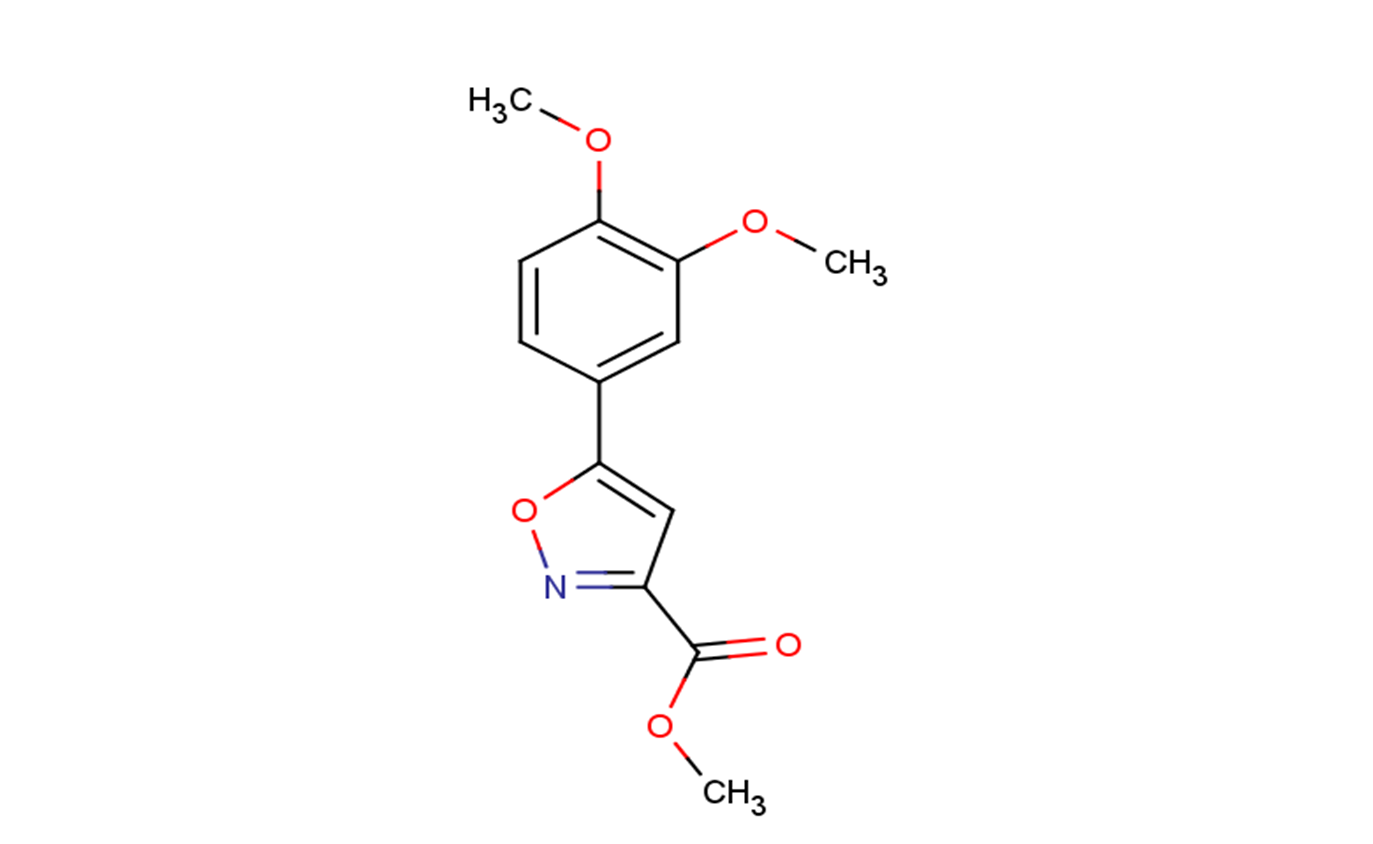
methyl 5-(3,4-dimethoxyphenyl)isoxazole-3-carboxylate
CAS No. 517870-17-6
methyl 5-(3,4-dimethoxyphenyl)isoxazole-3-carboxylate( —— )
Catalog No. M24490 CAS No. 517870-17-6
methyl 5-(3,4-dimethoxyphenyl)isoxazole-3-carboxylate targets MAPK.
Purity : >98% (HPLC)
 COA
Datasheet
HNMR
HPLC
MSDS
Handing Instructions
COA
Datasheet
HNMR
HPLC
MSDS
Handing Instructions
| Size | Price / USD | Stock | Quantity |
| 1 mL x 10 mM in DMSO | 28 | In Stock |


|
| 10MG | 29 | In Stock |
|
| 25MG | 51 | In Stock |
|
| 50MG | 75 | In Stock |
|
| 100MG | 112 | In Stock |
|
| 200MG | 168 | In Stock |
|
| 500MG | Get Quote | In Stock |
|
| 1G | Get Quote | In Stock |
|
Biological Information
-
Product Namemethyl 5-(3,4-dimethoxyphenyl)isoxazole-3-carboxylate
-
NoteResearch use only, not for human use.
-
Brief Descriptionmethyl 5-(3,4-dimethoxyphenyl)isoxazole-3-carboxylate targets MAPK.
-
Descriptionmethyl 5-(3,4-dimethoxyphenyl)isoxazole-3-carboxylate targets MAPK.
-
In Vitro——
-
In Vivo——
-
Synonyms——
-
PathwayMAPK/ERK Signaling
-
Targetp38 MAPK
-
RecptorMAPK
-
Research Area——
-
Indication——
Chemical Information
-
CAS Number517870-17-6
-
Formula Weight263.25
-
Molecular FormulaC13H13NO5
-
Purity>98% (HPLC)
-
SolubilityDMSO:10 mM
-
SMILESCOC1=C(C=C(C=C1)C2=CC(=NO2)C(=O)OC)OC
-
Chemical Name——
Shipping & Storage Information
-
Storage(-20℃)
-
ShippingWith Ice Pack
-
Stability≥ 2 years
Reference
molnova catalog



related products
-
AS1940477
A potent, selective, orally active p38α/p38β inhibitor with IC50 of 11.2/36.5 nM respectively, with no effect on p38γ and δ isoforms (IC50>1 uM).
-
HS-276
HS-276 is a highly selective, orally active inhibitor of TAK1 (Ki: 2.5 nM). HS-276 significantly inhibits TAK1 (IC50: 8.25 nM), CLK2 (IC50: 29 nM), GCK (IC50: 22 nM), ULK2 (IC50: 63 nM), MAP4K5 (IC50. HS-276 can be used to study rheumatoid arthritis (RA).
-
JNJ-49095397
JNJ-49095397 (RV-568) is a specific narrow-spectrum kinase inhibitor that inhibits a selected set of kinases involved in COPD inflammation with IC50 of 5, 40 and 52 nM for p38α, p38γ and HCK, respectively.
