


 Cart
Cart
 sales@molnova.com



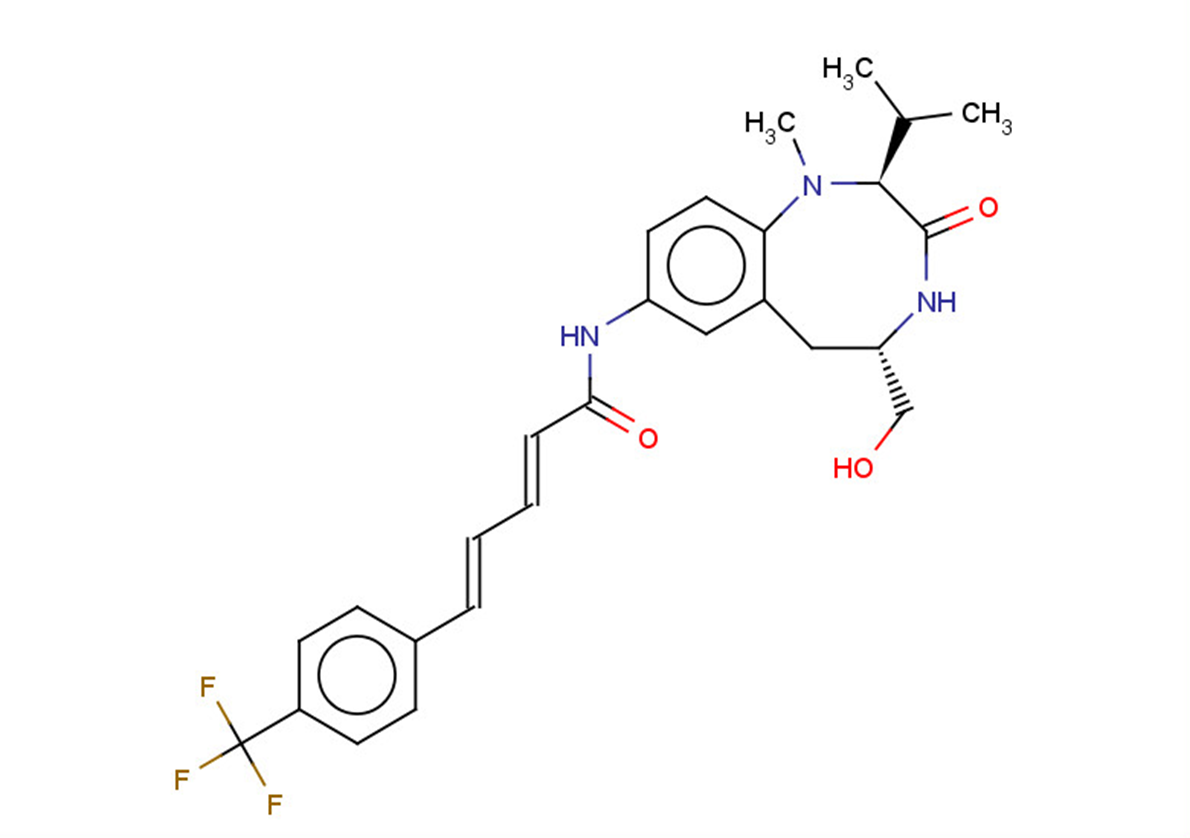
TPPB
CAS No. 497259-23-1
TPPB( —— )
Catalog No. M24458 CAS No. 497259-23-1
TPPB is a kinase C activator of cell-permeable benzolactam-derived protein (Ki: 11.9 nM).
Purity : >98% (HPLC)
 COA
Datasheet
HNMR
HPLC
MSDS
Handing Instructions
COA
Datasheet
HNMR
HPLC
MSDS
Handing Instructions
| Size | Price / USD | Stock | Quantity |
| 1 mL x 10 mM in DMSO | 560 | In Stock |


|
| 5MG | 519 | In Stock |
|
| 10MG | 748 | In Stock |
|
| 100MG | Get Quote | In Stock |
|
| 200MG | Get Quote | In Stock |
|
| 500MG | Get Quote | In Stock |
|
| 1G | Get Quote | In Stock |
|
Biological Information
-
Product NameTPPB
-
NoteResearch use only, not for human use.
-
Brief DescriptionTPPB is a kinase C activator of cell-permeable benzolactam-derived protein (Ki: 11.9 nM).
-
DescriptionTPPB is a kinase C activator of cell-permeable benzolactam-derived protein (Ki: 11.9 nM).
-
In Vitro——
-
In Vivo——
-
Synonyms——
-
PathwayAngiogenesis
-
TargetPKC
-
RecptorPKC
-
Research Area——
-
Indication——
Chemical Information
-
CAS Number497259-23-1
-
Formula Weight501.54
-
Molecular FormulaC27H30F3N3O3
-
Purity>98% (HPLC)
-
SolubilityDMSO:125 mg/mL (249.23 mM; Need ultrasonic)
-
SMILESCC(C)[C@@H](C(N[C@H](CO)C1)=O)N(C)c(cc2)c1cc2NC(/C=C/C=C/c1ccc(C(F)(F)F)cc1)=O
-
Chemical Name——
Shipping & Storage Information
-
Storage(-20℃)
-
ShippingWith Ice Pack
-
Stability≥ 2 years
Reference
1.Kozikowski AP, et al. New amide-bearing benzolactam-based protein kinase C modulators induce enhanced secretion of the amyloid precursor protein metabolite sAPPalpha. J Med Chem. 2003 Jan 30;46(3):364-73.
molnova catalog



related products
-
AS2521780
AS2521780 is a?potent, selective, orally bioavailable PKCθ inhibitor that inhibits combinant human PKCθ enzyme with IC50 of 0.48 nM.
-
Hispidin
Hispidin is a polyphenol originally including antioxidant anti-inflammatory and cytoprotective properties.
-
PKCβ inhibitor 1?
PKCβ inhibitor 1(KUN79359) is a potent selective and ATP-competitive?inhibitor of PKC? isozymes(IC50s of 21 and 5 nM for human PKCβ1 and PKCβ2 respectively).?
