


 Cart
Cart
 sales@molnova.com



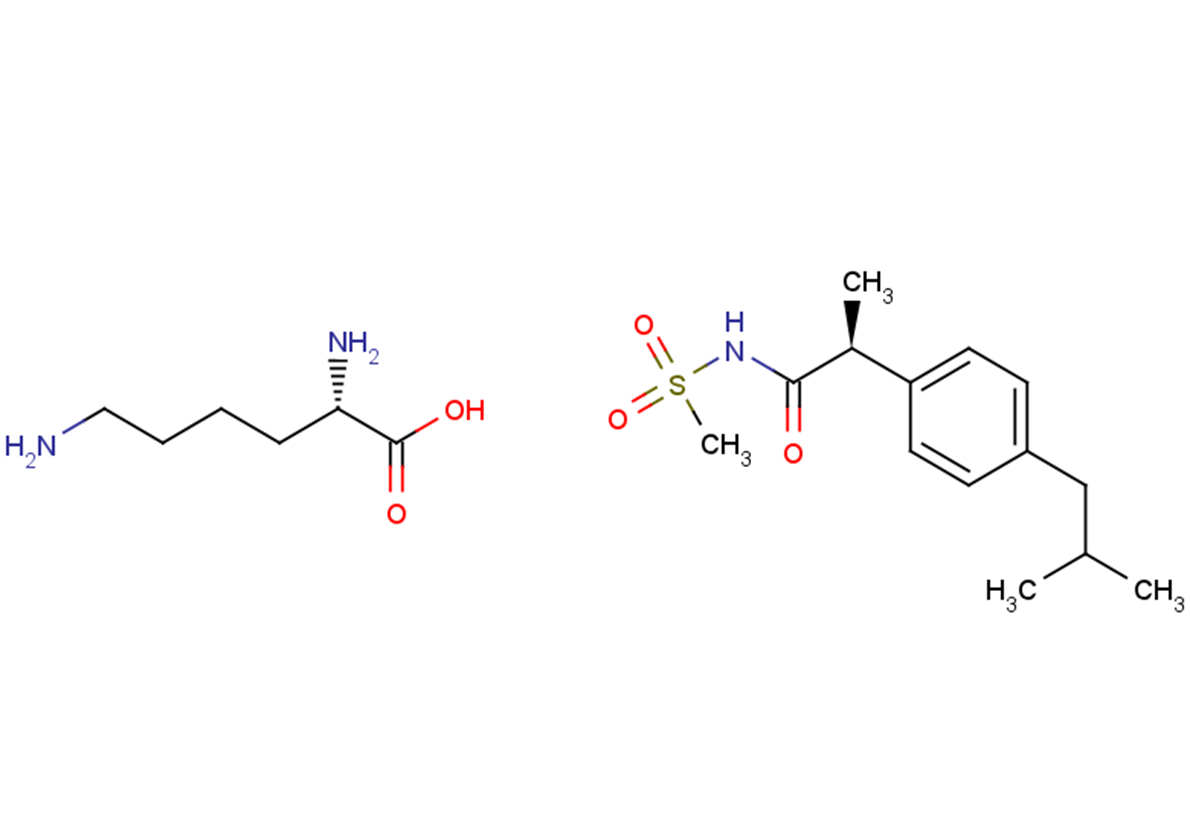
Reparixin L-lysine salt
CAS No. 266359-93-7
Reparixin L-lysine salt( Repertaxin L-lysine salt )
Catalog No. M24179 CAS No. 266359-93-7
Reparixin L-lysine salt is an allosteric chemokine receptor 1/2 (CXCR1/2) activation inhibitor.
Purity : >98% (HPLC)
 COA
Datasheet
HNMR
HPLC
MSDS
Handing Instructions
COA
Datasheet
HNMR
HPLC
MSDS
Handing Instructions
| Size | Price / USD | Stock | Quantity |
| 1 mL x 10 mM in DMSO | 41 | In Stock |


|
| 5MG | 37 | In Stock |
|
| 10MG | 52 | In Stock |
|
| 25MG | 116 | In Stock |
|
| 50MG | 183 | In Stock |
|
| 100MG | Get Quote | In Stock |
|
| 200MG | Get Quote | In Stock |
|
| 500MG | Get Quote | In Stock |
|
| 1G | Get Quote | In Stock |
|
Biological Information
-
Product NameReparixin L-lysine salt
-
NoteResearch use only, not for human use.
-
Brief DescriptionReparixin L-lysine salt is an allosteric chemokine receptor 1/2 (CXCR1/2) activation inhibitor.
-
DescriptionReparixin L-lysine salt is an allosteric chemokine receptor 1/2 (CXCR1/2) activation inhibitor.
-
In VitroReparixin is a potent functional inhibitor of CXCL8-induced biological activities on human PMNs with a marked selectivity (around 400-fold) for CXCR1, as shown in specific experiments on CXCR1/L1.2 and CXCR2/L1.2 transfected cells and on human PMNs. The efficacy of Reparixin is significantly lower in L1.2 cells expressing Ile43Val CXCR1 mutant (IC50 values of 5.6 nM and 80 nM for CXCR1 wt and CXCR1 Ile43Val, respectively). Reparixin is a non-competitive allosteric inhibitor of IL-8 receptors with a 400-fold higher efficacy in inhibiting CXCR1 activity than CXCR2.
-
In VivoThe pharmacokinetics and metabolism of Reparixin are investigated in rats and dogs after intravenous administration of [14C]-Reparixin L-lysine salt. Plasma protein binding of Reparixin is >99% in the laboratory animals and humans up to 50 μg/mL, but lower at higher concentrations. Although radioactivity is rapidly distributed into rat tissues, Vss is low (about 0.15 L/kg) in both rat and dog. Nevertheless, Reparixin is more rapidly eliminated in rats (t1/2~0.5 h) than in dogs (t1/2~10 h).
-
SynonymsRepertaxin L-lysine salt
-
PathwayAutophagy
-
TargetCXCR
-
RecptorCXCR1wt|CXCR1Ile43Val|CXCR1|CXCR2
-
Research Area——
-
Indication——
Chemical Information
-
CAS Number266359-93-7
-
Formula Weight429.57
-
Molecular FormulaC20H35N3O5S
-
Purity>98% (HPLC)
-
SolubilityH2O: 99 mg/mL (230.46 mM; Need ultrasonic); DMSO: 99 mg/mL (230.46 mM; Need ultrasonic)
-
SMILESN[C@@H](CCCCN)C(O)=O.O=C(NS(=O)(C)=O)[C@@H](C)C1=CC=C(CC(C)C)C=C1
-
Chemical Name——
Shipping & Storage Information
-
Storage(-20℃)
-
ShippingWith Ice Pack
-
Stability≥ 2 years
Reference
1.Moriconi A, et al. Design of noncompetitive interleukin-8 inhibitors acting on CXCR1 and CXCR2. J Med Chem. 2007 Aug 23;50(17):3984-4002.
molnova catalog



related products
-
VUF-11222
VUF-11222 is a CXCR3 nonmimetic peptide agonist that induces gliosis.VUF 11222 has been used in the study of retinal inflammation.
-
CHIR98014
CHIR 98014 is a potent GSK-3α/β inhibitor with IC50 of 0.65 nM/0.58 nM in cell-free assays, with the ability to distinguish GSK-3 from its closest homologs Cdc2 and ERK2.
-
CTCE 9908
CXCR4 antagonist; induces mitotic catastrophe in ovarian cancer cells. Displays additive cytotoxic effects when given with taxol. Enhances the efficacy of docetaxel in a mouse model.
