


 Cart
Cart
 sales@molnova.com



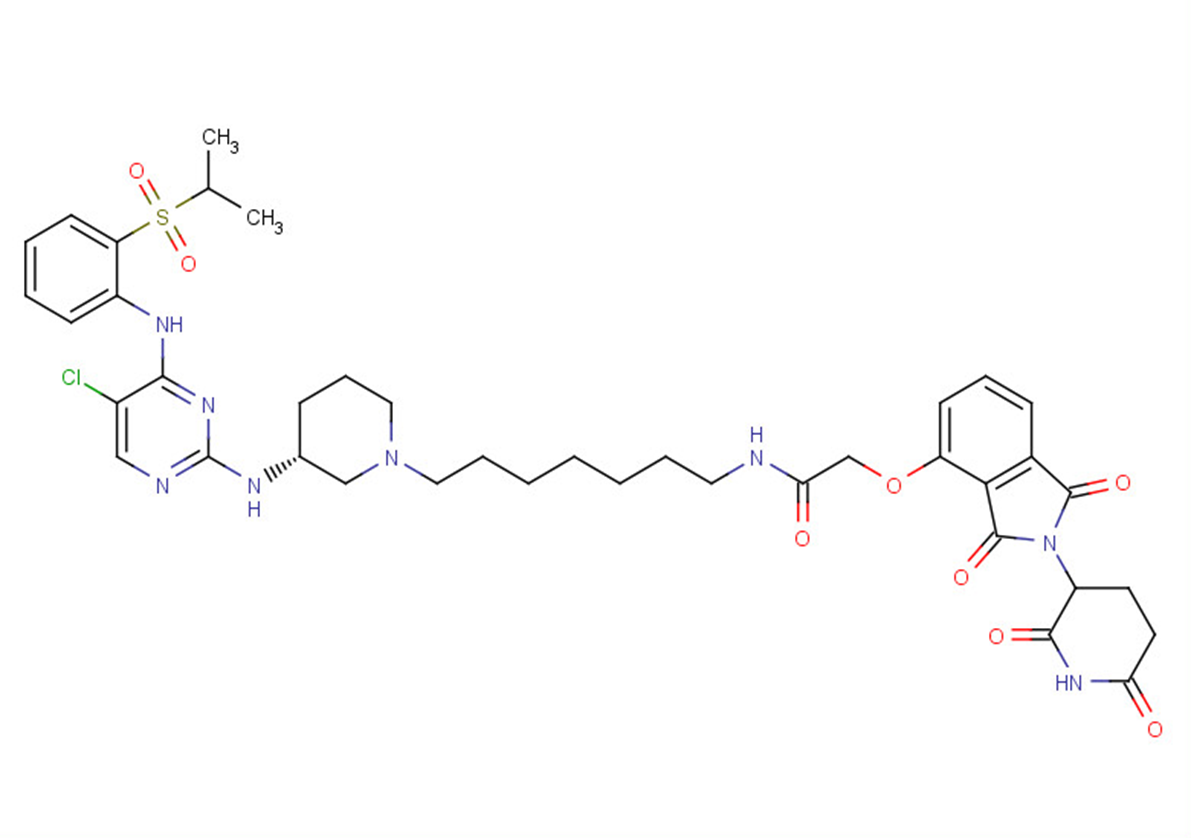
BSJ-4-116
CAS No. 2519823-34-6
BSJ-4-116( —— )
Catalog No. M24142 CAS No. 2519823-34-6
BSJ-4-116 is a highly potent and selective CDK12 degrader (PROTAC) with an IC50 of 6 nM. It downregulates DDR genes through a premature termination of transcription, primarily through increasing poly(adenylation).
Purity : >98% (HPLC)
 COA
Datasheet
HNMR
HPLC
MSDS
Handing Instructions
COA
Datasheet
HNMR
HPLC
MSDS
Handing Instructions
| Size | Price / USD | Stock | Quantity |
| 1 mL x 10 mM in DMSO | 164 | In Stock |


|
| 5MG | 107 | In Stock |
|
| 10MG | 180 | In Stock |
|
| 25MG | 376 | In Stock |
|
| 50MG | 592 | In Stock |
|
| 100MG | 886 | In Stock |
|
| 200MG | Get Quote | In Stock |
|
| 500MG | Get Quote | In Stock |
|
| 1G | Get Quote | In Stock |
|
Biological Information
-
Product NameBSJ-4-116
-
NoteResearch use only, not for human use.
-
Brief DescriptionBSJ-4-116 is a highly potent and selective CDK12 degrader (PROTAC) with an IC50 of 6 nM. It downregulates DDR genes through a premature termination of transcription, primarily through increasing poly(adenylation).
-
DescriptionBSJ-4-116 is a highly potent and selective CDK12 degrader (PROTAC) with an IC50 of 6 nM. It downregulates DDR genes through a premature termination of transcription, primarily through increasing poly(adenylation).
-
In VitroBSJ-4-116 (10-10000 nM; 72 hours) exhibits potent antiproliferative effects in Kelly CDK12C1039F.BSJ-4-116 (50?nM; 6-24?hours) decreases the level of CDK12 protein, regardless of the mutational status of the cell line.BSJ-4-116 inhibits the growth of T-ALL cells (Jurkat and MOLT-4 cells) and sensitizes them to PARP inhibition. BSJ-4-116 regulates DDR genes via poly(adenylation). BSJ-4-116 overcomes CDK12C1039F mutation. BSJ-4-116 represents the first example of resistance to a bivalent degrader molecule that is a consequence of an acquired point mutation in the target protein. Cell Proliferation Assay Cell Line:Parental Kelly and CDK12C1039F cellsConcentration:10-10000 nM Incubation Time:72 hours Result:Antiproliferative activity of BSJ-4-116 is independent of the mutational status, and the degrader compounds exhibited improved GR50 (growth rate inhibition) values in Kelly CDK12C1039F cells compared with the parental cell line.Western Blot Analysis Cell Line:Parental and CDK12C1039F (KellyCDK12CF)-expressing Kelly cells Concentration:50?nM Incubation Time:6-24?hours Result:Led to the same level of CDK12 protein level decrease, regardless of the mutational status of the cell line.
-
In Vivo——
-
Synonyms——
-
PathwayAngiogenesis
-
TargetCDK
-
RecptorCDK12|Cereblon
-
Research Area——
-
Indication——
Chemical Information
-
CAS Number2519823-34-6
-
Formula Weight837.38
-
Molecular FormulaC40H49ClN8O8S
-
Purity>98% (HPLC)
-
SolubilityDMSO:250 mg/mL (298.55 mM; Need ultrasonic)
-
SMILESO=C(NCCCCCCCN1C[C@H](NC2=NC=C(Cl)C(NC3=CC=CC=C3S(=O)(C(C)C)=O)=N2)CCC1)COC4=CC=CC(C(N5C(CC6)C(NC6=O)=O)=O)=C4C5=O
-
Chemical Name——
Shipping & Storage Information
-
Storage(-20℃)
-
ShippingWith Ice Pack
-
Stability≥ 2 years
Reference
1.Jiang B, et al. Discovery and resistance mechanism of a selective CDK12 degrader. Nat Chem Biol. 2021;17(6):675-683.
molnova catalog



related products
-
SU-9516
A selective CDK2 inhibitor with IC50 of 22 nM; shows less potent for CDK1/CDK4(IC50=40/200 nM), no inhibition on PKC, EGFR, p38MAPK; decreases the phosphorylation of pRb, and increases caspase-3 activation.
-
BAY-1251152
(±)-BAY-1251152 is a racemic mixture of BAY-1251152. BAY-1251152 is highly selective inhibitor of PTEF/CDK9.
-
TP-353
TP353 is a CDK7 inhibitor.
