


 Cart
Cart
 sales@molnova.com



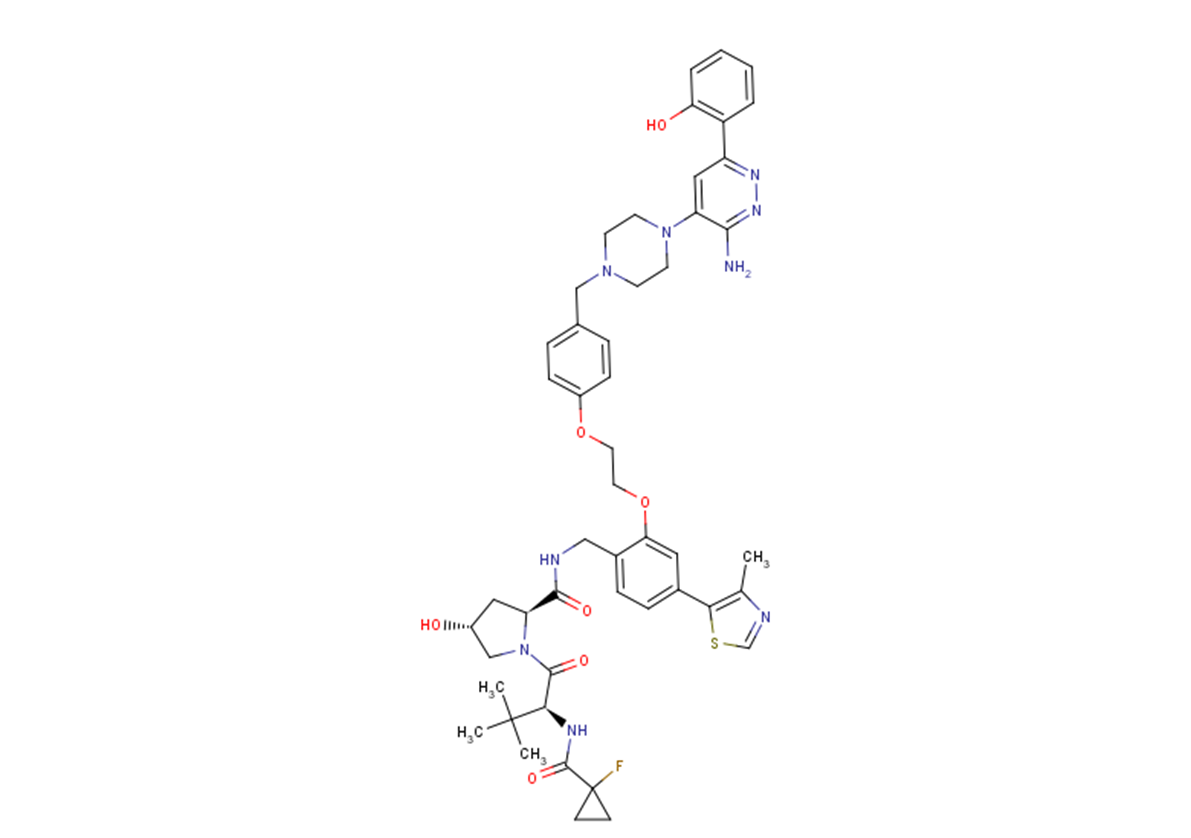
ACBI1
CAS No. 2375564-55-7
ACBI1( —— )
Catalog No. M24091 CAS No. 2375564-55-7
ACBI1 is a potent PROTAC degrader of BAF ATPase subunits SMARCA2 and SMARCA4, also degrades the polybromo-associated BAF (PBAF) complex member PBRM1, with DC50s of 6 nM, 11 nM and 32 nM for SMARCA2, SMARCA4 and PBRM1 in MV-4-11 cells, respectively.
Purity : >98% (HPLC)
 COA
Datasheet
HNMR
HPLC
MSDS
Handing Instructions
COA
Datasheet
HNMR
HPLC
MSDS
Handing Instructions
| Size | Price / USD | Stock | Quantity |
| 5MG | 225 | In Stock |


|
| 10MG | 363 | In Stock |
|
| 25MG | 607 | In Stock |
|
| 50MG | 849 | In Stock |
|
| 100MG | 1144 | In Stock |
|
| 200MG | Get Quote | In Stock |
|
| 500MG | Get Quote | In Stock |
|
| 1G | Get Quote | In Stock |
|
Biological Information
-
Product NameACBI1
-
NoteResearch use only, not for human use.
-
Brief DescriptionACBI1 is a potent PROTAC degrader of BAF ATPase subunits SMARCA2 and SMARCA4, also degrades the polybromo-associated BAF (PBAF) complex member PBRM1, with DC50s of 6 nM, 11 nM and 32 nM for SMARCA2, SMARCA4 and PBRM1 in MV-4-11 cells, respectively.
-
DescriptionACBI1 is a potent PROTAC degrader of BAF ATPase subunits SMARCA2 and SMARCA4, also degrades the polybromo-associated BAF (PBAF) complex member PBRM1, with DC50s of 6 nM, 11 nM and 32 nM for SMARCA2, SMARCA4 and PBRM1 in MV-4-11 cells, respectively. ACBI1 is composed of a bromodomain ligand, a linker, and the E3 ubiquitin ligase VHL. ACBI1 can induce anti-proliferative effects and apoptosis.
-
In VitroACBI1 (1-10000 nM; 3-7 days) shows anti-proliferative activity.ACBI1 (0.3 μM; 100 h) induces apoptosis in SK-MEL-5 cells.ACBI1 is composed of a bromodomain ligand, a linker, and the E3 ubiquitin ligase von Hippel-Lindau. Cell Proliferation Assay Cell Line:MV-4-11, NCI-H1568 cells Concentration:0-1000 nM Incubation Time:3-7 days Result:Showed anti-proliferative activity with IC50 of 29, 68 nM for MV-4-11, NCI-H1568 cells, respectively.Apoptosis Analysis Cell Line:SK-MEL-5 cells Concentration:0.3 μM Incubation Time:100 hResult:Induced apoptosis in SK-MEL-5 cells.
-
In Vivo——
-
Synonyms——
-
PathwayApoptosis
-
TargetApoptosis
-
RecptorApoptosis|Epigenetic Reader Domain|PROTAC
-
Research Area——
-
Indication——
Chemical Information
-
CAS Number2375564-55-7
-
Formula Weight936.1
-
Molecular FormulaC49H58FN9O7S
-
Purity>98% (HPLC)
-
SolubilityDMSO:100 mg/mL (106.83 mM)
-
SMILESCC(N=CS1)=C1C2=CC=C(CNC([C@@H]3C[C@@H](O)CN3C([C@H](C(C)(C)C)NC(C4(CC4)F)=O)=O)=O)C(OCCOC5=CC=C(CN6CCN(C7=CC(C8=C(O)C=CC=C8)=NN=C7N)CC6)C=C5)=C2
-
Chemical Name——
Shipping & Storage Information
-
Storage(-20℃)
-
ShippingWith Ice Pack
-
Stability≥ 2 years
Reference
1.Farnaby W, et al. BAF complex vulnerabilities in cancer demonstrated via structure-based PROTAC design. Nat Chem Biol. 2019 Jul;15(7):672-680.
molnova catalog



related products
-
Ac-DEVD-CHO
Ac-DEVD-CHO is a specific Caspase-3 inhibitor (Ki: 230 pM) with inhibitory effects on SLNT-induced apoptosis.
-
3-Methoxy-9H-Carbazo...
3-methoxy-9H-carbazole is a photosensitizer, a natural compound from Klauseneria heptaphylla and Klauseneria indica.3-methoxy-9H-carbazole has anti-breast cancer activity and induces apoptosis.
-
CP 461
CP 461 (UNII-68OJX9I7DT), a specific PDE2A inhibitor, is a novel pro-apoptotic compound that inhibits cyclic GMP phosphodiesterase but not cyclooxygenase-1 or -2.
