


 Cart
Cart
 sales@molnova.com



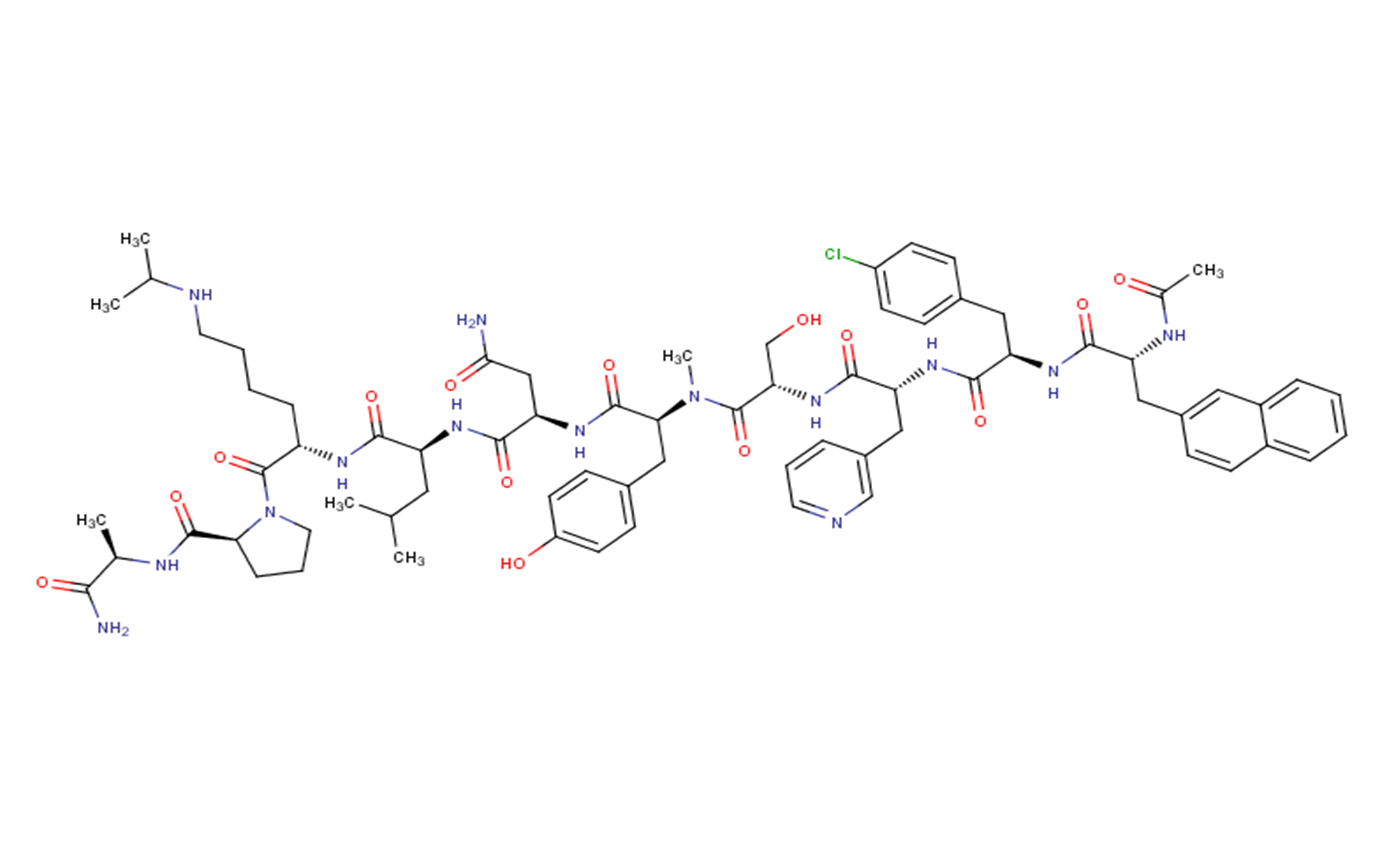
Abarelix
CAS No. 183552-38-7
Abarelix( R3827 | PPI 149 )
Catalog No. M23834 CAS No. 183552-38-7
Abarelix is a potent gonadotrophin-releasing hormone (GnRH) antagonist, which is used for prostate cancer treatment.
Purity : >98% (HPLC)
 COA
Datasheet
HNMR
HPLC
MSDS
Handing Instructions
COA
Datasheet
HNMR
HPLC
MSDS
Handing Instructions
| Size | Price / USD | Stock | Quantity |
| 1 mL x 10 mM in DMSO | 87 | In Stock |


|
| 2MG | 33 | In Stock |
|
| 5MG | 53 | In Stock |
|
| 10MG | 85 | In Stock |
|
| 25MG | 180 | In Stock |
|
| 50MG | 276 | In Stock |
|
| 100MG | 423 | In Stock |
|
| 200MG | Get Quote | In Stock |
|
| 500MG | Get Quote | In Stock |
|
| 1G | Get Quote | In Stock |
|
Biological Information
-
Product NameAbarelix
-
NoteResearch use only, not for human use.
-
Brief DescriptionAbarelix is a potent gonadotrophin-releasing hormone (GnRH) antagonist, which is used for prostate cancer treatment.
-
DescriptionAbarelix is a potent gonadotrophin-releasing hormone (GnRH) antagonist, which is used for prostate cancer treatment.(In Vitro):Abarelix (30 and 300 μg/mL) causes significantly increased histamine release. Abarelix is the first GnRH antagonist to be developed, and can produce rapid and sustained decreases in testosterone to castrate levels without the need for co-administration of an antiandrogen, and with a very low complication rate in the short term. Abarelix demonstrates to promptly and substantially reduce follicle-stimulating hormone levels to lower than LHRH agonist. Abarelix does not cause a surge in serum testosterone that can precipitate a flare phenomenon or worsening of disease, particularly dangerous for patients with metastatic, symptomatic disease, and produces medical castration more quickly.
-
In VitroAbarelix (30 and 300 μg/mL) causes significantly increased histamine release. Abarelix is the firstGnRH antagonist to be developed, and can produce rapid and sustained decreases in testosterone to castrate levels without the need for co-administration of an antiandrogen, and with a very low complication rate in the short term. Abarelix demonstrates to promptly and substantially reduce follicle-stimulating hormone levels to lower than LHRH agonist. Abarelix does not cause a surge in serum testosterone that can precipitate a flare phenomenon or worsening of disease, particularly dangerous for patients with metastatic, symptomatic disease, and produces medical castration more quickly.
-
In Vivo——
-
SynonymsR3827 | PPI 149
-
PathwayOthers
-
TargetOther Targets
-
RecptorGnRHR
-
Research Area——
-
Indication——
Chemical Information
-
CAS Number183552-38-7
-
Formula Weight1416.06
-
Molecular FormulaC72H95ClN14O14
-
Purity>98% (HPLC)
-
SolubilityDMSO:14.2 mg/mL (10.03 mM)
-
SMILESC[C@H](C(=O)N)NC(=O)[C@@H]1CCCN1C(=O)[C@H](CCCCNC(C)C)NC(=O)[C@H](CC(C)C)NC(=O)[C@@H](CC(=O)N)NC(=O)[C@H](CC2=CC=C(C=C2)O)N(C)C(=O)[C@H](CO)NC(=O)[C@@H](CC3=CN=CC=C3)NC(=O)[C@@H](CC4=CC=C(C=C4)Cl)NC(=O)[C@@H](CC5=CC6=CC=CC=C6C=C5)NC(=O)C
-
Chemical Name——
Shipping & Storage Information
-
Storage(-20℃)
-
ShippingWith Ice Pack
-
Stability≥ 2 years
Reference
1.Koechling W, et al. A novel GnRH antagonist, causes minimal histamine release compared with abarelix in an ex vivo model of human skin samples. Br J Clin Pharmacol. 2010 Oct;70(4):580-7.
molnova catalog



related products
-
Aloeresin J
Aloeresin J
-
Tenatumomab
Tenatumomab (ST2146) is a murine anti-tenascin-C monoclonal antibody used in the study of immune system diseases and lymphomas.
-
pTH-Related Protein ...
pTH-Related Protein (1-40) (human, mouse, rat) stimulates calcium uptake in rat intestinal cells through PTHR1 receptor and PKCα/β signaling pathways. pTH-Related Protein (1-40) up-regulates parathyroid hormone 1 receptor (PTHR1) protein, four transcellular calcium transporters, potential vanillin member 6 (TRPV6), calcium-binding protein-D9K (CaBP-D9k), sodium-calcium Exchanger 1 (NCX1) and plasma membrane calcium ATPase 1 (PMCA1).
