


 Cart
Cart
 sales@molnova.com



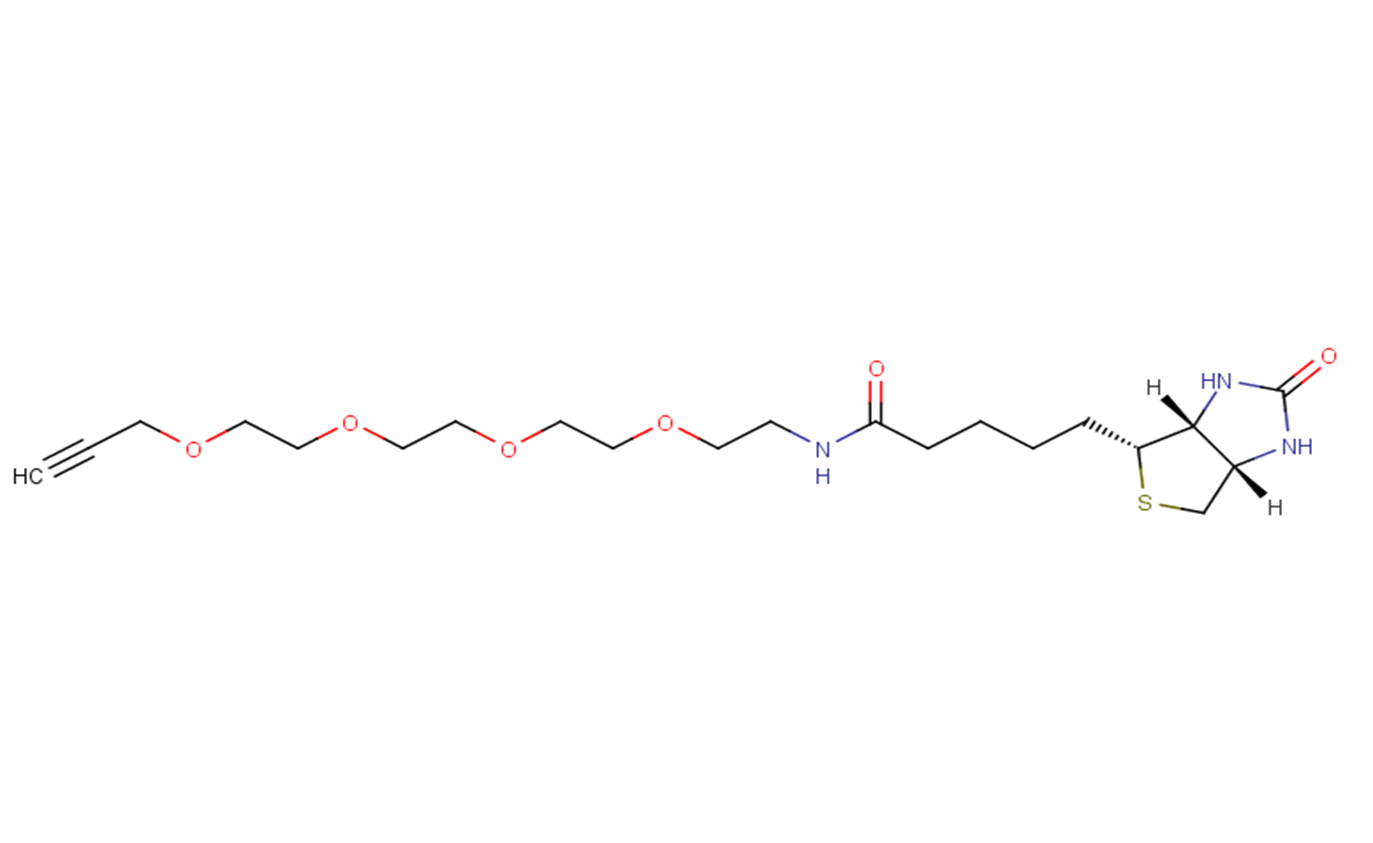
Biotin-PEG4-alkyne
CAS No. 1458576-00-5
Biotin-PEG4-alkyne( —— )
Catalog No. M23621 CAS No. 1458576-00-5
Biotin-PEG4-alkyne is a biotin-labeled, PEG-based PROTAC linker that can be used in the synthesis of PROTACs.
Purity : >98% (HPLC)
 COA
Datasheet
HNMR
HPLC
MSDS
Handing Instructions
COA
Datasheet
HNMR
HPLC
MSDS
Handing Instructions
| Size | Price / USD | Stock | Quantity |
| 1 mL x 10 mM in DMSO | 37 | In Stock |


|
| 10MG | 29 | In Stock |
|
| 25MG | 44 | In Stock |
|
| 50MG | 73 | In Stock |
|
| 100MG | Get Quote | In Stock |
|
| 200MG | Get Quote | In Stock |
|
| 500MG | Get Quote | In Stock |
|
| 1G | Get Quote | In Stock |
|
Biological Information
-
Product NameBiotin-PEG4-alkyne
-
NoteResearch use only, not for human use.
-
Brief DescriptionBiotin-PEG4-alkyne is a biotin-labeled, PEG-based PROTAC linker that can be used in the synthesis of PROTACs.
-
DescriptionBiotin-PEG4-alkyne is a biotin-labeled, PEG-based PROTAC linker that can be used in the synthesis of PROTACs.
-
In Vitro——
-
In Vivo——
-
Synonyms——
-
PathwayPROTACs
-
TargetPROTAC
-
RecptorPEGs
-
Research Area——
-
Indication——
Chemical Information
-
CAS Number1458576-00-5
-
Formula Weight457.58
-
Molecular FormulaC21H35N3O6S
-
Purity>98% (HPLC)
-
SolubilityDMSO:100 mg/mL (218.54 mM; Need ultrasonic)
-
SMILESO=C(NCCOCCOCCOCCOCC#C)CCCC[C@H]1SC[C@@]([C@@]1([H])N2)([H])NC2=O
-
Chemical Name——
Shipping & Storage Information
-
Storage(-20℃)
-
ShippingWith Ice Pack
-
Stability≥ 2 years
Reference
1.Gadd MS, et al. Structural basis of PROTAC cooperative recognition for selective protein degradation. Nat Chem Biol. 2017 May;13(5):514-521.
molnova catalog



related products
-
Fmoc-NH-PEG8-NHS est...
Fmoc-NH-PEG8-NHS ester is a PEG-based PROTAC linker that can be used in the synthesis of PROTACs.
-
MZ1
MZ1 is a?PROTAC that tethers JQ1 to a ligand for the E3 ubiquitin ligase VHL, triggers, induces degradation of the BET bromodomain BRD4.
-
VZ185
VZ185 (VZ-185) is a potent, fast and selective, VHL-based dual degrader probe (PROTAC) of BRD9 and BRD7 with DC50 of 1.8 and 4.5 nM, respectively.
