


 Cart
Cart
 sales@molnova.com



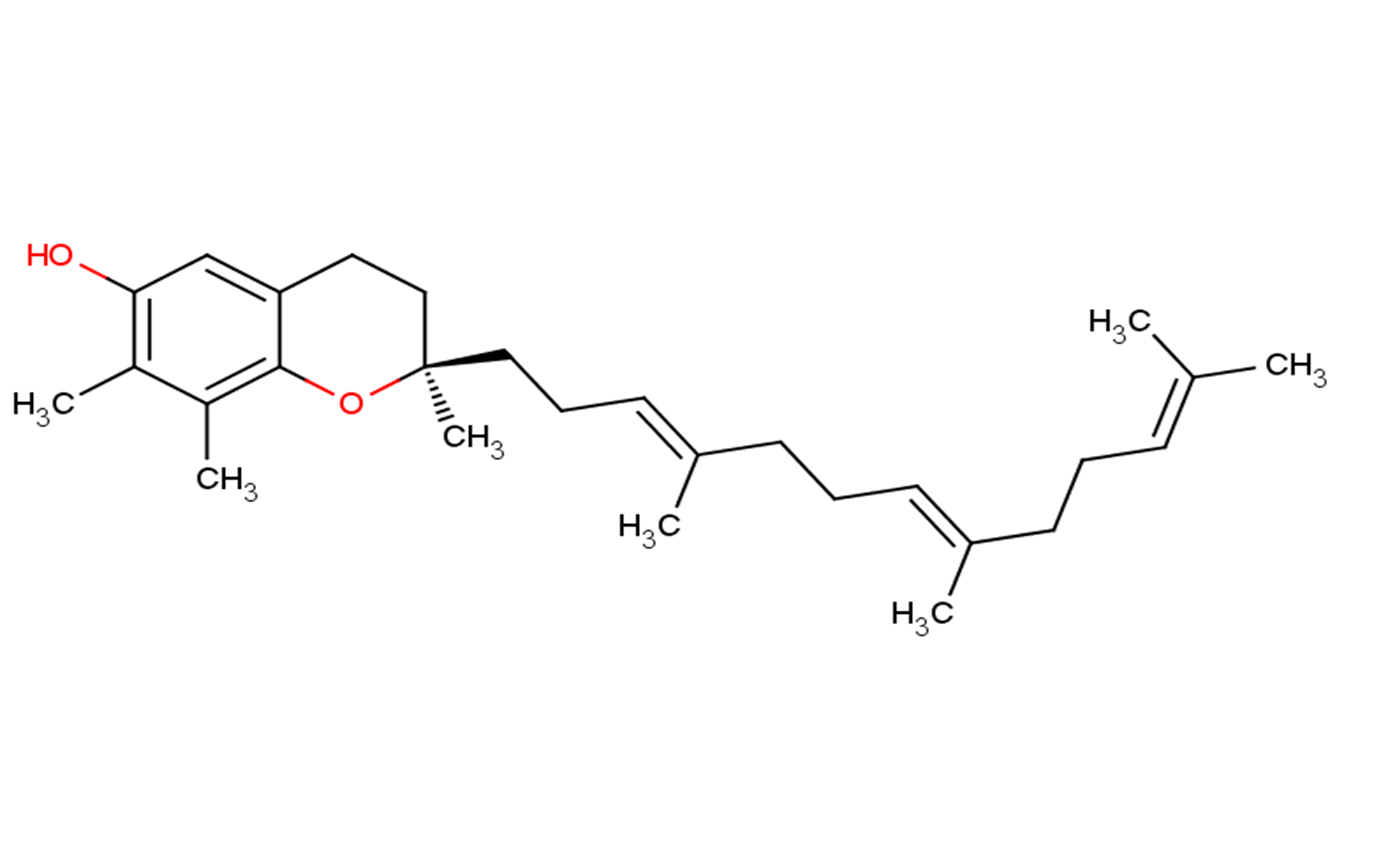
gamma-Tocotrienol
CAS No. 14101-61-2
gamma-Tocotrienol( Plastochromanol | D-gamma-Tocotrienol | gamma-Tocotrienol | gamma Tocotrienol | gammaTocotrienol )
Catalog No. M23566 CAS No. 14101-61-2
gamma-Tocotrienol is one of the four types of tocotrienol, a type of vitamin E. Itl is also a radioprotector, antioxidant.
Purity : >98% (HPLC)
 COA
Datasheet
HNMR
HPLC
MSDS
Handing Instructions
COA
Datasheet
HNMR
HPLC
MSDS
Handing Instructions
| Size | Price / USD | Stock | Quantity |
| 1 mL x 10 mM in DMSO | 93 | In Stock |


|
| 2MG | 53 | In Stock |
|
| 5MG | 88 | In Stock |
|
| 10MG | 140 | In Stock |
|
| 25MG | 236 | In Stock |
|
| 50MG | 343 | In Stock |
|
| 100MG | 505 | In Stock |
|
| 200MG | 728 | In Stock |
|
| 500MG | Get Quote | In Stock |
|
| 1G | Get Quote | In Stock |
|
Biological Information
-
Product Namegamma-Tocotrienol
-
NoteResearch use only, not for human use.
-
Brief Descriptiongamma-Tocotrienol is one of the four types of tocotrienol, a type of vitamin E. Itl is also a radioprotector, antioxidant.
-
Descriptiongamma-Tocotrienol is one of the four types of tocotrienol, a type of vitamin E. Itl is also a radioprotector, antioxidant. It shows antitumor and antihypertensive effects in vivo.
-
In Vitroγ-Tocotrienol (25 μM; 24 h) effectively inhibits the expression levels of mdr1 mRNA and P-gp protein, (25 μM and 50 μM; 24 h) suppresses mdr1 promoter activity and the efflux activity of P-gp as well.γ-Tocotrienol (25 μM and 50 μM; 24 h) reduces the activation of NF-κB signaling pathway and the transcriptional activity of NF-κB.γ-tocotrienol (50 μM; 48 h) effectively inhibits the process of nuclear translocation of p65 which was induced by TNFα. Immunofluorescence Cell Line:MCF-7/Adr cells Concentration:50 μM Incubation Time:48 hours Result:Decreased the red fluorescence of p65 in the nucleus, indicating nuclear translocation inhibiton of p65 induced by TNFα.
-
In Vivoγ-Tocotrienol’s liposomal formulation, GT3-Nano (20 mol% γ-Tocotrienol), (10 mg/kg, 6 mol%; i.v.; single dose, observed for 100 d) is highly effective in mitigating the marrow-suppressive effects of sublethal and lethal TBI in mice. GT3-Nano (50 mg/kg; i.v.; ) can facilitate rapid recovery of hematopoietic components in mice treated with the endoradiotherapeutic agent 153Sm-EDTMP. Animal Model:C57/BL6 mice (6-8 weeks old) treated with the whole-body irradiation Dosage:16, 24, 32, and 50 mg/kg Administration:Intravenous injection; observed mice for 100 days Result:Demonstrated dose-dependent radioprotection, achieving 90% survival at 50 mg/kg against lethal 9-Gy of total-body irradiation (TBI).And upregulated progenitor bone marrow cells MPP2 and CMP in GT3-Nano-treated mice.
-
SynonymsPlastochromanol | D-gamma-Tocotrienol | gamma-Tocotrienol | gamma Tocotrienol | gammaTocotrienol
-
PathwayOthers
-
TargetOther Targets
-
RecptorOthers
-
Research Area——
-
Indication——
Chemical Information
-
CAS Number14101-61-2
-
Formula Weight410.64
-
Molecular FormulaC28H42O2
-
Purity>98% (HPLC)
-
SolubilityDMSO:100 mg/mL (243.53 mM; Need ultrasonic)
-
SMILESOC1=C(C)C(C)=C2C(CC[C@](CC/C=C(C)/CC/C=C(C)/CC/C=C(C)/C)(C)O2)=C1
-
Chemical Name——
Shipping & Storage Information
-
Storage(-20℃)
-
ShippingWith Ice Pack
-
Stability≥ 2 years
Reference
1.Hofer M, Hoferová Z, Falk M. Pharmacological Modulation of Radiation Damage. Does It Exist a Chance for Other Substances than Hematopoietic Growth Factors and Cytokines? Int J Mol Sci. 2017 Jun 28;18(7). pii: E1385. doi: 10.3390/ijms18071385. Review. PubMed PMID: 28657605; PubMed Central PMCID: PMC5535878.
molnova catalog



related products
-
Span-85
Span is a synthetic non-ionic emulsifier, which is prepared by partial esterification of sorbitol or sorbitan with food grade palmitic acid.
-
SH2 Domain Ligand (2...
EPQpYEEIPIYL, a phosphopeptide, is a Src homology 2 (SH2) domain ligand. EPQpYEEIPIYL activates Src family members (e.g. Lck, Hck, Fyn) by binding to SH2 domains.
-
Amyloid Dan Protein ...
Amyloid Dan Protein (1-34) (reduced)
