


 Cart
Cart
 sales@molnova.com



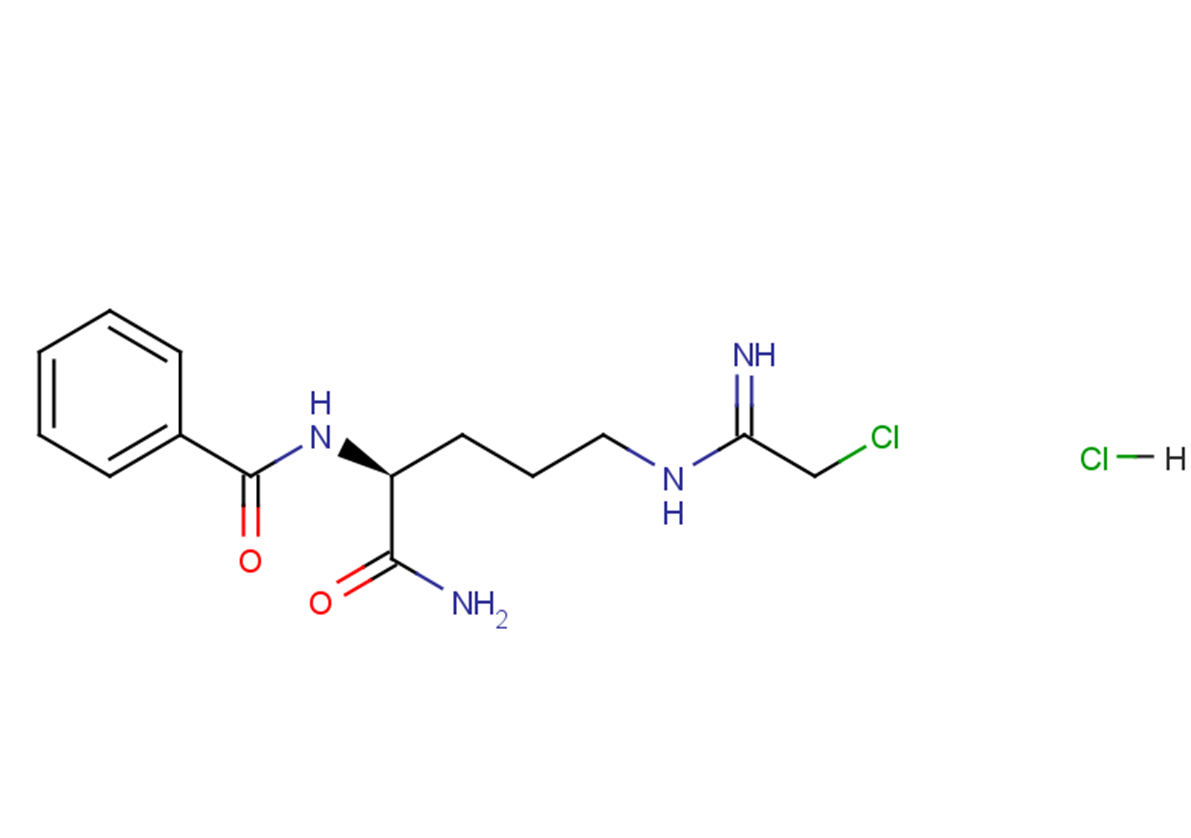
Cl-amidine hydrochloride
CAS No. 1373232-26-8
Cl-amidine hydrochloride( —— )
Catalog No. M23526 CAS No. 1373232-26-8
Cl-amidine hydrochloride is an orally active peptidylarginine deminase (PAD) inhibitor (IC50: 5.9 μM for PAD4).
Purity : >98% (HPLC)
 COA
Datasheet
HNMR
HPLC
MSDS
Handing Instructions
COA
Datasheet
HNMR
HPLC
MSDS
Handing Instructions
| Size | Price / USD | Stock | Quantity |
| 1 mL x 10 mM in DMSO | 93 | In Stock |


|
| 5MG | 85 | In Stock |
|
| 10MG | 140 | In Stock |
|
| 25MG | 275 | In Stock |
|
| 50MG | 436 | In Stock |
|
| 100MG | 631 | In Stock |
|
| 200MG | Get Quote | In Stock |
|
| 500MG | Get Quote | In Stock |
|
| 1G | Get Quote | In Stock |
|
Biological Information
-
Product NameCl-amidine hydrochloride
-
NoteResearch use only, not for human use.
-
Brief DescriptionCl-amidine hydrochloride is an orally active peptidylarginine deminase (PAD) inhibitor (IC50: 5.9 μM for PAD4).
-
DescriptionCl-amidine hydrochloride is an orally active peptidylarginine deminase (PAD) inhibitor (IC50: 5.9 μM for PAD4). Cl-amidine hydrochloride induces apoptosis in cancer cells and it also induces microRNA (miR)-16 in vitro causing cell cycle arrest. Cl-Amidine hydrochloride prevents histone 3 citrullination and neutrophil extracellular trap formation. It improves survival in a murine sepsis model.
-
In VitroApoptosis Analysis.Cell Line:TK6 lymphoblastoid cells and HT29 colon cancer cells. Concentration:0, 5, 10, 15, 20, 25, 50 μg/mL.Incubation Time:24 h.Result:Induced apoptosis dose-dependently.
-
In VivoAnimal Model:C57BL/6 mice (8-12 wk old, DSS mouse model of colitis).Dosage:75 mg/kg.Administration:IP once daily.Result:Suppressed PAD activity, protein citrullination, and PAD levels in the colon in vivo.Animal Model:C57BL/6 mice (8-12 wk old, DSS mouse model of colitis). Dosage:5, 25, 75 mg/kg.Administration:Oral gavage once daily.Result:Led to significant reductions in the histology scores.
-
Synonyms——
-
PathwayApoptosis
-
TargetApoptosis
-
RecptorApoptosis|MicroRNA|PAD4
-
Research Area——
-
Indication——
Chemical Information
-
CAS Number1373232-26-8
-
Formula Weight347.24
-
Molecular FormulaC14H20Cl2N4O2
-
Purity>98% (HPLC)
-
SolubilityH2O:50 mg/mL (143.99 mM; Need ultrasonic);DMSO:19.23 mg/mL (55.38 mM; Need ultrasonic)
-
SMILESO=C(N[C@H](C(N)=O)CCCNC(CCl)=N)C1=CC=CC=C1.[H]Cl
-
Chemical Name——
Shipping & Storage Information
-
Storage(-20℃)
-
ShippingWith Ice Pack
-
Stability≥ 2 years
Reference
1.Yuan Luo, et al. Inhibitors and Inactivators of Protein Arginine Deiminase 4: Functional and Structural Characterization. Biochemistry. 2006 Oct 3; 45(39): 11727–11736.
molnova catalog



related products
-
TMI-1
TMI-1 (WAY-171318), a novel orally active inhibitor of ADAM17 (TACE) and MMP, induces tumor apoptosis in a breast cancer.
-
3,4,5-Trihydroxycinn...
3,4,5-Trihydroxycinnamic acid decyl ester, an effective inhibitor of lipid absorption and accumulation, exhibits anti-obesity properties and acts as a pancreatic lipase inhibitor, with an EC50 of approximately 0.9 μM.
-
DC_AC50
DC_AC50 is a dual inhibitor of Atox1 and CCS (copper chaperones).
