


 Cart
Cart
 sales@molnova.com



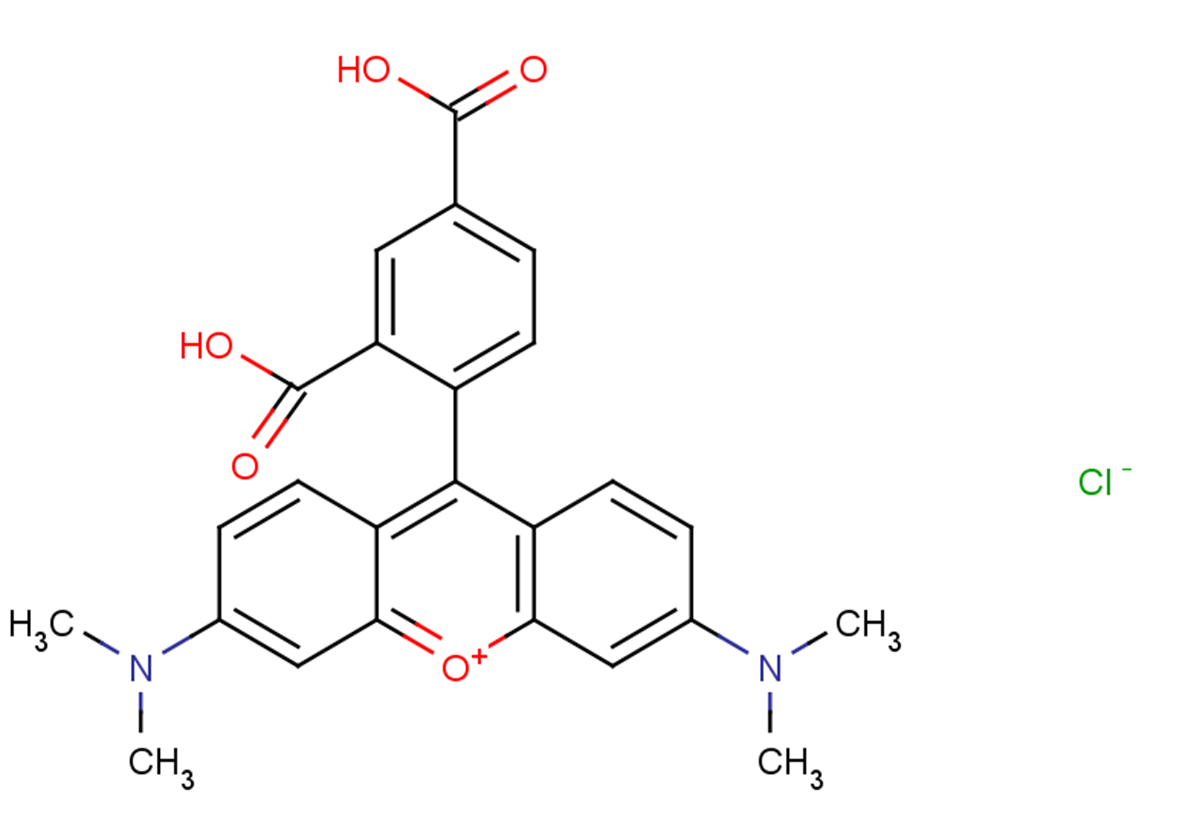
5-TAMRA chloride(91809-66-4 free base)
CAS No. 125481-77-8
5-TAMRA chloride(91809-66-4 free base)( —— )
Catalog No. M23425 CAS No. 125481-77-8
5-TAMRA can produce bright, pH insensitive orange fluorescence (Ex/ Em= 546 / 579nm), and has good photostability
Purity : >98% (HPLC)
 COA
Datasheet
HNMR
HPLC
MSDS
Handing Instructions
COA
Datasheet
HNMR
HPLC
MSDS
Handing Instructions
| Size | Price / USD | Stock | Quantity |
| 1 mL x 10 mM in DMSO | 183 | In Stock |


|
| 5MG | 172 | In Stock |
|
| 10MG | 258 | In Stock |
|
| 25MG | 377 | In Stock |
|
| 50MG | 569 | In Stock |
|
| 100MG | 764 | In Stock |
|
| 200MG | 1004 | In Stock |
|
| 500MG | Get Quote | In Stock |
|
| 1G | Get Quote | In Stock |
|
Biological Information
-
Product Name5-TAMRA chloride(91809-66-4 free base)
-
NoteResearch use only, not for human use.
-
Brief Description5-TAMRA can produce bright, pH insensitive orange fluorescence (Ex/ Em= 546 / 579nm), and has good photostability
-
Description5-TAMRA can produce bright, pH insensitive orange fluorescence (Ex/ Em= 546 / 579nm), and has good photostability
-
In Vitro——
-
In Vivo——
-
Synonyms——
-
PathwayOthers
-
TargetOther Targets
-
RecptorOthers
-
Research Area——
-
Indication——
Chemical Information
-
CAS Number125481-77-8
-
Formula Weight466.91
-
Molecular FormulaC25H23ClN2O5
-
Purity>98% (HPLC)
-
Solubility——
-
SMILESCN(C1=CC2=[O+]C3=C(C=CC(N(C)C)=C3)C(C4=CC=C(C(O)=O)C=C4C(O)=O)=C2C=C1)C.[Cl-]
-
Chemical Name——
Shipping & Storage Information
-
Storage(-20℃)
-
ShippingWith Ice Pack
-
Stability≥ 2 years
Reference
1.Differently fluorescence-labelled dibenzodiazepinone-type muscarinic acetylcholine receptor ligands with high M2R affinity[J]. RSC Medicinal Chemistry, 2020, 11.
molnova catalog



related products
-
Polybia-MP1
Polybia-MP1 is an antimicrobial mastoparan peptide.
-
Maltononaose
Maltononaose is a linear oligosaccharide consisting of 9 glucose units linked by alpha-1, 4-glucoside bonds. Maltononaose is used as a substrate to study the subsites affinity of glucoamylase. Maltononaose can be used to determine the activity of amylase and to optimize the process of starch hydrolysis.
-
14-Episinomenine
14-Episinomenine is an alkaloid that can be isolated from Stephania cepharantha.
