


 Cart
Cart
 sales@molnova.com



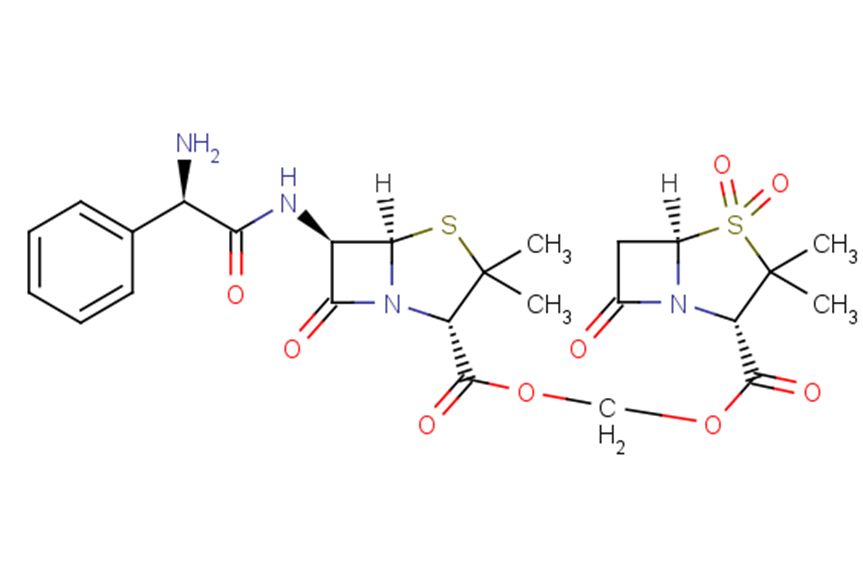
Sultamicillin
CAS No. 76497-13-7
Sultamicillin( —— )
Catalog No. M22710 CAS No. 76497-13-7
Sultamicillin is an orally active double prodrug of Ampicillin/Sulbactan. Sulbactam is a semisynthetic β-Lactamase inhibitor.
Purity : >98% (HPLC)
 COA
Datasheet
HNMR
HPLC
MSDS
Handing Instructions
COA
Datasheet
HNMR
HPLC
MSDS
Handing Instructions
| Size | Price / USD | Stock | Quantity |
| 1 mL x 10 mM in DMSO | 28 | In Stock |


|
| 25MG | 31 | In Stock |
|
| 50MG | 49 | In Stock |
|
| 100MG | 77 | In Stock |
|
| 200MG | 113 | In Stock |
|
| 500MG | Get Quote | In Stock |
|
| 1G | Get Quote | In Stock |
|
Biological Information
-
Product NameSultamicillin
-
NoteResearch use only, not for human use.
-
Brief DescriptionSultamicillin is an orally active double prodrug of Ampicillin/Sulbactan. Sulbactam is a semisynthetic β-Lactamase inhibitor.
-
DescriptionSultamicillin is an orally active double prodrug of Ampicillin/Sulbactan. Sulbactam is a semisynthetic β-Lactamase inhibitor.
-
In Vitro——
-
In Vivo——
-
Synonyms——
-
PathwayGPCR/G Protein
-
TargetAntibacterial
-
Recptorβ-Lactamase
-
Research Area——
-
Indication——
Chemical Information
-
CAS Number76497-13-7
-
Formula Weight594.66
-
Molecular FormulaC25H30N4O9S2
-
Purity>98% (HPLC)
-
SolubilityIn Vitro:?DMSO : 100 mg/mL (168.16 mM)
-
SMILES[H][C@]12SC(C)(C)[C@@H](N1C(=O)[C@H]2NC(=O)[C@H](N)c1ccccc1)C(=O)OCOC(=O)[C@@H]1N2C(=O)C[C@@]2([H])S(=O)(=O)C1(C)C
-
Chemical Name——
Shipping & Storage Information
-
Storage(-20℃)
-
ShippingWith Ice Pack
-
Stability≥ 2 years
Reference
1.Friedel HA, et al. Sultamicillin. A review of its antibacterial activity, pharmacokinetic properties and therapeutic use. Drugs. 1989 Apr;37(4):491-522.
molnova catalog



related products
-
Rifamycin S
Rifamycin S is a potent DNA-dependent RNA polymerase inhibitoris a quinone and an antibiotic agnet against Gram-positive bacteria.
-
Ridinilazole
Ridinilazole is a novel narrow-spectrum nonabsorbable antibiotic.
-
6-Ethoxychelerythrin...
6-Ethoxychelerythrine has anti-bacterial activity it exhibited strong activity against Aspergillus fumigatus and methicillin-resistant Staphylococcus aureus (MRSA).
