


 Cart
Cart
 sales@molnova.com



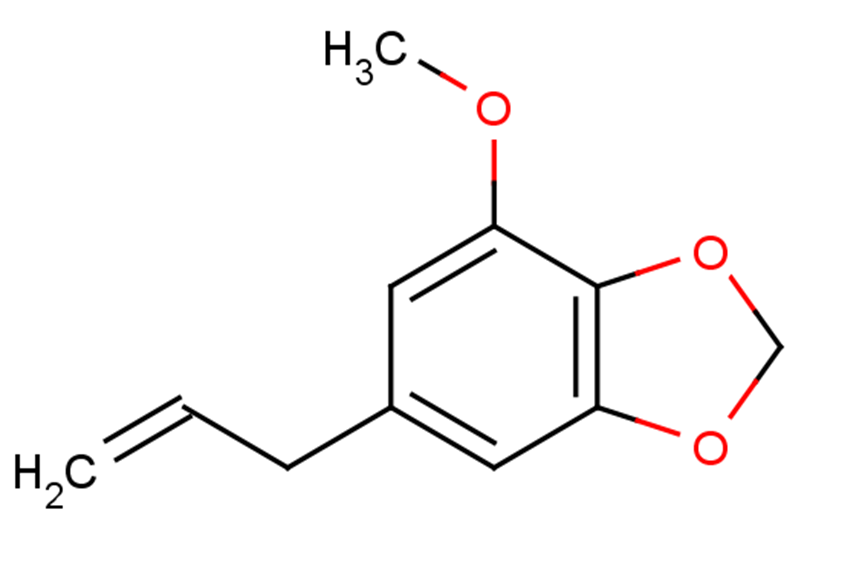
Myristicin
CAS No. 607-91-0
Myristicin( Myristicine )
Catalog No. M22625 CAS No. 607-91-0
Myristicin is a natural product found in spices and umbelliferous plants. Myristicin has anti-cholinergic, antibacterial, and hepatoprotective effects, it also has anti-inflammatory properties related with its inhibition of NO, cytokines,chemokines, and growth factors in dsRNA-stimulated macrophages via the calcium pathway.
Purity : >98% (HPLC)
 COA
Datasheet
HNMR
HPLC
MSDS
Handing Instructions
COA
Datasheet
HNMR
HPLC
MSDS
Handing Instructions
| Size | Price / USD | Stock | Quantity |
| 5MG | 65 | In Stock |


|
| 10MG | 87 | In Stock |
|
| 25MG | 146 | In Stock |
|
| 50MG | 214 | In Stock |
|
| 100MG | 322 | In Stock |
|
| 200MG | Get Quote | In Stock |
|
| 500MG | Get Quote | In Stock |
|
| 1G | Get Quote | In Stock |
|
Biological Information
-
Product NameMyristicin
-
NoteResearch use only, not for human use.
-
Brief DescriptionMyristicin is a natural product found in spices and umbelliferous plants. Myristicin has anti-cholinergic, antibacterial, and hepatoprotective effects, it also has anti-inflammatory properties related with its inhibition of NO, cytokines,chemokines, and growth factors in dsRNA-stimulated macrophages via the calcium pathway.
-
DescriptionMyristicin is a natural product found in spices and umbelliferous plants. Myristicin has anti-cholinergic, antibacterial, and hepatoprotective effects, it also has anti-inflammatory properties related with its inhibition of NO, cytokines,chemokines, and growth factors in dsRNA-stimulated macrophages via the calcium pathway. Myristicin may antagonize the anxiolytic effects of midazolam, increase anxiety, and affect motor movements. Myristicin can induce apoptosis as characterised by alterations in the mitochondrial membrane potential, cytochrome c release, caspase-3 activation, PARP-cleavage and DNA fragmentation. Myristicin (1-allyl-5-methoxy-3,4-methylenedioxybenzene) is an active aromatic compound found in nutmeg (the seed of Myristica fragrans), carrot, basil,cinnamon, and parsley. Myristicin has been known to have anti-cholinergic, antibacterial,and hepatoprotective effects, however, the effects of Myristicin on virus-stimulated macrophages are not fully reported. METHODS AND RESULTS:In this study, the anti-inflammatory effect of Myristicin on double-stranded RNA (dsRNA)-stimulated macrophages was examined. Myristicin did not reduce the cell viability of RAW 264.7 mouse macrophages at concentrations of up to 50 μM. Myristicin significantly inhibited the production of calcium, nitric oxide (NO),interleukin (IL)-6, IL-10, interferon inducible protein-10, monocyte chemotactic protein(MCP)-1, MCP-3, granulocyte-macrophage colony-stimulating factor, macrophage inflammatory protein (MIP)-1α, MIP-1β, and leukemia inhibitory factor in dsRNA[polyinosinic-polycytidylic acid]-induced RAW 264.7 cells (P < 0.05). CONCLUSIONS:In conclusion,Myristicin has anti-inflammatory properties related with its inhibition of NO, cytokines,chemokines, and growth factors in dsRNA-stimulated macrophages via the calcium pathway.
-
In VitroWestern Blot Analysis Cell Line:Human gastric cancer cells Concentration:7.8125, 15.625, and 31.25 μM Incubation Time:48 h Result:Significantly decreased expression of cyclins, increased Bax expression.
-
In VivoAnimal Model:Experimental colitis model in mice Dosage:200 mg/kg Administration: po; single dose, 6 h before Rectal AA (colitis inducer) instillation Result: Reduced cellular oxidative stress induced by AA, and relieved the histopathological colonic damage, alleviated inflammation in the AA-induced colitis.
-
SynonymsMyristicine
-
PathwayMicrobiology/Virology
-
TargetAntifection
-
RecptorAntifection|Bcl-2|Caspase|CYP17|GABA Receptor|IL Receptor|NO|PARP
-
Research Area——
-
Indication——
Chemical Information
-
CAS Number607-91-0
-
Formula Weight192.21
-
Molecular FormulaC11H12O3
-
Purity>98% (HPLC)
-
SolubilityIn Vitro:?DMSO : 100 mg/mL (520.26 mM)
-
SMILESCOc1cc(CC=C)cc2OCOc12
-
Chemical Name——
Shipping & Storage Information
-
Storage(-20℃)
-
ShippingWith Ice Pack
-
Stability≥ 2 years
Reference
1. Anti-inflammatory effect of myristicin on RAW 264.7 macrophages stimulated with polyinosinic-polycytidylic acid. Molecules. 2011;16(8):7132-42.
molnova catalog



related products
-
Piperlonguminine
Piperlonguminine is an alkaloid amide isolated from the Piper species.?Piperlonguminine shows anti-inflammatory, antitumor, neuroprotective, anti-platelet, anti-melanogenic, antifungal and antibacterial activities.Piperlonguminine is an inhibitor of Akt/mTOR signalling.
-
Prunin
Prunin possesses anti-diabetic, and anti-abacterial properties, it can inhibit protein tyrosine phosphatase 1B (PTP1B) and stimulate glucose uptake in insulin-resistant HepG2 cells; it also can stimulate growth of Pseudomonas aeruginosa and different Bacilllus sp.
-
Kamebanin
Kamebanin, a natural diterpenoid, has antibacterial activity. It shows efficient cytotoxic activity against HeLa and HL-60 cells.
