


 Cart
Cart
 sales@molnova.com



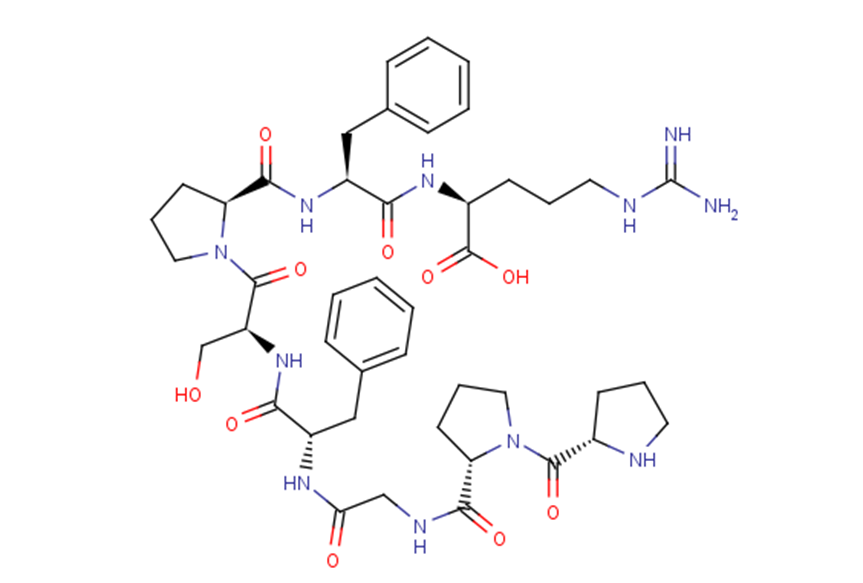
Bradykinin (2-9)
CAS No. 16875-11-9
Bradykinin (2-9)( Des-Arg1-bradykinin )
Catalog No. M22301 CAS No. 16875-11-9
Bradykinin (2-9) is a metabolite of Bradykinin, cleaved by Aminopeptidase P. Bradykinin (2-9) is an amino-truncated Bradykinin peptide.
Purity : >98% (HPLC)
 COA
Datasheet
HNMR
HPLC
MSDS
Handing Instructions
COA
Datasheet
HNMR
HPLC
MSDS
Handing Instructions
| Size | Price / USD | Stock | Quantity |
| 1 mL x 10 mM in DMSO | 147 | In Stock |


|
| 5MG | 81 | In Stock |
|
| 10MG | 132 | In Stock |
|
| 25MG | 221 | In Stock |
|
| 50MG | 323 | In Stock |
|
| 100MG | 479 | In Stock |
|
| 200MG | 682 | In Stock |
|
| 500MG | Get Quote | In Stock |
|
| 1G | Get Quote | In Stock |
|
Biological Information
-
Product NameBradykinin (2-9)
-
NoteResearch use only, not for human use.
-
Brief DescriptionBradykinin (2-9) is a metabolite of Bradykinin, cleaved by Aminopeptidase P. Bradykinin (2-9) is an amino-truncated Bradykinin peptide.
-
DescriptionBradykinin (2-9) is a metabolite of Bradykinin, cleaved by Aminopeptidase P. Bradykinin (2-9) is an amino-truncated Bradykinin peptide. The Bradykinin peptide system is a tissue-based system with potent cardiovascular and renal effects. To investigate the regulation of this system, a highly sensitive amino terminal-directed radioimmunoassay that, with high performance liquid chromatography, enables the measurement of Bradykinin-(1-7), Bradykinin-(1-8), and Bradykinin-(1-9), is developed. Together with a carboxy terminal-directed radioimmunoassay, Bradykinin peptides in rat kidney and blood are characterized. The predominant Bradykinin peptides in kidney are Bradykinin-(1-9) (~100 fmol/g wet weight of tissue) and Bradykinin-(1-7) (~70 fmol/g), with low levels of Bradykinin-(1-8) (~8 fmol/g) and Bradykinin-(4-9) (~12 fmol/g) detectable; Bradykinin-(2-9) and Bradykinin-(3-9) are below the limits of detection. In blood, the levels of Bradykinin-(1-9) are very low (~2 fmol/ml), and other Bradykinin peptides are below the limits ofdetection. Administration of the angiotensin converting enzyme (ACE) inhibitor Perindopril is associated with an approximate twofold increase in renal levels of Bradykinin-(1-8) and Bradykinin-(1-9) and a decrease in the Bradykinin-(1-7)/Bradykinin-(1-9) ratio. The amino terminal-directed radioimmunoassay is also applied to heart, aorta, brown adipose tissue, adrenal, lung, and brain. For these tissues, Bradykinin-(1-7) and Bradykinin-(1-9) are of similar abundance (16-340 fmol/g), with lower levels of Bradykinin-(1-8).
-
In VitroThe Bradykinin peptide system is a tissue-based system with potent cardiovascular and renal effects. To investigate the regulation of this system, a highly sensitive amino terminal-directed radioimmunoassay that, with high performance liquid chromatography, enables the measurement of Bradykinin-(1-7), Bradykinin-(1-8), and Bradykinin-(1-9), is developed. Together with a carboxy terminal-directed radioimmunoassay, Bradykinin peptides in rat kidney and blood are characterized. The predominant Bradykinin peptides in kidney are Bradykinin-(1-9) (~100 fmol/g wet weight of tissue) and Bradykinin-(1-7) (~70 fmol/g), with low levels of Bradykinin-(1-8) (~8 fmol/g) and Bradykinin-(4-9) (~12 fmol/g) detectable; Bradykinin-(2-9) and Bradykinin-(3-9) are below the limits of detection. In blood, the levels of Bradykinin-(1-9) are very low (~2 fmol/ml), and other Bradykinin peptides are below the limits ofdetection. Administration of the angiotensin converting enzyme (ACE) inhibitor Perindopril is associated with an approximate twofold increase in renal levels of Bradykinin-(1-8) and Bradykinin-(1-9) and a decrease in the Bradykinin-(1-7)/Bradykinin-(1-9) ratio. The amino terminal-directed radioimmunoassay is also applied to heart, aorta, brown adipose tissue, adrenal, lung, and brain. For these tissues, Bradykinin-(1-7) and Bradykinin-(1-9) are of similar abundance (16-340 fmol/g), with lower levels of Bradykinin-(1-8).
-
In Vivo——
-
SynonymsDes-Arg1-bradykinin
-
PathwayGPCR/G Protein
-
TargetBradykinin Receptor
-
RecptorBradykinin Receptor
-
Research Area——
-
Indication——
Chemical Information
-
CAS Number16875-11-9
-
Formula Weight904.02
-
Molecular FormulaC44H61N11O10
-
Purity>98% (HPLC)
-
SolubilityIn Vitro:?DMSO : 100 mg/mL (110.62 mM)
-
SMILESNC(=N)NCCC[C@H](NC(=O)[C@H](Cc1ccccc1)NC(=O)[C@@H]1CCCN1C(=O)[C@H](CO)NC(=O)[C@H](Cc1ccccc1)NC(=O)CNC(=O)[C@@H]1CCCN1C(=O)[C@@H]1CCCN1)C(O)=O
-
Chemical Name——
Shipping & Storage Information
-
Storage(-20℃)
-
ShippingWith Ice Pack
-
Stability≥ 2 years
Reference
1.Campbell DJ, et al. Bradykinin peptides in kidney, blood, and other tissues of the rat. Hypertension. 1993 Feb;21(2):155-65.
molnova catalog



related products
-
Bradykinin (1-6)
Bradykinin (1-6) is an amino-truncated Bradykinin peptide. Bradykinin (1-6) is a stable metabolite of Bradykinin, cleaved by carboxypeptidase Y (CPY).Bradykinin (1-6) is a fragment of bradykinin. Bradykinin activates pain receptors. It induces smooth muscle contractions and activates Ca2+-dependent nitric oxide synthetase.
-
[Des-Arg9]-Bradykini...
[Des-Arg9]-Bradykinin is a Bradykinin (B1) receptor agonist that displays selectivity for B1 over B2 receptors.
-
Bombinakinin M
Potent bradykinin receptor agonist. Highly selective for mammalian arterial smooth muscle bradykinin receptors, displaying ~ 50-fold greater potency than bradykinin. Elicits dose-dependent contractile effects in smooth muscle of guinea pig ileum (EC50 = 4.0 nM).
