


 Cart
Cart
 sales@molnova.com



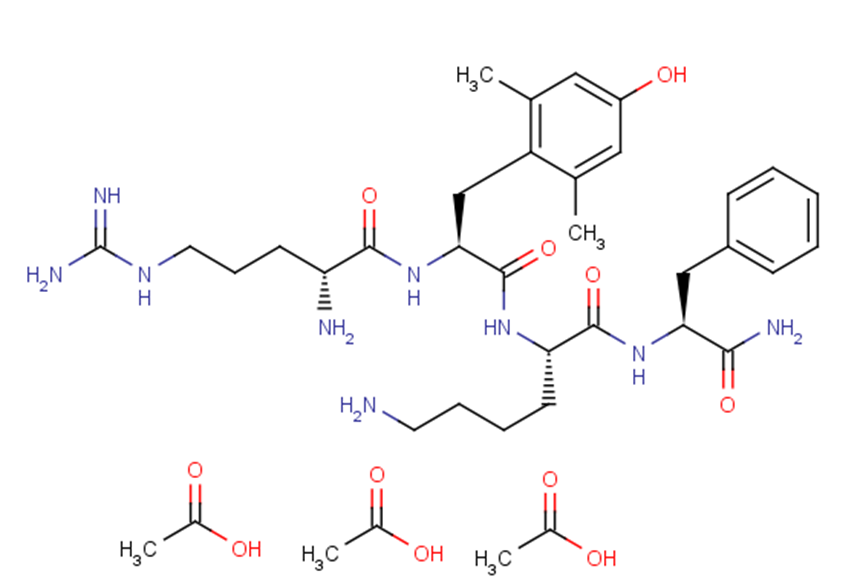
Elamipretide Triacetate
CAS No. 1849610-71-4
Elamipretide Triacetate( —— )
Catalog No. M22278 CAS No. 1849610-71-4
Elamipretide Triacetate is an aromatic-cationic tetrapeptide that readily penetrates cell membranes and transiently localizes to the inner mitochondrial membrane where it associates with cardiolipin.
Purity : >98% (HPLC)
 COA
Datasheet
HNMR
HPLC
MSDS
Handing Instructions
COA
Datasheet
HNMR
HPLC
MSDS
Handing Instructions
| Size | Price / USD | Stock | Quantity |
| 2MG | 178 | In Stock |


|
| 5MG | 267 | In Stock |
|
| 10MG | 408 | In Stock |
|
| 25MG | 672 | In Stock |
|
| 50MG | 945 | In Stock |
|
| 100MG | 1278 | In Stock |
|
| 200MG | Get Quote | In Stock |
|
| 500MG | Get Quote | In Stock |
|
| 1G | Get Quote | In Stock |
|
Biological Information
-
Product NameElamipretide Triacetate
-
NoteResearch use only, not for human use.
-
Brief DescriptionElamipretide Triacetate is an aromatic-cationic tetrapeptide that readily penetrates cell membranes and transiently localizes to the inner mitochondrial membrane where it associates with cardiolipin.
-
DescriptionElamipretide Triacetate is an aromatic-cationic tetrapeptide that readily penetrates cell membranes and transiently localizes to the inner mitochondrial membrane where it associates with cardiolipin.It has been used in trials studying the treatment of Leber's Hereditary Optic Neuropathy.
-
In Vitro——
-
In Vivo——
-
Synonyms——
-
PathwayOthers
-
TargetOther Targets
-
RecptorOthers
-
Research Area——
-
Indication——
Chemical Information
-
CAS Number1849610-71-4
-
Formula Weight819.94
-
Molecular FormulaC38H61N9O11
-
Purity>98% (HPLC)
-
Solubility——
-
SMILES——
-
Chemical Name——
Shipping & Storage Information
-
Storage(-20℃)
-
ShippingWith Ice Pack
-
Stability≥ 2 years
Reference
1. Chatfield K C , Sparagna G C , Chau S , et al. Elamipretide Improves Mitochondrial Function in the Failing Human Heart[J]. JACC: Basic to Translational ence, 2019, 4( 2):147-157.
molnova catalog



related products
-
BL-1020 Mesylate
BL-1020 Mesylate (CYP-1020 Mesylate) is an orally available GABA A receptor agonist and D2 antagonist that decreases dopamine activity and enhances GABAA activity.
-
N-Acetyl-L-leucine
N-Acetylleucine belongs to the class of organic compounds known as leucine and derivatives.
-
Nitisinone
Nitisinone(SC0735) is an inhibitor of the enzyme 4-hydroxyphenylpyruvate dioxygenase.
