


 Cart
Cart
 sales@molnova.com



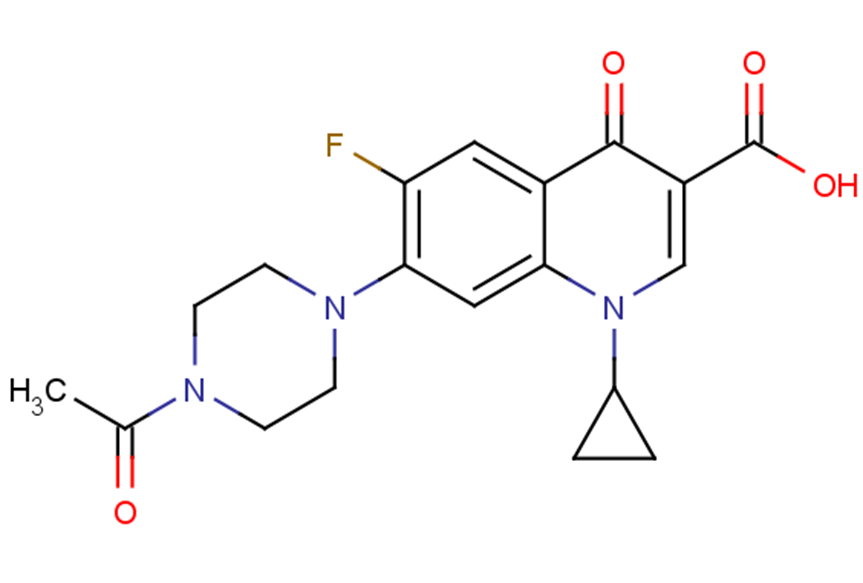
n-acetylciprofloxacin
CAS No. 93594-20-8
n-acetylciprofloxacin( 3-Quinolinecarboxylic acid, 7-(4-acetyl-1-piperazinyl)-1-cyclopropyl-6-fluoro-1 )
Catalog No. M22249 CAS No. 93594-20-8
n-acetylciprofloxacin is inhibitor of H37Rv.
Purity : >98% (HPLC)
 COA
Datasheet
HNMR
HPLC
MSDS
Handing Instructions
COA
Datasheet
HNMR
HPLC
MSDS
Handing Instructions
| Size | Price / USD | Stock | Quantity |
| 1 mL x 10 mM in DMSO | 187 | In Stock |


|
| 5MG | 170 | In Stock |
|
| 10MG | 258 | In Stock |
|
| 25MG | 426 | In Stock |
|
| 50MG | 586 | In Stock |
|
| 100MG | 792 | In Stock |
|
| 200MG | 1051 | In Stock |
|
| 500MG | Get Quote | In Stock |
|
| 1G | Get Quote | In Stock |
|
Biological Information
-
Product Namen-acetylciprofloxacin
-
NoteResearch use only, not for human use.
-
Brief Descriptionn-acetylciprofloxacin is inhibitor of H37Rv.
-
Descriptionn-acetylciprofloxacin is inhibitor of H37Rv.
-
In Vitro——
-
In Vivo——
-
Synonyms3-Quinolinecarboxylic acid, 7-(4-acetyl-1-piperazinyl)-1-cyclopropyl-6-fluoro-1
-
PathwayOthers
-
TargetOther Targets
-
RecptorH37Rv
-
Research Area——
-
Indication——
Chemical Information
-
CAS Number93594-20-8
-
Formula Weight373.38
-
Molecular FormulaC19H20FN3O4
-
Purity>98% (HPLC)
-
Solubility——
-
SMILESCC(=O)N1CCN(CC1)c3cc2n(cc(C(=O)O)c(=O)c2cc3[F])C4([H])CC4
-
Chemical Name——
Shipping & Storage Information
-
Storage(-20℃)
-
ShippingWith Ice Pack
-
Stability≥ 2 years
Reference
molnova catalog



related products
-
Chymase-IN-1
Chymase-IN-1 is a selective, orally active inhibitor of human mast cell chymase (IC50: 29 nM).
-
Cecropin B (free aci...
Cecropin B (free acid) is a polypeptide that can be found by peptide screening. Peptide screening is a research tool that pools active peptides primarily by immunoassay. Peptide screening can be used for protein interaction, functional analysis, epitope screening, especially in the field of agent research and development.
-
Allicin
Allicin exerts antioxidant, bactericidal, anti-cancer, anti-inflammatory activities, it exerts an inhibitory immunomodulatory effect on intestinal epithelial cells.
