


 Cart
Cart
 sales@molnova.com



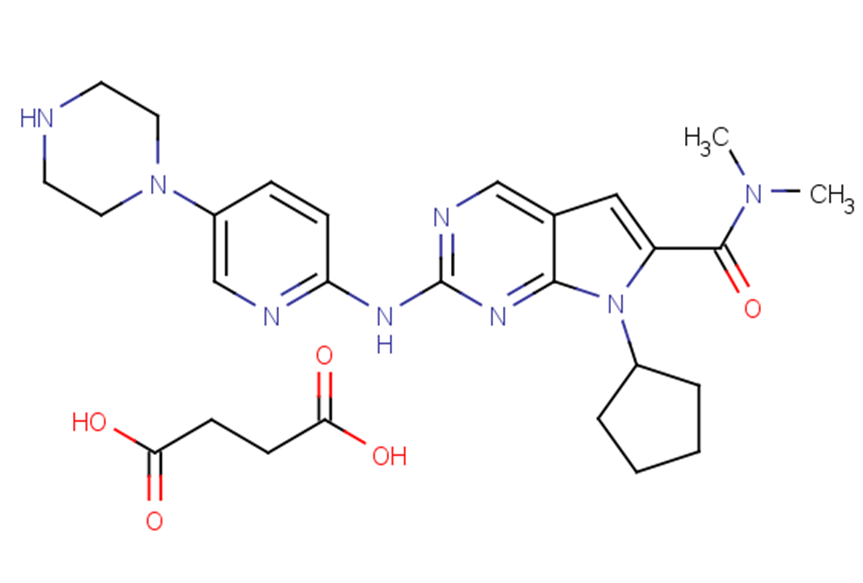
Ribociclib succinate
CAS No. 1374639-75-4
Ribociclib succinate( LEE011 succinate )
Catalog No. M22128 CAS No. 1374639-75-4
Ribociclib succinate is a highly specific CDK4/6 inhibitor (IC50: 10 nM and 39 nM, respectively). It also is over 1,000-fold less potent against the cyclin B/CDK1 complex.
Purity : >98% (HPLC)
 COA
Datasheet
HNMR
HPLC
MSDS
Handing Instructions
COA
Datasheet
HNMR
HPLC
MSDS
Handing Instructions
| Size | Price / USD | Stock | Quantity |
| 1 mL x 10 mM in DMSO | 55 | In Stock |


|
| 2MG | 29 | In Stock |
|
| 5MG | 45 | In Stock |
|
| 10MG | 64 | In Stock |
|
| 25MG | 93 | In Stock |
|
| 50MG | 109 | In Stock |
|
| 100MG | 165 | In Stock |
|
| 200MG | 266 | In Stock |
|
| 500MG | 473 | In Stock |
|
| 1G | Get Quote | In Stock |
|
Biological Information
-
Product NameRibociclib succinate
-
NoteResearch use only, not for human use.
-
Brief DescriptionRibociclib succinate is a highly specific CDK4/6 inhibitor (IC50: 10 nM and 39 nM, respectively). It also is over 1,000-fold less potent against the cyclin B/CDK1 complex.
-
DescriptionRibociclib succinate is a highly specific CDK4/6 inhibitor (IC50: 10 nM and 39 nM, respectively). It also is over 1,000-fold less potent against the cyclin B/CDK1 complex. Ribociclib succinate treatment of two neuroblastoma cell lines (BE2C and IMR5) with demonstrated sensitivity to CDK4/6 inhibition causes a dose-dependent accumulation of cells in the G0/G1 phase of the cell cycle. This G0/G1 arrest becomes significant at Ribociclib concentrations of 100 nM (p=0.007) and 250 nM (p=0.01), respectively. Treatment with Ribociclib obviously inhibits substrate adherent growth relative to the control in 12 of the 17 neuroblastoma cell lines examined (mean IC50=306±68 nM, considering sensitive lines only, where sensitivity is defined as an IC50 of less than 1 μM. Treating a panel of 17 neuroblastoma cell lines with Ribociclib across a four-log dose range (10 to 10,000 nM) .Tumor growth is obviously delayed throughout the 21 days of treatment in mice harboring the BE2C or 1643 xenografts (both, p<0.0001), although growth resumed post-treatment. CB17 immunodeficient mice bearing BE2C, NB-1643 (MYCN amplified, sensitive in vitro), or EBC1 (non-amplified, resistant in vitro) xenografts are treated once daily for 21 days with Ribociclib (LEE011; 200 mg/kg) or with vehicle control. This dosing strategy is well tolerated, as no weight loss or other signs of toxicity are observed in any of the xenograft models.(In Vitro):Treating a panel of 17 neuroblastoma cell lines with Ribociclib (LEE011) across a four-log dose range (10 to 10,000 nM). Treatment with Ribociclib significantly inhibits substrate adherent growth relative to the control in 12 of the 17 neuroblastoma cell lines examined (mean IC50=306±68 nM, considering sensitive lines only, where sensitivity is defined as an IC50 of less than 1 μM. Ribociclib treatment of two neuroblastoma cell lines (BE2C and IMR5) with demonstrated sensitivity to CDK4/6 inhibition results in a dose-dependent accumulation of cells in the G0/G1 phase of the cell cycle. This G0/G1 arrest becomes significant at Ribociclib concentrations of 100 nM (p=0.007) and 250 nM (p=0.01), respectively.(In Vivo):CB17 immunodeficient mice bearing BE2C, NB-1643 (MYCN amplified, sensitive in vitro), or EBC1 (non-amplified, resistant in vitro) xenografts are treated once daily for 21 days with Ribociclib (LEE011; 200 mg/kg) or with a vehicle control. This dosing strategy is well tolerated, as no weight loss or other signs of toxicity are observed in any of the xenograft models. Tumor growth is significantly delayed throughout the 21 days of treatment in mice harboring the BE2C or 1643 xenografts (both, p<0.0001), although growth resumed post-treatment.
-
In VitroTreating a panel of 17 neuroblastoma cell lines with Ribociclib (LEE011) across a four-log dose range (10 to 10,000 nM). Treatment with Ribociclib significantly inhibits substrate adherent growth relative to the control in 12 of the 17 neuroblastoma cell lines examined (mean IC50=306±68 nM, considering sensitive lines only, where sensitivity is defined as an IC50 of less than 1 μM. Ribociclib treatment of two neuroblastoma cell lines (BE2C and IMR5) with demonstrated sensitivity to CDK4/6 inhibition results in a dose-dependent accumulation of cells in the G0/G1 phase of the cell cycle. This G0/G1 arrest becomes significant at Ribociclib concentrations of 100 nM (p=0.007) and 250 nM (p=0.01), respectively.
-
In VivoCB17 immunodeficient mice bearing BE2C, NB-1643 (MYCN amplified, sensitive in vitro), or EBC1 (non-amplified, resistant in vitro) xenografts are treated once daily for 21 days with Ribociclib (LEE011; 200 mg/kg) or with a vehicle control. This dosing strategy is well tolerated, as no weight loss or other signs of toxicity are observed in any of the xenograft models. Tumor growth is significantly delayed throughout the 21 days of treatment in mice harboring the BE2C or 1643 xenografts (both, p<0.0001), although growth resumed post-treatment.
-
SynonymsLEE011 succinate
-
PathwayAngiogenesis
-
TargetCDK
-
RecptorCDK4|CDK6
-
Research AreaCancer
-
IndicationAdvanced Breast Cancer
Chemical Information
-
CAS Number1374639-75-4
-
Formula Weight552.63
-
Molecular FormulaC27H36N8O5
-
Purity>98% (HPLC)
-
SolubilityDMSO:41 mg/mL (74.19 mM; Need ultrasonic)
-
SMILESOC(=O)CCC(O)=O.CN(C)C(=O)c1cc2cnc(Nc3ccc(cn3)N3CCNCC3)nc2n1C1CCCC1
-
Chemical Name——
Shipping & Storage Information
-
Storage(-20℃)
-
ShippingWith Ice Pack
-
Stability≥ 2 years
Reference
1. VanArsdale T, et al. Molecular Pathways: Targeting the Cyclin D-CDK4/6 Axis for Cancer Treatment. Clin Cancer Res. 2015 Jul 1;21(13):2905-10.
molnova catalog



related products
-
WHI-P180
WHI-P180 is a potent EGFR and Cdk2 inhibitors with IC50 of 4.0 and 1.0 uM, respectively.
-
Ocaperidona
Ocaperidona (Ocaperidone), a very high affinity dopamine D2?antagonist.
-
HSD992
HSD992 is a potent, selective CDK2/3 inhibitor with moderate CDK9 inhibition with IC50 of 18 nM, 57 nM and 49 nM for CDK3/cyclin E, CDK2/cyclin A1 and CDK2/cyclin E, respecively.
