


 Cart
Cart
 sales@molnova.com



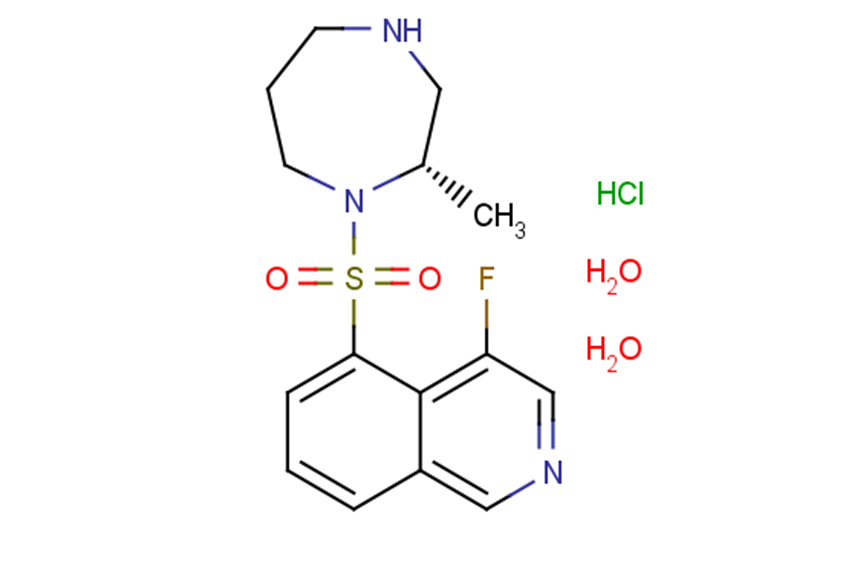
Ripasudil hydrochloride dihydrate
CAS No. 887375-67-9
Ripasudil hydrochloride dihydrate( K-115 )
Catalog No. M22117 CAS No. 887375-67-9
Ripasudil (K-115) hydrochloride dihydrate is a specific ROCK inhibitor (IC50s: 51/19 nM for ROCK1/ROCK2).Ripasudil shows less potent inhibitory activities against CaMKIIα, PKACα, and PKC (IC50s: 370 nM, 2.1 μM and 27 μM) .
Purity : >98% (HPLC)
 COA
Datasheet
HNMR
HPLC
MSDS
Handing Instructions
COA
Datasheet
HNMR
HPLC
MSDS
Handing Instructions
| Size | Price / USD | Stock | Quantity |
| 2MG | 85 | In Stock |


|
| 5MG | 141 | In Stock |
|
| 10MG | 230 | In Stock |
|
| 25MG | 510 | In Stock |
|
| 50MG | 732 | In Stock |
|
| 100MG | 1017 | In Stock |
|
| 200MG | Get Quote | In Stock |
|
| 500MG | 2034 | In Stock |
|
| 1G | Get Quote | In Stock |
|
Biological Information
-
Product NameRipasudil hydrochloride dihydrate
-
NoteResearch use only, not for human use.
-
Brief DescriptionRipasudil (K-115) hydrochloride dihydrate is a specific ROCK inhibitor (IC50s: 51/19 nM for ROCK1/ROCK2).Ripasudil shows less potent inhibitory activities against CaMKIIα, PKACα, and PKC (IC50s: 370 nM, 2.1 μM and 27 μM) .
-
DescriptionRipasudil (K-115) hydrochloride dihydrate is a specific ROCK inhibitor (IC50s: 51/19 nM for ROCK1/ROCK2).Ripasudil shows less potent inhibitory activities against CaMKIIα, PKACα, and PKC (IC50s: 370 nM, 2.1 μM and 27 μM) [1]. Ripasudil (1, 10 μM) induces cytoskeletal changes, including retraction and cell rounding and reduced actin bundles of cultured trabecular meshwork (TM) cells. Ripasudil (5 μM) significantly reduces transendothelial electrical resistance (TEER) and increases FITC-dextran permeability in Schlemm’s canal endothelial (SCE) cell monolayers [2].Ripasudil reduces intraocular pressure in a concentration-dependent manner at concentrations between 0.1% and 0.4% in monkey eyes and 0.0625% to 0.5% in rabbit eyes, respectively. Ripasudil (1 mg/kg, p.o. daily) shows a neuroprotective effect on retinal ganglion cells (RGCs) after nerve crush (NC). Ripasudil also inhibits the oxidative stress induced by axonal injury in mice. Ripasudil suppresses the time-dependent production of ROS in RGCs after NC injury.(In Vitro):Ripasudil (K-115) is a potent inhibitor of ROCK, with IC50s of 19 and 51 nM for ROCK2 and ROCK1, respectively. Ripasudil also shows less potent inhibitory activities against CaMKIIα, PKACα and PKC, with IC50s of 370 nM, 2.1 μM and 27 μM, respectively. Ripasudil (K-115; 1, 10 μM) induces cytoskeletal changes, including retraction and cell rounding and reduced actin bundles of cultured trabecular meshwork (TM) cells. Ripasudil (5 μM) sifnificantly reduces transendothelial electrical resistance (TEER), and increases FITC-dextran permeability in Schlemm’s canal endothelial (SCE) cell monolayers.(In Vivo):Ripasudil (K-115) reduces intraocular pressure (IOP) in a concentration-dependent manner at concentrations between 0.1% and 0.4% in monkey eyes and 0.0625% to 0.5% in rabbit eyes, respectively. Ripasudil (K-115; 1 mg/kg, p.o. daily) shows a neuroprotective effect on retinal ganglion cells (RGCs) after nerve crush (NC). Ripasudil also inhibits the oxidative stress induced by axonal injury in mice. Ripasudil suppresses the time-dependent production of ROS in RGCs after NC injury.
-
In VitroRipasudil (K-115) is a potent inhibitor of ROCK, with IC50s of 19 and 51 nM for ROCK2 and ROCK1, respectively. Ripasudil also shows less potent inhibitory activities against CaMKIIα, PKACα and PKC, with IC50s of 370 nM, 2.1 μM and 27 μM, respectively. Ripasudil (K-115; 1, 10 μM) induces cytoskeletal changes, including retraction and cell rounding and reduced actin bundles of cultured trabecular meshwork (TM) cells. Ripasudil (5 μM) sifnificantly reduces transendothelial electrical resistance (TEER), and increases FITC-dextran permeability in Schlemm’s canal endothelial (SCE) cell monolayers.
-
In VivoRipasudil (K-115) reduces intraocular pressure (IOP) in a concentration-dependent manner at concentrations between 0.1% and 0.4% in monkey eyes and 0.0625% to 0.5% in rabbit eyes, respectively. Ripasudil (K-115; 1 mg/kg, p.o. daily) shows a neuroprotective effect on retinal ganglion cells (RGCs) after nerve crush (NC). Ripasudil also inhibits the oxidative stress induced by axonal injury in mice. Ripasudil suppresses the time-dependent production of ROS in RGCs after NC injury.
-
SynonymsK-115
-
PathwayCell Cycle/DNA Damage
-
TargetROCK
-
RecptorROCK1| ROCK2
-
Research AreaOthers
-
IndicationDiabetic retinopathy; Fuchs' endothelial dystrophy
Chemical Information
-
CAS Number887375-67-9
-
Formula Weight395.88
-
Molecular FormulaC15H23ClFN3O4S
-
Purity>98% (HPLC)
-
SolubilityWater:45 mg/mL (113.67 mM)
-
SMILESO.O.Cl.C[C@H]1CNCCCN1S(=O)(=O)c1cccc2cncc(F)c12
-
Chemical Name——
Shipping & Storage Information
-
Storage(-20℃)
-
ShippingWith Ice Pack
-
Stability≥ 2 years
Reference
1. Isobe T, et al. Effects of K-115, a rho-kinase inhibitor, on aqueous humor dynamics in rabbits. Curr Eye Res. 2014 Aug;39(8):813-22.
molnova catalog



related products
-
Azaindole 1
Azaindole 1 is a selective and ATP-competitive ROCK inhibitor with IC50 of 0.6 and 1.1?nM for human ROCK-1 and ROCK-2.
-
Y27632
Y-27632 is a selective ROCK1 (p160ROCK) inhibitor with Ki of 140 nM in a cell-free assay.
-
Thiazovivin
Thiazovivin (Tzv) is a novel ROCK inhibitor with IC50 of 0.5 μM, promotes hESC survival after single-cell dissociation.
