


 Cart
Cart
 sales@molnova.com



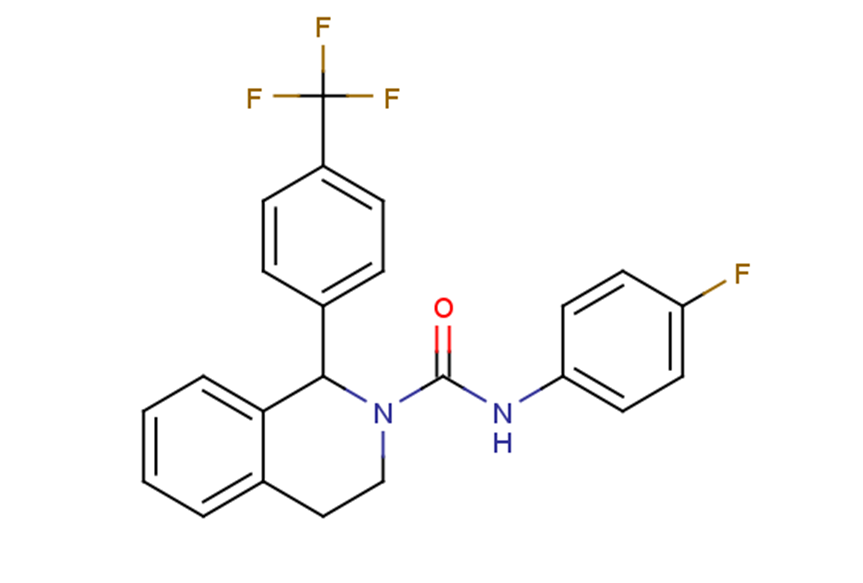
TC-I2000
CAS No. 1159996-20-9
TC-I2000( —— )
Catalog No. M21933 CAS No. 1159996-20-9
TC-I2000 is an TRPM8 channel blocker. Inhibits icilin-induced TRPM8 channel activation in rTRPM8-expressing CHO cells with IC50 of 53 nM.
Purity : >98% (HPLC)
 COA
Datasheet
HNMR
HPLC
MSDS
Handing Instructions
COA
Datasheet
HNMR
HPLC
MSDS
Handing Instructions
| Size | Price / USD | Stock | Quantity |
| 1 mL x 10 mM in DMSO | 42 | In Stock |


|
| 5MG | 29 | In Stock |
|
| 10MG | 44 | In Stock |
|
| 25MG | 77 | In Stock |
|
| 50MG | 113 | In Stock |
|
| 100MG | 170 | In Stock |
|
| 200MG | 253 | In Stock |
|
| 500MG | Get Quote | In Stock |
|
| 1G | Get Quote | In Stock |
|
Biological Information
-
Product NameTC-I2000
-
NoteResearch use only, not for human use.
-
Brief DescriptionTC-I2000 is an TRPM8 channel blocker. Inhibits icilin-induced TRPM8 channel activation in rTRPM8-expressing CHO cells with IC50 of 53 nM.
-
DescriptionTC-I2000 is an TRPM8 channel blocker. Inhibits icilin-induced TRPM8 channel activation in rTRPM8-expressing CHO cells with IC50 of 53 nM.
-
In Vitro——
-
In Vivo——
-
Synonyms——
-
PathwayMembrane Transporter/Ion Channel
-
TargetTRP/TRPV Channel
-
RecptorTRPM8
-
Research Area——
-
Indication——
Chemical Information
-
CAS Number1159996-20-9
-
Formula Weight414.4
-
Molecular FormulaC23H18F4N2O?
-
Purity>98% (HPLC)
-
Solubility——
-
SMILESFc1ccc(NC(=O)N2CCc3ccccc3C2c2ccc(cc2)C(F)(F)F)cc1
-
Chemical Name——
Shipping & Storage Information
-
Storage(-20℃)
-
ShippingWith Ice Pack
-
Stability≥ 2 years
Reference
1.Tamayo N A , Bo Y , Gore V , et al. Fused Piperidines as a Novel Class of Potent and Orally Available Transient Receptor Potential Melastatin Type 8 (TRPM8) Antagonists[J]. Journal of Medicinal Chemistry, 2012, 55(4):1593-1611.
molnova catalog



related products
-
Mubritinib
Mubritinib (TAK-165) is a potent inhibitor of HER2/ErbB2 with IC50 of 6 nM.
-
ABT 102
ABT 102 is a selective antagonist of transient receptor potential vanilloid 1 (TRPV1) receptor.
-
Asivatrep
Asivatrep (PAC-14028) is a potent, selective TRPV1 antagonist with IC50 of 55 nM against capsaicin-induced Ca2+ influx in rat DRG neurons.
