


 Cart
Cart
 sales@molnova.com



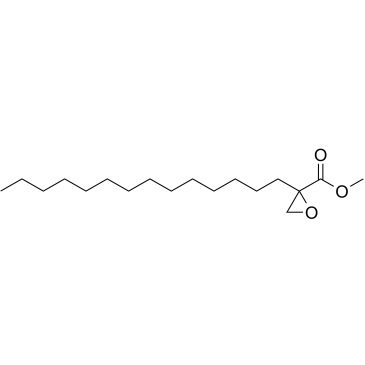
McN3716
CAS No. 69207-52-9
McN3716( Methyl palmoxirate | NSC359682 )
Catalog No. M21897 CAS No. 69207-52-9
Inhibition of brain mitochondrial β-oxidation by McN3716 (Methyl palmoxirate, MEP) significantly reduces the levels of all measured HETE and epoxytrienoic acids (EET), nonenzymatic auto-oxidative metabolites of ARA.
Purity : >98% (HPLC)
 COA
Datasheet
HNMR
HPLC
MSDS
Handing Instructions
COA
Datasheet
HNMR
HPLC
MSDS
Handing Instructions
| Size | Price / USD | Stock | Quantity |
| 5MG | 922 | In Stock |


|
| 10MG | 1140 | In Stock |
|
| 25MG | 1511 | In Stock |
|
| 50MG | 1841 | In Stock |
|
| 100MG | 2325 | In Stock |
|
| 200MG | Get Quote | In Stock |
|
| 500MG | 4650 | In Stock |
|
| 1G | Get Quote | In Stock |
|
Biological Information
-
Product NameMcN3716
-
NoteResearch use only, not for human use.
-
Brief DescriptionInhibition of brain mitochondrial β-oxidation by McN3716 (Methyl palmoxirate, MEP) significantly reduces the levels of all measured HETE and epoxytrienoic acids (EET), nonenzymatic auto-oxidative metabolites of ARA.
-
DescriptionInhibition of brain mitochondrial β-oxidation by McN3716 (Methyl palmoxirate, MEP) significantly reduces the levels of all measured HETE and epoxytrienoic acids (EET), nonenzymatic auto-oxidative metabolites of ARA, by 23% to 44% and 32% to 50% compared with vehicle-injected rats, respectively, except for 15-HETE which was unaffected. There is a significant 34% reduction in the level of 6-keto-PGF1α, a byproduct of PGI2 (prostacyclin) in McN3716-treated rats. Similarly, the brain level of hydroxyeicosapentaenoic acids, nonenzymatic auto-oxidative metabolites of EPA, is reduced by 35% to 76% upon McN3716 treatment relative to vehicle.
-
In Vitro——
-
In VivoInhibition of brain mitochondrial β-oxidation by McN3716 (Methyl palmoxirate, MEP) significantly reduces the levels of all measured HETE and epoxytrienoic acids (EET), nonenzymatic auto-oxidative metabolites of ARA, by 23% to 44% and 32% to 50% compared with vehicle-injected rats, respectively, except for 15-HETE which was unaffected. There is a significant 34% reduction in the level of 6-keto-PGF1α, a byproduct of PGI2 (prostacyclin) in McN3716-treated rats. Similarly, the brain level of hydroxyeicosapentaenoic acids, nonenzymatic auto-oxidative metabolites of EPA, is reduced by 35% to 76% upon McN3716 treatment relative to vehicle.
-
SynonymsMethyl palmoxirate | NSC359682
-
PathwayOthers
-
TargetOther Targets
-
RecptorCarnitine palmitoyltransferase I (CPT-1)
-
Research Area——
-
Indication——
Chemical Information
-
CAS Number69207-52-9
-
Formula Weight298.46
-
Molecular FormulaC??H??O?
-
Purity>98% (HPLC)
-
Solubility——
-
SMILESO=C(C1(CCCCCCCCCCCCCC)OC1)OC
-
Chemical Name——
Shipping & Storage Information
-
Storage(-20℃)
-
ShippingWith Ice Pack
-
Stability≥ 2 years
Reference
1. Chen CT, et al. Inhibiting mitochondrial β-oxidation selectively reduces levels of nonenzymatic oxidative polyunsaturated fatty acid metabolites in the brain. J Cereb Blood Flow Metab. 2014 Mar;34(3):376-9.
molnova catalog



related products
-
PDD00017272
PDD00017272 (34f) is a potent inhibitor of poly(ADP-ribose) glycohydrolase (PARG), exhibiting an EC50 value of 4.8 nM in biochemical assays and 9.2 nM in cellular POM.
-
Gomisin U
Gomisin U is a natural product for research related to life sciences.
-
Gimeracil
An inhibitor of dihydropyrimidine dehydrogenase, degrades pyrimidine including 5-fluorouracil in the blood.
