


 Cart
Cart
 sales@molnova.com



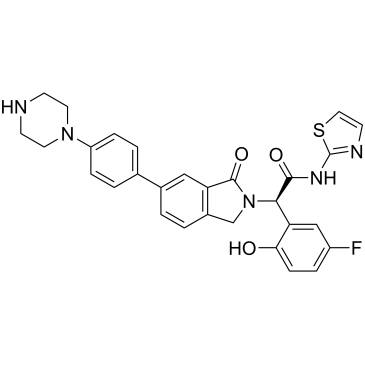
JBJ-04-125-02
CAS No. 2060610-53-7
JBJ-04-125-02 ( —— )
Catalog No. M21870 CAS No. 2060610-53-7
JBJ-04-125-02 (0-1000 nM; 72 hours; H1975 cells) treatment could inhibit cell proliferation of H1975 cells at low nanomolar concentrations.
Purity : >98% (HPLC)
 COA
Datasheet
HNMR
HPLC
MSDS
Handing Instructions
COA
Datasheet
HNMR
HPLC
MSDS
Handing Instructions
| Size | Price / USD | Stock | Quantity |
| 5MG | 873 | In Stock |


|
| 50MG | 1782 | In Stock |
|
| 100MG | 2250 | In Stock |
|
| 200MG | Get Quote | In Stock |
|
| 500MG | Get Quote | In Stock |
|
| 1G | Get Quote | In Stock |
|
Biological Information
-
Product NameJBJ-04-125-02
-
NoteResearch use only, not for human use.
-
Brief DescriptionJBJ-04-125-02 (0-1000 nM; 72 hours; H1975 cells) treatment could inhibit cell proliferation of H1975 cells at low nanomolar concentrations.
-
DescriptionJBJ-04-125-02 (0-1000 nM; 72 hours; H1975 cells) treatment could inhibit cell proliferation of H1975 cells at low nanomolar concentrations.JBJ-04-125-02 treatment also inhibits cell proliferation in Ba/F3 cells stably transfected with EGFRL858R, EGFRL858R/T790M, or EGFRL858R/T790M/C797S mutations.The ability of JBJ-04-125-02 (0.01-10 μM) to inhibit EGFR phosphorylation using Ba/F3, H1975 and NIH-3T3 cells is examined. JBJ-04-125-02 demonstrates mutant selectivity by inhibiting mutant EGFR and downstream AKT and ERK1/2 phosphorylation.
-
In VitroJBJ-04-125-02 (0-1000 nM; 72 hours; H1975 cells) treatment could inhibit cell proliferation of H1975 cells at low nanomolar concentrations.JBJ-04-125-02 treatment also inhibits cell proliferation in Ba/F3 cells stably transfected with EGFRL858R, EGFRL858R/T790M, or EGFRL858R/T790M/C797S mutations.The ability of JBJ-04-125-02 (0.01-10 μM) to inhibit EGFR phosphorylation using Ba/F3, H1975 and NIH-3T3 cells is examined. JBJ-04-125-02 demonstrates mutant selectivity by inhibiting mutant EGFR and downstream AKT and ERK1/2 phosphorylation. Cell Proliferation Assay Cell Line:H1975 cells Concentration:0 nM, 0.1 nM, 1 nM, 10 nM, 100 nM, 1000 nM Incubation Time:72 hours Result:Inhibited cell proliferation of H1975 cells at low nanomolar concentrations.
-
In VivoJBJ-04-125-02 (50 mg/kg; oral gavage; once daily; for 15 weeks; EGFRL858R/T790M/C797S genetically engineered mice) treatment leads to marked tumor regressions within 4 weeks of treatment.JBJ-04-125-02 exhibits a moderate half-life of 3 hours and a high area under curve of 728,577 min?ng/mL (AUClast) following 3 mg/kg intravenous (i.v.) dose. A 20 mg/kg oral dose of JBJ-04-125-02 achieves an average maximal plasma concentration of 1.1 μmol/L with an oral bioavailability of 3%. Animal Model:EGFRL858R/T790M/C797S genetically engineered mice (GEM) Dosage:50 mg/kg Administration:Oral gavage; once daily; for 15 weeksResult:Led to marked tumor regressions within 4 weeks of treatment.
-
Synonyms——
-
PathwayAngiogenesis
-
TargetEGFR
-
RecptorEGFR (L858R/T790M)
-
Research Area——
-
Indication——
Chemical Information
-
CAS Number2060610-53-7
-
Formula Weight543.61
-
Molecular FormulaC??H??FN?O?S
-
Purity>98% (HPLC)
-
Solubility——
-
SMILESO=C(NC1=NC=CS1)[C@@H](C2=CC(F)=CC=C2O)N(CC3=C4C=C(C5=CC=C(N6CCNCC6)C=C5)C=C3)C4=O
-
Chemical Name——
Shipping & Storage Information
-
Storage(-20℃)
-
ShippingWith Ice Pack
-
Stability≥ 2 years
Reference
1. To C, et al. Single and Dual Targeting of Mutant EGFR with an Allosteric Inhibitor. Cancer Discov. 2019 Jul;9(7):926-943.
molnova catalog



related products
-
Tiotropium Bromide h...
Tiotropium Bromide hydrate is a monohydrate of tiotropium bromide (Spiriva; Tiova; BA 679BR; tiopropium) that is an anticholinergic and bronchodilator and a muscarinic receptor antagonist.
-
Gefitinib
A potent, selective, orally active EGFR inhibitor with IC50 of 23 nM; inhibits EGF-stimulated proliferation of KB cells with IC50 of 80 nM.
-
FRAX1036
FRAX-1036 is a effective and selective PAK1 inhibitor.
