


 Cart
Cart
 sales@molnova.com



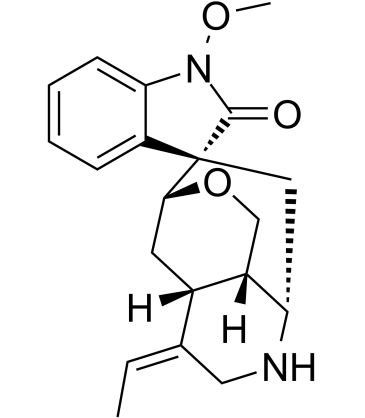
Rankinidine
CAS No. 106466-66-4
Rankinidine( —— )
Catalog No. M21811 CAS No. 106466-66-4
Rankinidine is an oxindole alkaloid that is isolated from the MeOH extract of the stem of Gelsemium rankinii.
Purity : >98% (HPLC)
 COA
Datasheet
HNMR
HPLC
MSDS
Handing Instructions
COA
Datasheet
HNMR
HPLC
MSDS
Handing Instructions
| Size | Price / USD | Stock | Quantity |
| 10MG | 1098 | In Stock |


|
| 100MG | Get Quote | In Stock |
|
| 200MG | Get Quote | In Stock |
|
| 500MG | Get Quote | In Stock |
|
| 1G | Get Quote | In Stock |
|
Biological Information
-
Product NameRankinidine
-
NoteResearch use only, not for human use.
-
Brief DescriptionRankinidine is an oxindole alkaloid that is isolated from the MeOH extract of the stem of Gelsemium rankinii.
-
DescriptionRankinidine is an oxindole alkaloid that is isolated from the MeOH extract of the stem of Gelsemium rankinii.
-
In Vitro——
-
In Vivo——
-
Synonyms——
-
PathwayOthers
-
TargetOther Targets
-
Recptor——
-
Research Area——
-
Indication——
Chemical Information
-
CAS Number106466-66-4
-
Formula Weight340.42
-
Molecular FormulaC??H??N?O?
-
Purity>98% (HPLC)
-
Solubility——
-
SMILESO=C1[C@]2([C@H]3C[C@]4([H])[C@@](CO3)([H])[C@@H](NC/C4=C\C)C2)C5=CC=CC=C5N1OC
-
Chemical Name——
Shipping & Storage Information
-
Storage(-20℃)
-
ShippingWith Ice Pack
-
Stability≥ 2 years
Reference
1. Schun Y, et, al. Rankinidine, a new indole alkaloid from Gelsemium rankinii. J Nat Prod. Sep-Oct 1986; 49(5): 806-8.
molnova catalog



related products
-
Ondansetron
Ondansetron is a serotonin 5-HT3 receptor antagonist used mainly as an antiemetic.
-
Phenyl-Ac-Gln-OH
Phenylacetylglutamine is a normal constituent of human urine but other mammals such as the dog cat rat monkey sheep and horse do not excrete this compound. Phenylacetylglutamine is a major nitrogenous metabolite that accumulates in uremia. Phenylacetylglutamine also is a microbial metabolite found in Christensenellaceae Lachnospiraceae and Ruminococcaceae.
-
Vardenafil hydrochlo...
Vardenafil HCl Trihydrate is a new type PDE inhibitor with IC50 of 0.7 and 180 nM for PDE5 and PDE1, respectively.
