


 Cart
Cart
 sales@molnova.com



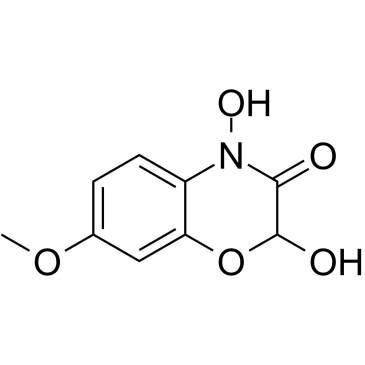
DIMBOA
CAS No. 15893-52-4
DIMBOA ( —— )
Catalog No. M21763 CAS No. 15893-52-4
DIMBOA, an antibiotic, is a benzoxazinoid, part of the chemical defense system of graminaceous plants such as maize, wheat, and rye.
Purity : >98% (HPLC)
 COA
Datasheet
HNMR
HPLC
MSDS
Handing Instructions
COA
Datasheet
HNMR
HPLC
MSDS
Handing Instructions
| Size | Price / USD | Stock | Quantity |
| 1 mL x 10 mM in DMSO | 83 | In Stock |


|
| 5MG | 61 | In Stock |
|
| 10MG | 93 | In Stock |
|
| 25MG | 198 | In Stock |
|
| 50MG | 315 | In Stock |
|
| 100MG | 505 | In Stock |
|
| 200MG | 728 | In Stock |
|
| 500MG | Get Quote | In Stock |
|
| 1G | Get Quote | In Stock |
|
Biological Information
-
Product NameDIMBOA
-
NoteResearch use only, not for human use.
-
Brief DescriptionDIMBOA, an antibiotic, is a benzoxazinoid, part of the chemical defense system of graminaceous plants such as maize, wheat, and rye.
-
DescriptionDIMBOA, an antibiotic, is a benzoxazinoid, part of the chemical defense system of graminaceous plants such as maize, wheat, and rye. DIMBOA possess growth inhibitory properties against many strains of studied bacteria and fungi, such as Staphylococcus aureus, Escherichia coli as well as against Saccharomyces cerevisiae. DIMBOA exhibits a potent free-radical scavenging activity and a weaker iron (III) ions reducing activity. Antioxidant activity.
-
In VitroCell Viability Assay Cell Line:JCM 9873 Concentration:250 μM Incubation Time: 48, 96 h Result:Completely abolished toxin production without any apparent effect on fungal growth.
-
In Vivo——
-
Synonyms——
-
PathwayGPCR/G Protein
-
TargetAntibacterial
-
Recptor——
-
Research Area——
-
Indication——
Chemical Information
-
CAS Number15893-52-4
-
Formula Weight211.17
-
Molecular FormulaC?H?NO?
-
Purity>98% (HPLC)
-
SolubilityDMSO : 125 mg/mL?(591.94 mM;?Need ultrasonic)
-
SMILESO=C1C(O)OC2=CC(OC)=CC=C2N1O
-
Chemical Name——
Shipping & Storage Information
-
Storage(-20℃)
-
ShippingWith Ice Pack
-
Stability≥ 2 years
Reference
1. Gleńsk M, et al. In vitro evaluation of the antioxidant and antimicrobial activity of DIMBOA [2,4-dihydroxy-7-methoxy-2H-1,4-benzoxazin-3(4H)-one]. Nat Prod Res. 2016;30(11):1305-1308.
2. Sasai H, et al. Species-specific glucosylation of DIMBOA in larvae of the rice Armyworm. Biosci Biotechnol Biochem. 2009;73(6):1333-1338.
3. Phuong, T.T.T., Yamamoto, M., Fujii, T. et al. Comparison of the ability to catabolize DIMBOA, a maize antibiotic, between Ostrinia furnacalis and Ostrinia scapulalis(Lepidoptera: Crambidae), with reference to their hybrids. Appl Entomol Zool 51, 143–149 (2016).
molnova catalog



related products
-
Heneicosane
Heneicosane is a pheromone that inhibits the production of aflatoxins. Heneicosane is an aroma component isolated from Streptomyces philanthi RL-1-178 or Serapias cordigera.
-
57-Dihydroxy-4-pheny...
57-dihydroxy-4-phenyl coumarin is found in the plant Passiflora serratodigitata with the antibacterial activity.
-
Fuberidazole
Fuberidazole is an antifungal agent.
