


 Cart
Cart
 sales@molnova.com



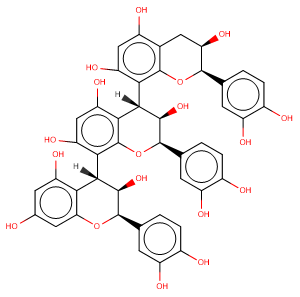
Procyanidin C1
CAS No. 37064-30-5
Procyanidin C1( —— )
Catalog No. M21659 CAS No. 37064-30-5
Procyanidin C1 is a natural product with anti-inflammatory effects and induces apoptosis.
Purity : >98% (HPLC)
 COA
Datasheet
HNMR
HPLC
MSDS
Handing Instructions
COA
Datasheet
HNMR
HPLC
MSDS
Handing Instructions
| Size | Price / USD | Stock | Quantity |
| 1 mL x 10 mM in DMSO | 487 | In Stock |


|
| 5MG | 306 | In Stock |
|
| 10MG | 471 | In Stock |
|
| 25MG | 803 | In Stock |
|
| 50MG | 1051 | In Stock |
|
| 100MG | 1423 | In Stock |
|
| 200MG | Get Quote | In Stock |
|
| 500MG | Get Quote | In Stock |
|
| 1G | Get Quote | In Stock |
|
Biological Information
-
Product NameProcyanidin C1
-
NoteResearch use only, not for human use.
-
Brief DescriptionProcyanidin C1 is a natural product with anti-inflammatory effects and induces apoptosis.
-
DescriptionProcyanidin C1 is a natural product with anti-inflammatory effects and induces apoptosis.
-
In VitroCell Cycle Analysis Cell Line:MCF-7 and MDA-MB-231 cell lines Concentration:35 μg/mL Incubation Time:48 h Result:Induced the cell cycle arrest at the S-phase in MCF-7 and MDA-MB-231 cell lines.Cell Cytotoxicity Assay Cell Line:MCF-7 and MDA-MB-231 cell lines Concentration:6.25-100 μg/mL Incubation Time:48 h Result:Inhibited cell proliferation of MCF-7 and MDA-MB-231 cells with IC50 values of 31.5 and 36.6 μg/mL and showed a higher cytotoxic activity to MDA-MB-231 than tamoxifen.
-
In VivoAnimal Model:Non-obese diabetes and severe combined immunodficiency mice with PSC27 and PC3 cancer cells injection, and pre-treated with mitoxantrone (MIT) Dosage:20 mg/kg Administration:Intraperitoneal injection; 20 mg/kg; 2 weeks after the first MIT dose and then delivered biweekly Result:Remarkably enhanced tumour regression (55.2% reduction in tumour size compared with MIT alone; 74.9% reduction in tumour volume compared with the placebo treatment) and depleted the majority of senescent cells in chemotherapy treated animals.Animal Model:24-27 months of age mice (both sexes)Dosage:20 mg/kg Administration:Oral gavage; 20 mg/kg; for three consecutive days Result:Enhanced the median post-treatment lifespan with 64.2% and decreased the mortality hazard than the vehicle-treated group.
-
Synonyms——
-
PathwayApoptosis
-
TargetApoptosis
-
RecptorApoptosis
-
Research Area——
-
Indication——
Chemical Information
-
CAS Number37064-30-5
-
Formula Weight866.77
-
Molecular FormulaC45H38O18
-
Purity>98% (HPLC)
-
SolubilityIn Vitro:?DMSO : 100 mg/mL (115.37 mM)
-
SMILES[H][C@]1([C@@H](O)[C@H](Oc2cc(O)cc(O)c12)c1ccc(O)c(O)c1)c1c(O)cc(O)c2c1O[C@@H]([C@H](O)[C@@]2([H])c1c(O)cc(O)c2C[C@@H](O)[C@H](Oc12)c1ccc(O)c(O)c1)c1ccc(O)c(O)c1
-
Chemical Name——
Shipping & Storage Information
-
Storage(-20℃)
-
ShippingWith Ice Pack
-
Stability≥ 2 years
Reference
1.Sun P Li K Wang T et al. Procyanidin C1 a Component of Cinnamon Extracts Is a Potential Insulin Sensitizer That Targets Adipocytes[J]. Journal of Agricultural and Food Chemistry 2019 67(32).
molnova catalog



related products
-
SACLAC
SACLAC is a cysteine asparaginase activation inhibitor with antitumor activity that decreases AML cell viability, inhibits AML cell proliferation, increases AML cell death, and induces apoptosis of AML cells, and is used in the study of acute myeloid leukemia and cancer.
-
GUT-70
GUT-70 is a tricyclic coumarin derived from Calophyllum brasiliense, markedly reduces cell proliferation.
-
PI3Kα-IN-9
PI3Kα-IN-9 is an orally available, selective and potent PI3Kα inhibitor with antiproliferative activity, inhibits PI3Kα, PI3Kγ, PI3Kδ, and PI3Kβ, induces apoptosis, and can be used in the study of cancer.
