


 Cart
Cart
 sales@molnova.com



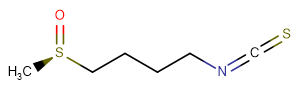
L-Sulforaphane
CAS No. 142825-10-3
L-Sulforaphane( (R)-Sulforaphane )
Catalog No. M21483 CAS No. 142825-10-3
(R)-Sulforaphane is a potent inducer of the Keap1/Nrf2/ARE pathway.
Purity : >98% (HPLC)
 COA
Datasheet
HNMR
HPLC
MSDS
Handing Instructions
COA
Datasheet
HNMR
HPLC
MSDS
Handing Instructions
| Size | Price / USD | Stock | Quantity |
| 2MG | 78 | In Stock |


|
| 5MG | 130 | In Stock |
|
| 10MG | 223 | In Stock |
|
| 25MG | 377 | In Stock |
|
| 50MG | 542 | In Stock |
|
| 100MG | Get Quote | In Stock |
|
| 200MG | Get Quote | In Stock |
|
| 500MG | Get Quote | In Stock |
|
| 1G | Get Quote | In Stock |
|
Biological Information
-
Product NameL-Sulforaphane
-
NoteResearch use only, not for human use.
-
Brief Description(R)-Sulforaphane is a potent inducer of the Keap1/Nrf2/ARE pathway.
-
Description(R)-Sulforaphane is a potent inducer of the Keap1/Nrf2/ARE pathway.
-
In Vitro——
-
In Vivo——
-
Synonyms(R)-Sulforaphane
-
PathwayOthers
-
TargetOther Targets
-
RecptorKEAP1-Nrf2
-
Research Area——
-
Indication——
Chemical Information
-
CAS Number142825-10-3
-
Formula Weight177.3
-
Molecular FormulaC6H11NOS2
-
Purity>98% (HPLC)
-
SolubilityDMSO:16mg/ml(90.24mM)
-
SMILESC[S@](CCCCN=C=S)=O
-
Chemical Name(R)-1-isothiocyanato-4-(methylsulfinyl)butane
Shipping & Storage Information
-
Storage(-20℃)
-
ShippingWith Ice Pack
-
Stability≥ 2 years
Reference
1.De Nicola GR et al. Novel gram-scale production of enantiopure R-sulforaphane from Tuscan black kale seeds. Molecules. 2014 May 27;19(6):6975-86.
molnova catalog



related products
-
(3E)-4-(1H-indol-3-y...
(3E)-4-(1H-indol-3-yl)but-3-en-2-one ((E)-4-(1H-indol-3-yl)but-3-en-2-one) is a marine derived natural products found in Tedania (Tedania) ignis.
-
Rubioncolin C
Rubioncolin C shows good cytotoxicity with IC50 value of 1.53 μM and NF-κB inhibitory activity with IC50 value of 2.97 μM.
-
EM127
EM127 is a highly selective and potent covalent inhibitor of SMYD3 with a KD value of 13 μM.EM127 inhibits ERK1/2 phosphorylation and inhibits transcriptional regulation of SMYD3 target genes.
