


 Cart
Cart
 sales@molnova.com



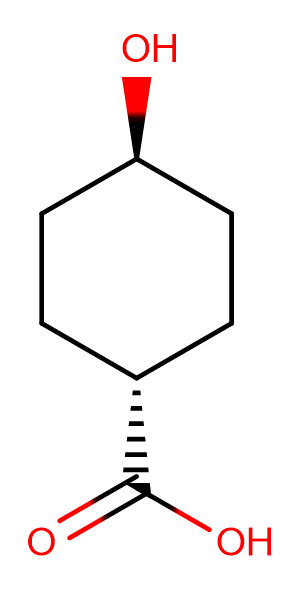
trans-4-Hydroxycyclohexanecarboxylic Acid
CAS No. 3685-26-5
trans-4-Hydroxycyclohexanecarboxylic Acid( —— )
Catalog No. M21370 CAS No. 3685-26-5
trans-4-Hydroxycyclohexanecarboxylic Acid is an organic intermediate.
Purity : >98% (HPLC)
 COA
Datasheet
HNMR
HPLC
MSDS
Handing Instructions
COA
Datasheet
HNMR
HPLC
MSDS
Handing Instructions
| Size | Price / USD | Stock | Quantity |
| 1 mL x 10 mM in DMSO | 28 | In Stock |


|
| 100MG | 27 | In Stock |
|
| 200MG | Get Quote | In Stock |
|
| 500MG | Get Quote | In Stock |
|
| 1G | Get Quote | In Stock |
|
Biological Information
-
Product Nametrans-4-Hydroxycyclohexanecarboxylic Acid
-
NoteResearch use only, not for human use.
-
Brief Descriptiontrans-4-Hydroxycyclohexanecarboxylic Acid is an organic intermediate.
-
Descriptiontrans-4-Hydroxycyclohexanecarboxylic Acid is an organic intermediate.
-
In Vitro——
-
In Vivo——
-
Synonyms——
-
PathwayOthers
-
TargetOther Targets
-
RecptorOthers
-
Research Area——
-
Indication——
Chemical Information
-
CAS Number3685-26-5
-
Formula Weight144.17
-
Molecular FormulaC7H12O3
-
Purity>98% (HPLC)
-
SolubilityDMSO:28 mg/mL (194.21 mM)
-
SMILESO[C@H]1CC[C@@H](CC1)C(O)=O
-
Chemical Name——
Shipping & Storage Information
-
Storage(-20℃)
-
ShippingWith Ice Pack
-
Stability≥ 2 years
Reference
1.Yoshizako F Chubachi M Nishimura A et al. Metabolism of n-alkyl-substituted cyclohexanes with an odd number of carbon atoms in the side chain by Micrococcus sp. RCO-4M.[J]. Journal of Fermentation & Bioengineering 1990 70(4):283-285.
molnova catalog



related products
-
Epimedoside
Epimedoside is a flavonol glycoside, isolated from the aerial parts of Epimedium koreanum Nakai (Berberidaceae).
-
Dehydrobrusatol
Dehydrobrusatol
-
S-(5-Adenosyl)-L-met...
S-(5'-Adenosyl)-L-methionine chloride is a natural product. S-(5'-Adenosyl)-L-methionine chloride can be used as a reference standard.
