


 Cart
Cart
 sales@molnova.com



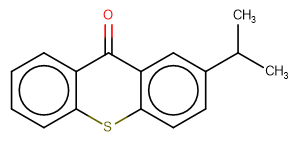
2-Isopropyl Thioxanthone
CAS No. 5495-84-1
2-Isopropyl Thioxanthone( —— )
Catalog No. M21290 CAS No. 5495-84-1
2-Isopropyl Thioxanthone has potential anti-estrogenic and anti-androgenic properties.
Purity : >98% (HPLC)
 COA
Datasheet
HNMR
HPLC
MSDS
Handing Instructions
COA
Datasheet
HNMR
HPLC
MSDS
Handing Instructions
| Size | Price / USD | Stock | Quantity |
| 1 mL x 10 mM in DMSO | 28 | In Stock |


|
| 100MG | Get Quote | In Stock |
|
| 200MG | 34 | In Stock |
|
| 500MG | 55 | In Stock |
|
| 1G | 83 | In Stock |
|
Biological Information
-
Product Name2-Isopropyl Thioxanthone
-
NoteResearch use only, not for human use.
-
Brief Description2-Isopropyl Thioxanthone has potential anti-estrogenic and anti-androgenic properties.
-
Description2-Isopropyl Thioxanthone has potential anti-estrogenic and anti-androgenic properties.
-
In Vitro——
-
In Vivo——
-
Synonyms——
-
PathwayOthers
-
TargetOther Targets
-
RecptorOthers
-
Research Area——
-
Indication——
Chemical Information
-
CAS Number5495-84-1
-
Formula Weight254.3
-
Molecular FormulaC16H14OS
-
Purity>98% (HPLC)
-
Solubility——
-
SMILESCC(C)c(cc1)cc2c1Sc(cccc1)c1C2=O
-
Chemical Name——
Shipping & Storage Information
-
Storage(-20℃)
-
ShippingWith Ice Pack
-
Stability≥ 2 years
Reference
1.Peijnenburg A Riethof-Poortman J Baykus H et al. AhR-agonistic anti-androgenic and anti-estrogenic potencies of 2-isopropylthioxanthone (ITX) as determined by in vitro bioassays and gene expression profiling[J]. Toxicology in Vitro 2010 24(6):0-1628.
molnova catalog



related products
-
α-Hydroxyisobutyric ...
Alpha-Hydroxyisobutyric acid is a metabolite of methyl tert-butyl ether (MTBE). MTBE may be obtained through environmental exposure. MTBE is rapidly eliminated from the body mainly through expired air as the unchanged compound. MTBE is to some extent metabolised to t-butyl alcohol (TBA) and formaldehyde and oxidised to 2-methyl-12-propanediol and a-hydroxy isobuturic acid. Alpha-Hydroxyisobutyric acid has been used as an arial bactericide.
-
3-Bromobenzoic acid
3-Bromobenzoic acid is a marine derived natural products found in Tubastraea micranthus.
-
Iopanoic acid
Iopanoic acid is an iodine-containing radiocontrast medium used in cholecystography.
