


 Cart
Cart
 sales@molnova.com



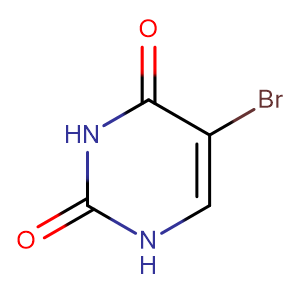
5-Bromouracil
CAS No. 51-20-7
5-Bromouracil( —— )
Catalog No. M21286 CAS No. 51-20-7
5-Bromouracil disrupts nucleosome positioning by inducing A-form-like DNA.
Purity : >98% (HPLC)
 COA
Datasheet
HNMR
HPLC
MSDS
Handing Instructions
COA
Datasheet
HNMR
HPLC
MSDS
Handing Instructions
| Size | Price / USD | Stock | Quantity |
| 1 mL x 10 mM in DMSO | 29 | In Stock |


|
| 100MG | Get Quote | In Stock |
|
| 200MG | Get Quote | In Stock |
|
| 500MG | Get Quote | In Stock |
|
| 1G | 27 | In Stock |
|
Biological Information
-
Product Name5-Bromouracil
-
NoteResearch use only, not for human use.
-
Brief Description5-Bromouracil disrupts nucleosome positioning by inducing A-form-like DNA.
-
Description5-Bromouracil disrupts nucleosome positioning by inducing A-form-like DNA.
-
In Vitro——
-
In Vivo——
-
Synonyms——
-
PathwayOthers
-
TargetOther Targets
-
RecptorOthers
-
Research Area——
-
Indication——
Chemical Information
-
CAS Number51-20-7
-
Formula Weight190.98
-
Molecular FormulaC4H3BrN2O2
-
Purity>98% (HPLC)
-
SolubilityIn Vitro:?DMSO : 100 mg/mL (523.62 mM)
-
SMILESO=C(C(Br)=CN1)NC1=O
-
Chemical Name——
Shipping & Storage Information
-
Storage(-20℃)
-
ShippingWith Ice Pack
-
Stability≥ 2 years
Reference
1.Miki K Shimizu M Fujii M et al. 5-Bromouracil disrupts nucleosome positioning by inducing A-form-like DNA conformation in yeast cells[J]. biochemical & biophysical research communications 2008 368(3):0-669.
molnova catalog



related products
-
Extracellular Death ...
Extracellular death factor (EDF) is the only single signaling molecule involved in Escherichia coli quorum sensing, and can initiate MAZEF-mediated cell death. Extracellular death factor significantly amplifies the endoribonucleolytic activities of both MazF and ChpBK.
-
Aristolochic acid Va
Aristolochic acid Va is a natural compound that can be isolated from Aristolochiaplants.
-
GCN2-IN-1
GCN2-IN-1 is an effective GCN2 inhibitor and can be used in research on the treatment of cancer as a chemotherapeutic agent.
