


 Cart
Cart
 sales@molnova.com



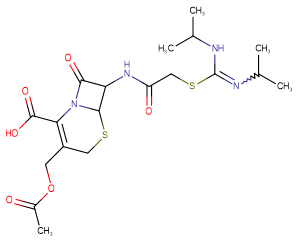
Cefathiamidine
CAS No. 33075-00-2
Cefathiamidine( —— )
Catalog No. M21185 CAS No. 33075-00-2
Cefathiamidine exhibits a wide spectrum of antimicrobial activity against bacteria. Cefathiamidine is used for the treatment of respiratory liver five senses urinary tract infections endocarditis and sepsis.
Purity : >98% (HPLC)
 COA
Datasheet
HNMR
HPLC
MSDS
Handing Instructions
COA
Datasheet
HNMR
HPLC
MSDS
Handing Instructions
| Size | Price / USD | Stock | Quantity |
| 1 mL x 10 mM in DMSO | 41 | In Stock |


|
| 10MG | 37 | In Stock |
|
| 25MG | 65 | In Stock |
|
| 50MG | 98 | In Stock |
|
| 100MG | 146 | In Stock |
|
| 200MG | Get Quote | In Stock |
|
| 500MG | Get Quote | In Stock |
|
| 1G | Get Quote | In Stock |
|
Biological Information
-
Product NameCefathiamidine
-
NoteResearch use only, not for human use.
-
Brief DescriptionCefathiamidine exhibits a wide spectrum of antimicrobial activity against bacteria. Cefathiamidine is used for the treatment of respiratory liver five senses urinary tract infections endocarditis and sepsis.
-
DescriptionCefathiamidine exhibits a wide spectrum of antimicrobial activity against bacteria. Cefathiamidine is used for the treatment of respiratory liver five senses urinary tract infections endocarditis and sepsis.(In Vitro):The in-vitro activity of Cefathiamidine against Streptococcus faecalis and Streptococcus faecium are studied in comparison with other β-lactams. All the 56 strains of Str. faecalis tested are inhibited by 2 mg/L of Cefathiamidine. The MBCs of Cefathiamidine and Ampicillin for ten strains of Str. faecalis show that the ratios of MBC/MIC are greater than 64. The rates of killing of Str. faecalis are reduced at concentrations of Cefathiamidine and Ampicillin greater than the MIC. The most rapid killing is obtained at 2 mg/L Cefathiamidine or 4 mg/L of Ampicillin. With the addition of 1 mg/L gentamicin this paradoxical bacteriocidal effect is eliminated. Time killing studies show99.9% of the cells are killed within 6 hours by a combination of aminoglycoside and β-lactam.(In Vivo):Cefathiamidine is not absorbed orally and is, thus, administered through the parenteral route (intravenously or intramuscularly). Cefathiamidine is widely distributed in most bodily fluids and tissues; however, Cefathiamidine cannot pass through the blood-brain barrier. The protein-binding capacity of Cefathiamidine is 23%, and more than 90% of Cefathiamidine is excreted unchanged by the kidney.
-
In VitroThe in-vitro activity of Cefathiamidine against Streptococcus faecalis and Streptococcus faecium are studied in comparison with other β-lactams. All the 56 strains of Str. faecalis tested are inhibited by 2 mg/L of Cefathiamidine. The MBCs of Cefathiamidine and Ampicillin for ten strains of Str. faecalis show that the ratios of MBC/MIC are greater than 64. The rates of killing of Str. faecalis are reduced at concentrations of Cefathiamidine and Ampicillin greater than the MIC. The most rapid killing is obtained at 2 mg/L Cefathiamidine or 4 mg/L of Ampicillin. With the addition of 1 mg/L gentamicin this paradoxical bacteriocidal effect is eliminated. Time killing studies show99.9% of the cells are killed within 6 hours by a combination of aminoglycoside and β-lactam.
-
In VivoCefathiamidine is not absorbed orally and is, thus, administered through the parenteral route (intravenously or intramuscularly). Cefathiamidine is widely distributed in most bodily fluids and tissues; however, Cefathiamidine cannot pass through the blood-brain barrier. The protein-binding capacity of Cefathiamidine is 23%, and more than 90% of Cefathiamidine is excreted unchanged by the kidney.
-
Synonyms——
-
PathwayGPCR/G Protein
-
TargetAntibacterial
-
RecptorBacterial
-
Research AreaInflammation/Immunology
-
IndicationRespiratory tract infection biliary tract infection urinary tract infection gynecological infection
Chemical Information
-
CAS Number33075-00-2
-
Formula Weight472.6
-
Molecular FormulaC19H28N4O6S2
-
Purity>98% (HPLC)
-
SolubilityDMSO:250 mg/mL (529.01 mM; Need ultrasonic)
-
SMILESCC(=O)OCC1=C(C(=O)O)N2C(=O)C(NC(=O)CSC(=NC(C)C)NC(C)C)C2SC1
-
Chemical Name——
Shipping & Storage Information
-
Storage(-20℃)
-
ShippingWith Ice Pack
-
Stability≥ 2 years
Reference
1 .Chen HY et al. The killing effects of cefathiamidine or ampicillin alone and in combination with gentamicin against enterococci. J Antimicrob Chemother. 1983 Jul;12(1):19-26.
molnova catalog



related products
-
TCA-1
A small molecule with activity against drug-resistant and persistent tuberculosis; shows bactericidal activity against nonreplicating Mtb in vitro and is efficacious in acute and chronic Mtb infection mouse models.
-
Roxarsone
Roxarsone is an organoarsenic compound that is widely used in poultry production as a feed additive to increase weight gain and improve feed efficiency and as a coccidiostat.
-
JOSAMYCIN
JOSAMYCIN is a macrolide antibiotic exhibiting antimicrobial activity. The dissociation constant Kd from ribosome for Josamycin is 5.5 nM.
