


 Cart
Cart
 sales@molnova.com



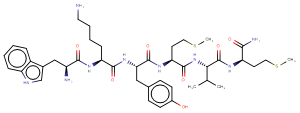
WKYMVM
CAS No. 187986-17-0
WKYMVM( —— )
Catalog No. M21014 CAS No. 187986-17-0
WKYMVM is a N-formyl peptide receptor (FPR1) agonist.
Purity : >98% (HPLC)
 COA
Datasheet
HNMR
HPLC
MSDS
Handing Instructions
COA
Datasheet
HNMR
HPLC
MSDS
Handing Instructions
| Size | Price / USD | Stock | Quantity |
| 5MG | 262 | In Stock |


|
| 10MG | 391 | In Stock |
|
| 100MG | Get Quote | In Stock |
|
| 200MG | Get Quote | In Stock |
|
| 500MG | Get Quote | In Stock |
|
| 1G | Get Quote | In Stock |
|
Biological Information
-
Product NameWKYMVM
-
NoteResearch use only, not for human use.
-
Brief DescriptionWKYMVM is a N-formyl peptide receptor (FPR1) agonist.
-
DescriptionWKYMVM is a N-formyl peptide receptor (FPR1) agonist.
-
In Vitro——
-
In Vivo——
-
Synonyms——
-
PathwayOthers
-
TargetOther Targets
-
RecptorFPR1?
-
Research Area——
-
Indication——
Chemical Information
-
CAS Number187986-17-0
-
Formula Weight856.11
-
Molecular FormulaC41H61N9O7S2
-
Purity>98% (HPLC)
-
SolubilityIn Vitro:?H2O : 12.5 mg/mL (14.60 mM)
-
SMILESCSCC[C@H](NC(=O)[C@H](Cc1ccc(O)cc1)NC(=O)[C@H](CCCCN)NC(=O)[C@@H](N)Cc1c[nH]c2ccccc12)C(=O)N[C@H](C(=O)N[C@H](CCSC)C(N)=O)C(C)C
-
Chemical Name——
Shipping & Storage Information
-
Storage(-20℃)
-
ShippingWith Ice Pack
-
Stability≥ 2 years
Reference
1.Christophe T Karlsson A Dugave C et al. The Synthetic Peptide Trp-Lys-Tyr-Met-Val-Met-NH2 Specifically Activates Neutrophils through FPRL1/Lipoxin A4 Receptors and Is an Agonist for the Orphan Monocyte-expressed Chemoattractant Receptor FPRL2[J]. Journal of Biological Chemistry 2001 276(24):21585-21593.
molnova catalog



related products
-
BOS-318
BOS-318 is a Furin inhibitor with slowly dissociating, highly selective, and cell-pemeable characteristcs.
-
Isophysalin G
Reference standards. Physalin G analogue.
-
Ferric maltol
Ferric maltol is a ferric, non-salt-based oral iron formulation demonstrating improved tolerance in patients with previous intolerance to other iron formulations.
