


 Cart
Cart
 sales@molnova.com



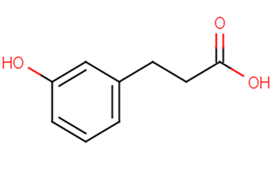
3-(3-Hydroxyphenyl)propionic Acid
CAS No. 621-54-5
3-(3-Hydroxyphenyl)propionic Acid( m-Hydroxyphenylpropionic acid | 3-Hydroxyhydrocinnamic acid )
Catalog No. M20847 CAS No. 621-54-5
3-(3-Hydroxyphenyl)propionic Acid is one of the major metabolites of ingested caffeic acid.it inhibited osteoclastogenesis and bone osteoclastic resorptive activity.
Purity : >98% (HPLC)
 COA
Datasheet
HNMR
HPLC
MSDS
Handing Instructions
COA
Datasheet
HNMR
HPLC
MSDS
Handing Instructions
| Size | Price / USD | Stock | Quantity |
| 100MG | Get Quote | In Stock |


|
| 200MG | Get Quote | In Stock |
|
| 500MG | 38 | In Stock |
|
| 1G | Get Quote | In Stock |
|
Biological Information
-
Product Name3-(3-Hydroxyphenyl)propionic Acid
-
NoteResearch use only, not for human use.
-
Brief Description3-(3-Hydroxyphenyl)propionic Acid is one of the major metabolites of ingested caffeic acid.it inhibited osteoclastogenesis and bone osteoclastic resorptive activity.
-
Description3-(3-Hydroxyphenyl)propionic Acid is one of the major metabolites of ingested caffeic acid.it inhibited osteoclastogenesis and bone osteoclastic resorptive activity.
-
In Vitro——
-
In Vivo——
-
Synonymsm-Hydroxyphenylpropionic acid | 3-Hydroxyhydrocinnamic acid
-
PathwayOthers
-
TargetOther Targets
-
RecptorOthers
-
Research Area——
-
Indication——
Chemical Information
-
CAS Number621-54-5
-
Formula Weight166.17
-
Molecular FormulaC9H10O3
-
Purity>98% (HPLC)
-
SolubilityDMSO:33mg/mL(198.59mM)
-
SMILESO=C(O)CCc1cccc(O)c1
-
Chemical Name——
Shipping & Storage Information
-
Storage(-20℃)
-
ShippingWith Ice Pack
-
Stability≥ 2 years
Reference
1.Zhao H Lazarenko O P Jin‐Ran Chen. Hippuric acid and 3‐(3‐hydroxyphenyl) propionic acid inhibit murine osteoclastogenesis through RANKL‐RANK independent pathway[J]. Journal of Cellular Physiology 2020 235(1).
molnova catalog



related products
-
ms48107
MS48107 is a potent and selective positive allosteric modulator of G protein-coupled receptor 68 (GPR68). It is selective for GPR68 over the closely related proton GPCRs, neurotransmitter transporters, and hERG ion channels. It can readily cross the blood-brain barrier (BBB) in mice.
-
Ac - 5A/5B Peptide
Ac - 5A/5B Peptide
-
tert-Butyl5-bromo-1H...
Tert-Butyl5-bromo-1H-indole-1-carboxylate (N-Boc-5-bromoindole) is an indole derivative with therapeutic potential for pain, inflammation, and other conditions.
