


 Cart
Cart
 sales@molnova.com



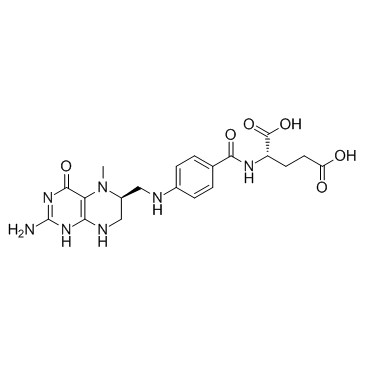
Levomefolic Acid
CAS No. 31690-09-2
Levomefolic Acid( 5-MTHF )
Catalog No. M20673 CAS No. 31690-09-2
Levomefolinic acid is a natural active form of folic acid used at the cellular level for DNA reproduction the cysteine cycle and the regulation of homocysteine among other functions. Levomefolinic acid is used as a treatment and to prevent Folate Deficiency.
Purity : >98% (HPLC)
 COA
Datasheet
HNMR
HPLC
MSDS
Handing Instructions
COA
Datasheet
HNMR
HPLC
MSDS
Handing Instructions
| Size | Price / USD | Stock | Quantity |
| 10MG | 48 | In Stock |


|
| 50MG | 93 | In Stock |
|
| 100MG | Get Quote | In Stock |
|
| 200MG | Get Quote | In Stock |
|
| 500MG | Get Quote | In Stock |
|
| 1G | Get Quote | In Stock |
|
Biological Information
-
Product NameLevomefolic Acid
-
NoteResearch use only, not for human use.
-
Brief DescriptionLevomefolinic acid is a natural active form of folic acid used at the cellular level for DNA reproduction the cysteine cycle and the regulation of homocysteine among other functions. Levomefolinic acid is used as a treatment and to prevent Folate Deficiency.
-
DescriptionLevomefolinic acid is a natural active form of folic acid used at the cellular level for DNA reproduction the cysteine cycle and the regulation of homocysteine among other functions. Levomefolinic acid is used as a treatment and to prevent Folate Deficiency.(In Vitro):Levomefolic acid (5-MTHF) shows interaction with residues Glu406, Ile 418, Lys417 and Tyr453, of which Lys 417 and Tyr 453 play a strong physiological role in the interaction between S1 and ACE and may act as a potential inhibitor of the S1:ACE2 interaction of the SARS-CoV-2 virus.Levomefolic acid (5-MTHF) (50 nM, 72 h) increases intracellular folate metabolite activity by 7-fold better than folic acid by 2-fold in human lymphoblastoid cell line (LCL), and is a good folic acid supplement.
-
In VitroLevomefolic acid (5-MTHF) shows interaction with residues Glu406, Ile 418, Lys417 and Tyr453, of which Lys 417 and Tyr 453 play a strong physiological role in the interaction between S1 and ACE and may act as a potential inhibitor of the S1:ACE2 interaction of the SARS-CoV-2 virus.Levomefolic acid (5-MTHF) (50 nM, 72 h) increases intracellular folate metabolite activity by 7-fold better than folic acid by 2-fold in human lymphoblastoid cell line (LCL), and is a good folic acid supplement.
-
In Vivo——
-
Synonyms5-MTHF
-
PathwayProteasome/Ubiquitin
-
TargetEndogenous Metabolite
-
RecptorHuman Endogenous Metabolite
-
Research Area——
-
Indication——
Chemical Information
-
CAS Number31690-09-2
-
Formula Weight459.46
-
Molecular FormulaC20H25N7O6
-
Purity>98% (HPLC)
-
SolubilityH2O:5 mg/mL (10.88 mM);DMSO:0.526 mg/mL (1.14 mM)
-
SMILESCN1[C@@H](CNc2ccc(cc2)C(=O)N[C@@H](CCC(O)=O)C(O)=O)CNc2nc(N)[nH]c(=O)c12
-
Chemical Name(4-((((S)-2-amino-5-methyl-4-oxo-145678-hexahydropteridin-6-yl)methyl)amino)benzoyl)-L-glutamic acid
Shipping & Storage Information
-
Storage(-20℃)
-
ShippingWith Ice Pack
-
Stability≥ 2 years
Reference
1.Thermal oxidation studies on reduced folate L-5-methyltetrahydrofolic acid (L-5-MTHF) and strategies for stabilization using food matrices.
molnova catalog



related products
-
7,8-Dihydro-L-biopte...
7,8-Dihydro-L-biopterin is an oxidation product of tetrahydrobiopterin.
-
Methyl 4-anisate
Methyl anisate is an endogenous metabolite.
-
16-Dehydroprogestero...
16-Dehydroprogesterone is a steroidal progestin.
