


 Cart
Cart
 sales@molnova.com



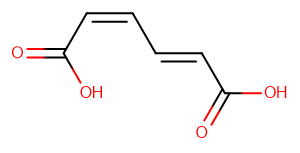
ciscis-Muconic acid
CAS No. 1119-72-8
ciscis-Muconic acid( ciscis-Muconate | ciscis-24-Hexadienedioic acid )
Catalog No. M20235 CAS No. 1119-72-8
ciscis-Muconic acid is a naturally-occurring organic acid. It is used in the manufacture of several widely-used consumer plastics. Its microbial production via extending the shikimate pathway has been reported.
Purity : >98% (HPLC)
 COA
Datasheet
HNMR
HPLC
MSDS
Handing Instructions
COA
Datasheet
HNMR
HPLC
MSDS
Handing Instructions
| Size | Price / USD | Stock | Quantity |
| 100MG | Get Quote | In Stock |


|
| 200MG | 28 | In Stock |
|
| 500MG | 43 | In Stock |
|
| 1G | 60 | In Stock |
|
Biological Information
-
Product Nameciscis-Muconic acid
-
NoteResearch use only, not for human use.
-
Brief Descriptionciscis-Muconic acid is a naturally-occurring organic acid. It is used in the manufacture of several widely-used consumer plastics. Its microbial production via extending the shikimate pathway has been reported.
-
Descriptionciscis-Muconic acid is a naturally-occurring organic acid. It is used in the manufacture of several widely-used consumer plastics. Its microbial production via extending the shikimate pathway has been reported.
-
In Vitro——
-
In Vivo——
-
Synonymsciscis-Muconate | ciscis-24-Hexadienedioic acid
-
PathwayOthers
-
TargetOther Targets
-
RecptorOthers
-
Research Area——
-
Indication——
Chemical Information
-
CAS Number1119-72-8
-
Formula Weight142.11
-
Molecular FormulaC6H6O4
-
Purity>98% (HPLC)
-
SolubilityDMSO: 20 mg/mL (140.74 mM)
-
SMILESOC(=O)\C=C\C=C/C(O)=O
-
Chemical Name——
Shipping & Storage Information
-
Storage(-20℃)
-
ShippingWith Ice Pack
-
Stability≥ 2 years
Reference
molnova catalog



related products
-
Cycloartenyl ferulat...
Cycloartenyl ferulate (also known as cycloartenol ferulate) is a representative triterpene alcohol with diverse biological properties, such as antioxidant, anti-allergic, anti-inflammatory, and anticancer activities.
-
Chaetocin
Chaetocin, a natural product from Chaetomium species, is a histone methyltransferase inhibitor with IC50 of 0.8 μM, 2.5 μM and 3 μM for dSU(VAR)3-9, mouse G9a and Neurospora crassa DIM5, respectively.
-
magnolin
Magnolin reduces the renal oxidative stress, suppresses caspase-3 activity, and increases Bcl-2 expression in vivo and in vitro. Magnolin has anti-inflammatory and antioxidative effects.
