


 Cart
Cart
 sales@molnova.com



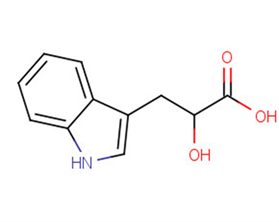
DL-Indole-3-lactic acid
CAS No. 832-97-3
DL-Indole-3-lactic acid( —— )
Catalog No. M20143 CAS No. 832-97-3
DL-Indole-3-lactic acid is a reactant for the preparation of antibacterial agents.
Purity : >98% (HPLC)
 COA
Datasheet
HNMR
HPLC
MSDS
Handing Instructions
COA
Datasheet
HNMR
HPLC
MSDS
Handing Instructions
| Size | Price / USD | Stock | Quantity |
| 1 mL x 10 mM in DMSO | 341 | In Stock |


|
| 5MG | 319 | In Stock |
|
| 10MG | 472 | In Stock |
|
| 25MG | 753 | In Stock |
|
| 50MG | 1051 | In Stock |
|
| 100MG | Get Quote | In Stock |
|
| 200MG | Get Quote | In Stock |
|
| 500MG | Get Quote | In Stock |
|
| 1G | Get Quote | In Stock |
|
Biological Information
-
Product NameDL-Indole-3-lactic acid
-
NoteResearch use only, not for human use.
-
Brief DescriptionDL-Indole-3-lactic acid is a reactant for the preparation of antibacterial agents.
-
DescriptionDL-Indole-3-lactic acid is a reactant for the preparation of antibacterial agents.
-
In Vitro——
-
In Vivo——
-
Synonyms——
-
PathwayOthers
-
TargetOther Targets
-
RecptorOthers
-
Research Area——
-
Indication——
Chemical Information
-
CAS Number832-97-3
-
Formula Weight205.21
-
Molecular FormulaC11H11NO3
-
Purity>98% (HPLC)
-
SolubilityDMSO:10 mM
-
SMILESOC(Cc1c[nH]c2ccccc12)C(O)=O
-
Chemical Name——
Shipping & Storage Information
-
Storage(-20℃)
-
ShippingWith Ice Pack
-
Stability≥ 2 years
Reference
molnova catalog



related products
-
CCG 50014
CCG 50014 is a potent and selective inhibitor of RGS4 with IC50 of 30 nM.
-
Riluzole hydrochlori...
Riluzole hydrochloride (PK 26124 hydrochloride) is an anticonvulsant compound belonging to the family of sodium channel blockers that inhibits GABA uptake.
-
AC1NS4RE
SU5614 is a potent and selective FLT3 inhibitor. SU5614 has inhibitory activity for FLT3 and selectively induces growth arrest, apoptosis, and cell cycle arrest in Ba/F3 and AML cell lines expressing a constitutively activated FLT3.
