


 Cart
Cart
 sales@molnova.com



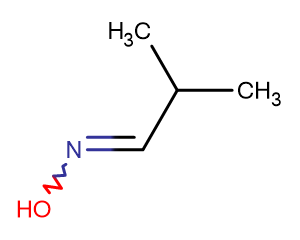
ISOBUTYRALDEHYDE OXIME
CAS No. 151-00-8
ISOBUTYRALDEHYDE OXIME( —— )
Catalog No. M19919 CAS No. 151-00-8
2-methylpropanal oxime is an aldoxime derived from 2-methylpropanal. It derives from an isobutyraldehyde.
Purity : >98% (HPLC)
 COA
Datasheet
HNMR
HPLC
MSDS
Handing Instructions
COA
Datasheet
HNMR
HPLC
MSDS
Handing Instructions
| Size | Price / USD | Stock | Quantity |
| 1 mL x 10 mM in DMSO | 46 | In Stock |


|
| 10MG | 71 | In Stock |
|
| 25MG | 122 | In Stock |
|
| 50MG | 179 | In Stock |
|
| 100MG | 267 | In Stock |
|
| 200MG | 401 | In Stock |
|
| 500MG | Get Quote | In Stock |
|
| 1G | Get Quote | In Stock |
|
Biological Information
-
Product NameISOBUTYRALDEHYDE OXIME
-
NoteResearch use only, not for human use.
-
Brief Description2-methylpropanal oxime is an aldoxime derived from 2-methylpropanal. It derives from an isobutyraldehyde.
-
Description2-methylpropanal oxime is an aldoxime derived from 2-methylpropanal. It derives from an isobutyraldehyde.
-
In Vitro——
-
In Vivo——
-
Synonyms——
-
PathwayOthers
-
TargetOther Targets
-
RecptorOthers
-
Research Area——
-
Indication——
Chemical Information
-
CAS Number151-00-8
-
Formula Weight87.12
-
Molecular FormulaC4H9NO
-
Purity>98% (HPLC)
-
SolubilityDMSO:10 mM
-
SMILESCC(C)C=NO
-
Chemical Name——
Shipping & Storage Information
-
Storage(-20℃)
-
ShippingWith Ice Pack
-
Stability≥ 2 years
Reference
molnova catalog



related products
-
Prepro TRH (53-74)
Prepro TRH (53-74)
-
N-Phenylacrylamide
N-Phenylacrylamide inhibit human recombinant TGM2 by fluorescent transamidation assay.
-
Dehydrodiconiferyl a...
Dehydrodiconiferyl alcohol 4-O-beta-D-glucopyranoside is a natural product from Ligusticopsis wallichiana (DC) Pimenov & Kljuykov.
