


 Cart
Cart
 sales@molnova.com



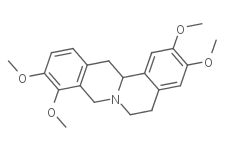
Rotundine b
CAS No. 483-14-7
Rotundine b( L-Tetrahydropalmatine | (-)-Tetrahydropalmatine | Caseanine | Gindarine )
Catalog No. M19458 CAS No. 483-14-7
Rotundine (L-tetrahydropalmatine L-THP) is a selective dopamine D1 receptor antagonist with IC50 of 166 nM.
Purity : >98% (HPLC)
 COA
Datasheet
HNMR
HPLC
MSDS
Handing Instructions
COA
Datasheet
HNMR
HPLC
MSDS
Handing Instructions
| Size | Price / USD | Stock | Quantity |
| 50MG | 29 | In Stock |


|
| 100MG | 41 | In Stock |
|
| 200MG | Get Quote | In Stock |
|
| 500MG | 91 | In Stock |
|
| 1G | 138 | In Stock |
|
Biological Information
-
Product NameRotundine b
-
NoteResearch use only, not for human use.
-
Brief DescriptionRotundine (L-tetrahydropalmatine L-THP) is a selective dopamine D1 receptor antagonist with IC50 of 166 nM.
-
DescriptionRotundine (L-tetrahydropalmatine L-THP) is a selective dopamine D1 receptor antagonist with IC50 of 166 nM.(In Vivo):It is reported that Rotundine (l-THP) possesses a blocking effect on dopamine D1 and D2 receptors and can inhibit physical dependence in morphine dependent mice and significantly reduce the development of the conditional place preference induced by morphine in mice. On day 1 and 7, there is no difference in locomotor counts between the Rotundine groups (6.25, 12.5, and 18.75 mg/kg) and saline group [F(3, 37)=1.360, P>0.05, F(3, 37)=0.348, P>0.05, respectively]. Locomotor counts are greatly increased in the oxycodone group compare with the saline group. Rotundine at doses of 6.25, 12.5, and 18.75 mg/kg antagonizes hyperactivity induced by oxycodone [F(4, 60)=15.76, P<0.01]. Rotundine (6.25, 12.5 mg/kg) does not affect the magnitude of sensitization, but there is a marked difference between oxycodone+oxycodone group and Rotundine (18.75 mg/kg)+oxycodone+oxycodone group, indicating that Rotundine (18.75 mg/kg) greatly inhibits the development of oxycodone sensitization [F(4, 62)=8.766, P<0.01].
-
In Vitro——
-
In VivoIt is reported that Rotundine (l-THP) possesses a blocking effect on dopamine D1 and D2 receptors and can inhibit physical dependence in morphine dependent mice and significantly reduce the development of the conditional place preference induced by morphine in mice. On day 1 and 7, there is no difference in locomotor counts between the Rotundine groups (6.25, 12.5, and 18.75 mg/kg) and saline group [F(3, 37)=1.360, P>0.05, F(3, 37)=0.348, P>0.05, respectively]. Locomotor counts are greatly increased in the oxycodone group compare with the saline group. Rotundine at doses of 6.25, 12.5, and 18.75 mg/kg antagonizes hyperactivity induced by oxycodone [F(4, 60)=15.76, P<0.01]. Rotundine (6.25, 12.5 mg/kg) does not affect the magnitude of sensitization, but there is a marked difference between oxycodone+oxycodone group and Rotundine (18.75 mg/kg)+oxycodone+oxycodone group, indicating that Rotundine (18.75 mg/kg) greatly inhibits the development of oxycodone sensitization [F(4, 62)=8.766, P<0.01].
-
SynonymsL-Tetrahydropalmatine | (-)-Tetrahydropalmatine | Caseanine | Gindarine
-
PathwayGPCR/G Protein
-
TargetDopamine Receptor
-
RecptorD1 receptor 5-HT1A D2 receptor D3 receptor
-
Research Area——
-
Indication——
Chemical Information
-
CAS Number483-14-7
-
Formula Weight355.43
-
Molecular FormulaC21H25NO4
-
Purity>98% (HPLC)
-
SolubilityDMSO:8 mg/mL (22.5 mM);Ethanol:<1 mg/mL;Water:<1 mg/mL
-
SMILES[H][C@@]12CC3=CC=C(OC)C(OC)=C3CN1CCC1=C2C=C(OC)C(OC)=C1
-
Chemical Name——
Shipping & Storage Information
-
Storage(-20℃)
-
ShippingWith Ice Pack
-
Stability≥ 2 years
Reference



-
Cabergoline
Cabergoline is an ergot derived-dopamine D2-like receptor agonist. It has high affinity for D2, D3, and 5-HT2B receptors (Ki=0.7, 1.5, and 1.2, respectively).Cabergoline permits rapid and effective hormonal and tumor control by normalizing prolactin-producing pituitary adenomas levels.Cabergoline acts as a potent agonist of D2, D3 and 5-HT2B receptors.
-
Bromocriptine mesyla...
Bromocriptine (CB-154) is a dopamine D2 receptor agonist (Ki=3 nM) and and various serotonin receptors, also inhibits the release of glutamate by reversing the glutamate GLT1 transporter.
-
Quinpirole Hydrochlo...
Quinpirole Hydrochloride (LY 171555), as an agonist with high affinity for dopamine receptor D2/D3, has been widely used to study the function of dopamine receptor D2/D3 in humans and mice
