


 Cart
Cart
 sales@molnova.com



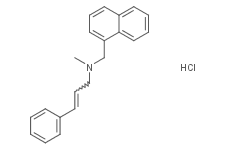
Naftifine hydrochloride
CAS No. 65473-14-5
Naftifine hydrochloride( —— )
Catalog No. M19365 CAS No. 65473-14-5
Naftifine Hydrochloride is the hydrochloride salt form of naftifine, an allylamine derivate with synthetic broad-spectrum antifungal activity.
Purity : >98% (HPLC)
 COA
Datasheet
HNMR
HPLC
MSDS
Handing Instructions
COA
Datasheet
HNMR
HPLC
MSDS
Handing Instructions
| Size | Price / USD | Stock | Quantity |
| 1 mL x 10 mM in DMSO | 29 | In Stock |


|
| 100MG | 33 | In Stock |
|
| 200MG | Get Quote | In Stock |
|
| 500MG | 78 | In Stock |
|
| 1G | 101 | In Stock |
|
Biological Information
-
Product NameNaftifine hydrochloride
-
NoteResearch use only, not for human use.
-
Brief DescriptionNaftifine Hydrochloride is the hydrochloride salt form of naftifine, an allylamine derivate with synthetic broad-spectrum antifungal activity.
-
DescriptionNaftifine Hydrochloride is the hydrochloride salt form of naftifine, an allylamine derivate with synthetic broad-spectrum antifungal activity. Although the exact mechanism through which naftifine hydrochloride exerts its effect is unknown, it appears to selectively inhibit the enzyme squalene 2, 3-epoxidase, thereby inhibiting the biosynthesis of sterol. This results in a decreased amount of sterols, especially ergosterol which is the primary fungal membrane sterol, and a corresponding accumulation of squalene in fungal cells. Naftifine hydrochloride can be fungicidal as well as fungistatic to yeasts depending on the concentration and the organisms involved.(In Vitro):Naftifine exhibits an interesting in vitro spectrum of activity against dermatophytes (38 strains; minimal inhibitory concentration (MIC) range 0.1 to 0.2 mg/mL), aspergilli (6 strains; MIC range, 0.8 to 12.5 mg/mL), Sporothrix schenckii (2 strains; MICs, 0.8 and 1.5 mg/mL), and yeasts of the genus Candida (77 strains; MIC range, 1.5 to greater than 100 mg/mL).
-
In VitroNaftifine exhibits an interesting in vitro spectrum of activity against dermatophytes (38 strains; minimal inhibitory concentration (MIC) range 0.1 to 0.2 mg/mL), aspergilli (6 strains; MIC range, 0.8 to 12.5 mg/mL), Sporothrix schenckii (2 strains; MICs, 0.8 and 1.5 mg/mL), and yeasts of the genus Candida (77 strains; MIC range, 1.5 to greater than 100 mg/mL).
-
In Vivo——
-
Synonyms——
-
PathwayGPCR/G Protein
-
TargetHedgehog (Hh)
-
RecptorSmoothened
-
Research AreaInfection
-
Indication——
Chemical Information
-
CAS Number65473-14-5
-
Formula Weight323.86
-
Molecular FormulaC21H22ClN
-
Purity>98% (HPLC)
-
SolubilityEthanol : 42.5 mg/mL 131.23 mM
-
SMILESCN(C/C=C/C1=CC=CC=C1)CC2=CC=CC3=CC=CC=C32.Cl
-
Chemical Name——
Shipping & Storage Information
-
Storage(-20℃)
-
ShippingWith Ice Pack
-
Stability≥ 2 years
Reference
1. Georgopoulos A, et al. Antimicrob Agents ChemOthers, 1981, 19(3), 386-389.
molnova catalog



related products
-
Cyclopamine tartrate
Cyclopamine tartrate is a natural steroidal alkaloid that inhibits hedgehog (Hh) signaling with IC50 of 46 nM.
-
BRD9526
BRD9526 is a potent, small-molecule inhibitor of the Sonic Hedgehog (Shh) pathway with EC50 of 60 nM.
-
Ciliobrevin A
A small molecule Hedgehog pathway inhibitor (IC50=7 uM) that acts downstream of Su(fu) to modulate Gli processing, activation or trafficking.
