


 Cart
Cart
 sales@molnova.com



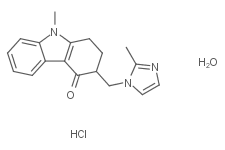
Ondansetron HCl
CAS No. 99614-01-4
Ondansetron HCl( GR 38032 (hydrochloride) | SN 307 (hydrochloride) )
Catalog No. M19305 CAS No. 99614-01-4
Ondansetron is a serotonin 5-HT3 receptor antagonist, used to prevent nausea and vomiting caused by cancer chemotherapy, and radiation therapy.
Purity : >98% (HPLC)
 COA
Datasheet
HNMR
HPLC
MSDS
Handing Instructions
COA
Datasheet
HNMR
HPLC
MSDS
Handing Instructions
| Size | Price / USD | Stock | Quantity |
| 1 mL x 10 mM in DMSO | 37 | In Stock |


|
| 25MG | 35 | In Stock |
|
| 50MG | 49 | In Stock |
|
| 100MG | Get Quote | In Stock |
|
| 200MG | Get Quote | In Stock |
|
| 500MG | Get Quote | In Stock |
|
| 1G | Get Quote | In Stock |
|
Biological Information
-
Product NameOndansetron HCl
-
NoteResearch use only, not for human use.
-
Brief DescriptionOndansetron is a serotonin 5-HT3 receptor antagonist, used to prevent nausea and vomiting caused by cancer chemotherapy, and radiation therapy.
-
DescriptionOndansetron is a serotonin 5-HT3 receptor antagonist, used to prevent nausea and vomiting caused by cancer chemotherapy, and radiation therapy.
-
In Vitro——
-
In Vivo——
-
SynonymsGR 38032 (hydrochloride) | SN 307 (hydrochloride)
-
PathwayOthers
-
TargetOther Targets
-
Recptor5-HT3
-
Research AreaCancer|Neurological Disease
-
Indication——
Chemical Information
-
CAS Number99614-01-4
-
Formula Weight329.82
-
Molecular FormulaC18H19N3O·HCl
-
Purity>98% (HPLC)
-
Solubility——
-
SMILESCl.CN1C2=CC=CC=C2C2=C1CCC(CN1C=CN=C1C)C2=O
-
Chemical Name——
Shipping & Storage Information
-
Storage(-20℃)
-
ShippingWith Ice Pack
-
Stability≥ 2 years
Reference
1. Pinelli A, et al. Eur J Pharmacol, 1997, 340(2-3), 111-119.
molnova catalog



related products
-
LM10
Selective tryptophan 2, 3-dioxygenase (TDO) inhibitor (IC50 values are 0.62 and 2 μM for human and mouse TDO, respectively).
-
SJF 1521
SJF 1521 is an EGFR degrader belonging to the PROTAC class that selectively degrades EGFR while preserving HER2.
-
Maximaisoflavone B
Maximaisoflavone B
