


 Cart
Cart
 sales@molnova.com



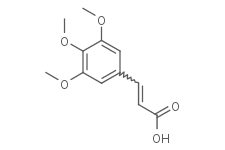
3,4,5-Trimethoxycinnamic acid
CAS No. 90-50-6
3,4,5-Trimethoxycinnamic acid( —— )
Catalog No. M19250 CAS No. 90-50-6
3,4,5-Trimethoxycinnamic acid is a phenylpropanoid isolated from the roots of Polygala tenuifolia WILLD, with anti-stress effect, prolonging the sleeping time in animals. 3,4,5-Trimethoxycinnamic acid increases expression of GAD65 and γ-subunit of GABAA receptor, but shows no effect on the amounts of α-, β-subunits.
Purity : >98% (HPLC)
 COA
Datasheet
HNMR
HPLC
MSDS
Handing Instructions
COA
Datasheet
HNMR
HPLC
MSDS
Handing Instructions
| Size | Price / USD | Stock | Quantity |
| 100MG | Get Quote | In Stock |


|
| 200MG | Get Quote | In Stock |
|
| 500MG | Get Quote | In Stock |
|
| 1G | 27 | In Stock |
|
Biological Information
-
Product Name3,4,5-Trimethoxycinnamic acid
-
NoteResearch use only, not for human use.
-
Brief Description3,4,5-Trimethoxycinnamic acid is a phenylpropanoid isolated from the roots of Polygala tenuifolia WILLD, with anti-stress effect, prolonging the sleeping time in animals. 3,4,5-Trimethoxycinnamic acid increases expression of GAD65 and γ-subunit of GABAA receptor, but shows no effect on the amounts of α-, β-subunits.
-
Description3,4,5-Trimethoxycinnamic acid is a phenylpropanoid isolated from the roots of Polygala tenuifolia WILLD, with anti-stress effect, prolonging the sleeping time in animals. 3,4,5-Trimethoxycinnamic acid increases expression of GAD65 and γ-subunit of GABAA receptor, but shows no effect on the amounts of α-, β-subunits.
-
In Vitro——
-
In Vivo——
-
Synonyms——
-
PathwayOthers
-
TargetOther Targets
-
RecptorOthers
-
Research Area——
-
Indication——
Chemical Information
-
CAS Number90-50-6
-
Formula Weight238.24
-
Molecular FormulaC12H14O5
-
Purity>98% (HPLC)
-
SolubilityIn Vitro:?DMSO : 100 mg/mL (419.74 mM)
-
SMILESc1c(cc(c(c1OC)OC)OC)/C=C/C(=O)O
-
Chemical Name——
Shipping & Storage Information
-
Storage(-20℃)
-
ShippingWith Ice Pack
-
Stability≥ 2 years
Reference
1. Lee CI, et al. Arch Pharm Res. 2013 Oct;36(10):1244-51.
molnova catalog



related products
-
Neoartanin
Neoartanin is a betaine pigment isolated from the fresh root of red beet with antioxidant capacity.
-
Perfluorooctanoic ac...
Perfluorooctanoic acid (PFOA) is a persistent and widespread industry-made chemical.
-
1-Methyl-2,8-dihydro...
1-Methyl-2,8-dihydroxy-3-carboxy-9,10-anthraquinone is a natural product for research related to life sciences.
