


 Cart
Cart
 sales@molnova.com



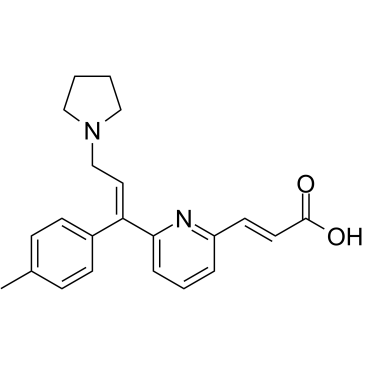
Acrivastine
CAS No. 87848-99-5
Acrivastine( Acrivastine | BW 825C )
Catalog No. M19216 CAS No. 87848-99-5
Acrivastine is a short-acting histamine 1 receptor antagonist.
Purity : >98% (HPLC)
 COA
Datasheet
HNMR
HPLC
MSDS
Handing Instructions
COA
Datasheet
HNMR
HPLC
MSDS
Handing Instructions
| Size | Price / USD | Stock | Quantity |
| 1 mL x 10 mM in DMSO | 32 | In Stock |


|
| 5MG | 29 | In Stock |
|
| 10MG | 45 | In Stock |
|
| 25MG | 84 | In Stock |
|
| 50MG | 114 | In Stock |
|
| 100MG | 163 | In Stock |
|
| 200MG | Get Quote | In Stock |
|
| 500MG | 407 | In Stock |
|
| 1G | Get Quote | In Stock |
|
Biological Information
-
Product NameAcrivastine
-
NoteResearch use only, not for human use.
-
Brief DescriptionAcrivastine is a short-acting histamine 1 receptor antagonist.
-
DescriptionAcrivastine is an antihistamine with reduced sedating potential.(In Vivo):Acrivastine (usually 8mg three times daily) is an effective and well tolerated antihistamine in the treatment of chronic urticaria and allergic rhinitis. Acrivastine is more effective than placebo and similar in efficacy to clemastine or terfenadine in the treatment of seasonal allergic rhinitis. In the treatment of dermatoses in which histamine has a pathogenetic role, the efficacy of acrivastine is superior to that of placebo and similar to that of usual dosages of clemastine, hydroxyzine, chlorpheniramine, cyproheptadine or terfenadine. Acrivastine causes less drowsiness than clemastine, the incidence of adverse effects being indistinguishable from that with placebo or terfenadine. Both 4 mg and 8 mg acrivastine alleviate the symptoms of seasonal allergic rhinitis with significant improvements in the symptom scores for sneezing, running nose and the calculated overall score. In addition, 8 mg acrivastine reduces the symptom scores for watery eyes and itchy throat. Acrivastine is both well tolerated and effective in the treatment of seasonal allergic rhinitis.
-
In Vitro——
-
In VivoAcrivastine (usually 8mg three times daily) is an effective and well tolerated antihistamine in the treatment of chronic urticaria and allergic rhinitis. Acrivastine is more effective than placebo and similar in efficacy to clemastine or terfenadine in the treatment of seasonal allergic rhinitis. In the treatment of dermatoses in which histamine has a pathogenetic role, the efficacy of acrivastine is superior to that of placebo and similar to that of usual dosages of clemastine, hydroxyzine, chlorpheniramine, cyproheptadine or terfenadine. Acrivastine causes less drowsiness than clemastine, the incidence of adverse effects being indistinguishable from that with placebo or terfenadine. Both 4 mg and 8 mg acrivastine alleviate the symptoms of seasonal allergic rhinitis with significant improvements in the symptom scores for sneezing, running nose and the calculated overall score. In addition, 8 mg acrivastine reduces the symptom scores for watery eyes and itchy throat. Acrivastine is both well tolerated and effective in the treatment of seasonal allergic rhinitis.
-
SynonymsAcrivastine | BW 825C
-
PathwayOthers
-
TargetOther Targets
-
RecptorH1 receptor
-
Research Area——
-
Indication——
Chemical Information
-
CAS Number87848-99-5
-
Formula Weight348.44
-
Molecular FormulaC22H24N2O2
-
Purity>98% (HPLC)
-
SolubilityDMSO : 10.45 mg/mL 29.99 mM
-
SMILESCc1ccc(cc1)C(=C/CN1CCCC1)\c1cccc(\C=C\C(O)=O)n1
-
Chemical Name2-Propenoic acid, 3-(6-(1-(4-methylphenyl)-3-(1-pyrrolidinyl)-1-propenyl)-2-pyridinyl)-, (E,E)-
Shipping & Storage Information
-
Storage(-20℃)
-
ShippingWith Ice Pack
-
Stability≥ 2 years
Reference
1. Brogden RN, et al. Acrivastine. A review of its pharmacological properties and therapeutic efficacy in allergic rhinitis, urticaria and related disorders. Drugs. 1991 Jun;41(6):927-40.
molnova catalog



related products
-
Oxynitidine
Oxynitidine is an HBV inhibitor (ID50=30.8 μg/mL), which can effectively inhibit the DNA replication activity of HBV. Oxynitidine can be used in the study of viral infections.
-
MAO-B-IN-2
MAO-B-IN-2 is a selective and competitive inhibitor of MAO-B and BChE with IC50 values of 0.51 μM and 7.00 μM, respectively. It attenuates H2O2-induced cellular damage due to its strong ROS scavenging properties.
-
Rilematovir
JNJ-678 is a novel inhibitor of the fusion protein. JNJ-678 shows the potential for respiratory syncytial virus (RSV) treatment.
